
Arbitrary Wavefront Manipulation in Real Space and Momentum Space Based on Elliptical Structures
IF 6.8
2区 物理与天体物理
Q1 MATERIALS SCIENCE, MULTIDISCIPLINARY
引用次数: 0
Abstract
ABSTRACT Leveraging elliptical structures with strong spatial continuity and anisotropy—while preserving real space arbitrary wavefront manipulation via the Pancharatnam–Berry (PB) phase—we generalize the manipulation to momentum space by exploiting the localized dipole momentum embedded in bound states in the continuum (BIC), thereby enhancing the flexibility of information transmission across the dual spaces for micro–nano devices and boosting information capacity. The proposed scheme utilizes the rotation characteristics of anisotropic elliptical structures to precisely modulate the polarization phase distribution in real space. In momentum space, defect perturbations are introduced to construct an independent geometric phase gradient, thereby flexibly tailoring the wavefront profiles of vertically emitting modes. Numerical results demonstrate that the designed unit cell exhibits excellent resonance stability and favorable linear phase modulation performance. The cross–polarization transmission efficiency in real space is approximately 25% at all orientation angles. The Q factor in momentum space can exceed 4000. Continuous phase modulation ranging from 0 to 2 can be realized in both spaces, with nearly zero crosstalk. Multifunctional integrated outputs such as beam deflection and focusing can be flexibly achieved in the near–infrared communication band.基于椭圆结构的实空间和动量空间任意波前处理
利用具有强空间连续性和各向异性的椭圆结构,在保留实际空间任意波前操作的同时,通过Pancharatnam-Berry (PB)相位,我们利用嵌入在连续介质(BIC)束缚态中的局域偶极子动量,将这种操作推广到动量空间,从而增强了微纳器件在对偶空间中信息传输的灵活性,提高了信息容量。该方案利用各向异性椭圆结构的旋转特性来精确调制实际空间中的偏振相位分布。在动量空间中,引入缺陷摄动来构造独立的几何相位梯度,从而灵活地裁剪垂直发射模式的波前轮廓。数值结果表明,所设计的单元电池具有良好的谐振稳定性和良好的线性相位调制性能。在实际空间中,各取向角的交叉极化传输效率约为25%。动量空间中的Q因子可以超过4000。在两个空间均可实现0 ~ 2的连续相位调制,且串扰几乎为零。在近红外通信波段可以灵活地实现波束偏转、聚焦等多功能集成输出。
本文章由计算机程序翻译,如有差异,请以英文原文为准。
求助全文
约1分钟内获得全文
求助全文
来源期刊
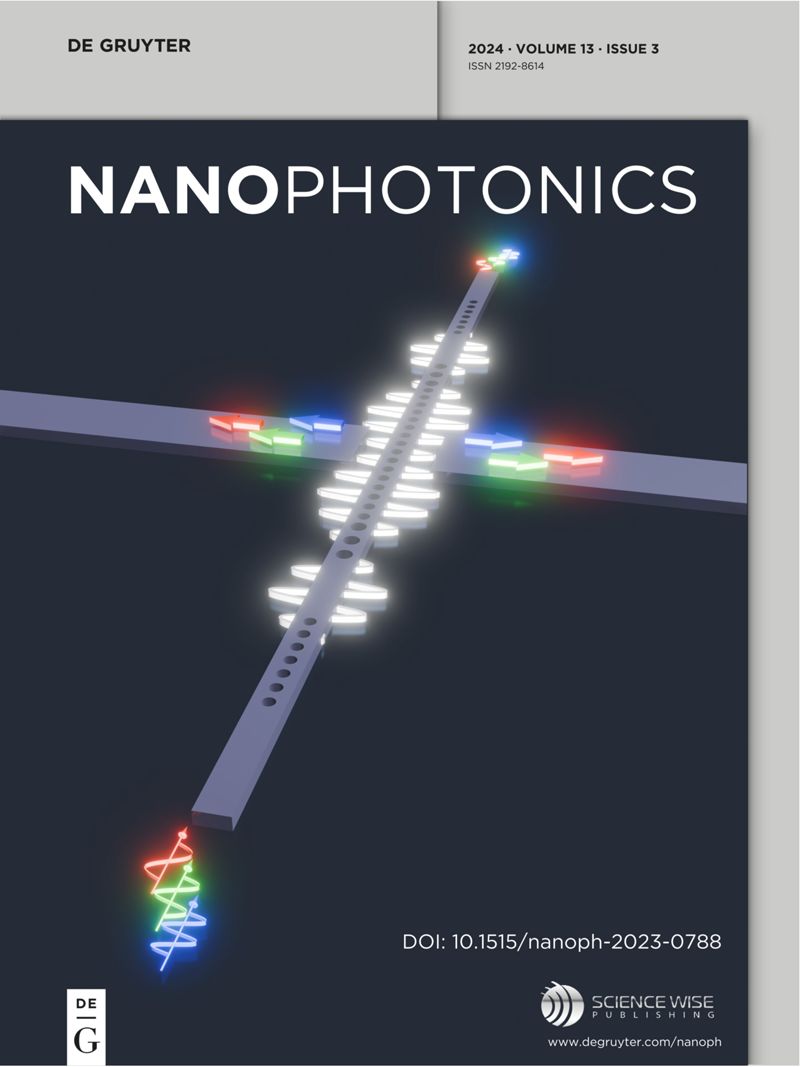
Nanophotonics
NANOSCIENCE & NANOTECHNOLOGY-MATERIALS SCIENCE, MULTIDISCIPLINARY
CiteScore
13.50
自引率
6.70%
发文量
358
审稿时长
7 weeks
期刊介绍:
Nanophotonics, published in collaboration with Sciencewise, is a prestigious journal that showcases recent international research results, notable advancements in the field, and innovative applications. It is regarded as one of the leading publications in the realm of nanophotonics and encompasses a range of article types including research articles, selectively invited reviews, letters, and perspectives.
The journal specifically delves into the study of photon interaction with nano-structures, such as carbon nano-tubes, nano metal particles, nano crystals, semiconductor nano dots, photonic crystals, tissue, and DNA. It offers comprehensive coverage of the most up-to-date discoveries, making it an essential resource for physicists, engineers, and material scientists.
 求助内容:
 应助结果提醒方式:


 京公网安备 11010802042870号


