
Machine learning‐assisted design of low‐energy, high‐efficiency nonaqueous amine solutions

IF 4.4 3区 工程技术 Q2 ENGINEERING, CHEMICAL
AIChE Journal Pub Date : 2026-09-24 DOI:10.1002/aic.70668
Xinping Yang, Juntao Wang, Yiming Zhao, Yongchun Zhang, Anmin Liu, Qilei Liu, Chong Peng
{"title":"Machine learning‐assisted design of low‐energy, high‐efficiency nonaqueous amine solutions","authors":"Xinping Yang, Juntao Wang, Yiming Zhao, Yongchun Zhang, Anmin Liu, Qilei Liu, Chong Peng","doi":"10.1002/aic.70668","DOIUrl":null,"url":null,"abstract":"Conventional aqueous alkanolamines suffer from high regeneration energy, corrosion, and solvent degradation, limiting large‐scale CO <jats:sub>2</jats:sub> capture. Here, a machine‐learning‐assisted strategy was developed to screen nonaqueous absorbents from a limited experimental dataset by correlating molecular structure with CO <jats:sub>2</jats:sub> desorption performance. The identified 2‐(butylamino)ethanol (BEA)‐tetramethylethylenediamine (TMEDA) system achieved a desorption capacity of 0.668 mol CO <jats:sub>2</jats:sub> ·mol <jats:sup>−1</jats:sup> amine and a maximum desorption rate of 0.0513 mol CO <jats:sub>2</jats:sub> ·mol <jats:sup>−1</jats:sup> amine·min <jats:sup>−1</jats:sup> , while exhibiting good cyclic stability, low‐temperature performance, and low corrosivity. Its regeneration energy requirement was only 1.38 GJ·t <jats:sup>−1</jats:sup> CO <jats:sub>2</jats:sub> , 62.3% lower than that of aqueous monoethanolamine. Quantitative <jats:sup>13</jats:sup> C NMR spectroscopy and density functional theory calculations revealed that BEA governs CO <jats:sub>2</jats:sub> fixation, whereas TMEDA acts as a proton acceptor, facilitates proton transfer, destabilizes the intermediate products, and lowers the heat of reaction. This work establishes a data‐driven and mechanistically informed framework for the rational development of energy‐efficient nonaqueous absorbents for CO <jats:sub>2</jats:sub> capture.","PeriodicalId":120,"journal":{"name":"AIChE Journal","volume":"52 1","pages":""},"PeriodicalIF":4.4000,"publicationDate":"2026-09-24","publicationTypes":"Journal Article","fieldsOfStudy":null,"isOpenAccess":false,"openAccessPdf":"","citationCount":"0","resultStr":null,"platform":"Semanticscholar","paperid":null,"PeriodicalName":"AIChE Journal","FirstCategoryId":"5","ListUrlMain":"https://doi.org/10.1002/aic.70668","RegionNum":3,"RegionCategory":"工程技术","ArticlePicture":[],"TitleCN":null,"AbstractTextCN":null,"PMCID":null,"EPubDate":"","PubModel":"","JCR":"Q2","JCRName":"ENGINEERING, CHEMICAL","Score":null,"Total":0}
引用次数: 0

Abstract

Conventional aqueous alkanolamines suffer from high regeneration energy, corrosion, and solvent degradation, limiting large‐scale CO 2 capture. Here, a machine‐learning‐assisted strategy was developed to screen nonaqueous absorbents from a limited experimental dataset by correlating molecular structure with CO 2 desorption performance. The identified 2‐(butylamino)ethanol (BEA)‐tetramethylethylenediamine (TMEDA) system achieved a desorption capacity of 0.668 mol CO 2 ·mol −1 amine and a maximum desorption rate of 0.0513 mol CO 2 ·mol −1 amine·min −1 , while exhibiting good cyclic stability, low‐temperature performance, and low corrosivity. Its regeneration energy requirement was only 1.38 GJ·t −1 CO 2 , 62.3% lower than that of aqueous monoethanolamine. Quantitative 13 C NMR spectroscopy and density functional theory calculations revealed that BEA governs CO 2 fixation, whereas TMEDA acts as a proton acceptor, facilitates proton transfer, destabilizes the intermediate products, and lowers the heat of reaction. This work establishes a data‐driven and mechanistically informed framework for the rational development of energy‐efficient nonaqueous absorbents for CO 2 capture.
低能量、高效率非水胺溶液的机器学习辅助设计
传统的水相烷醇胺存在再生能量高、腐蚀和溶剂降解等问题,限制了大规模的二氧化碳捕获。本文开发了一种机器学习辅助策略,通过将分子结构与CO 2解吸性能相关联,从有限的实验数据集中筛选非水吸收剂。所鉴定的2 -(丁胺)乙醇(BEA) -四甲基乙二胺(TMEDA)体系的解吸量为0.668 mol co2·mol−1胺,最大解吸速率为0.0513 mol co2·mol−1胺·min−1,同时具有良好的循环稳定性、低温性能和低腐蚀性。其再生能量需求仅为1.38 GJ·t−1 CO 2,比单乙醇胺低62.3%。定量13c核磁共振波谱和密度泛函数理论计算表明,BEA控制co2固定,而TMEDA作为质子受体,促进质子转移,使中间产物不稳定,降低反应热。这项工作为合理开发用于二氧化碳捕获的节能非水吸收剂建立了一个数据驱动和机械信息框架。
本文章由计算机程序翻译,如有差异,请以英文原文为准。
求助全文
约1分钟内获得全文 求助全文
来源期刊
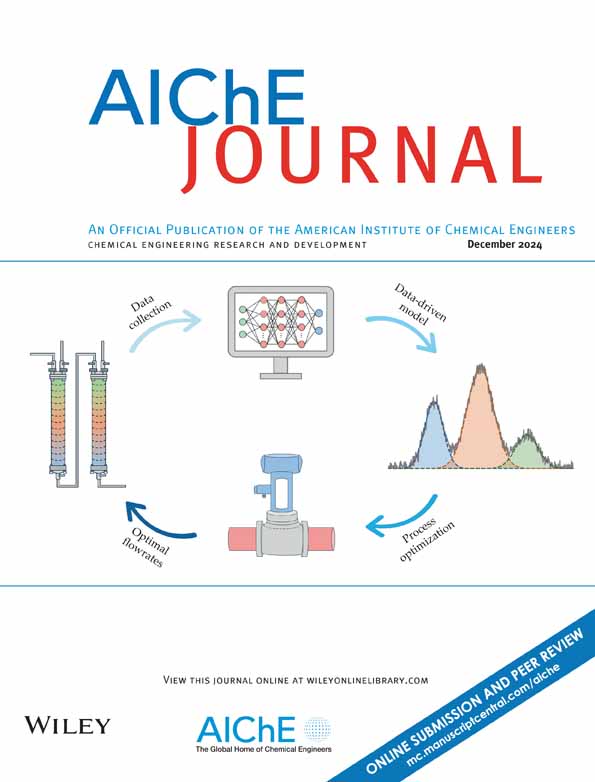
AIChE Journal
AIChE Journal 工程技术-工程:化工
CiteScore
7.10
自引率
10.80%
发文量
411
审稿时长
3.6 months
期刊介绍: The AIChE Journal is the premier research monthly in chemical engineering and related fields. This peer-reviewed and broad-based journal reports on the most important and latest technological advances in core areas of chemical engineering as well as in other relevant engineering disciplines. To keep abreast with the progressive outlook of the profession, the Journal has been expanding the scope of its editorial contents to include such fast developing areas as biotechnology, electrochemical engineering, and environmental engineering. The AIChE Journal is indeed the global communications vehicle for the world-renowned researchers to exchange top-notch research findings with one another. Subscribing to the AIChE Journal is like having immediate access to nine topical journals in the field. Articles are categorized according to the following topical areas: Biomolecular Engineering, Bioengineering, Biochemicals, Biofuels, and Food Inorganic Materials: Synthesis and Processing Particle Technology and Fluidization Process Systems Engineering Reaction Engineering, Kinetics and Catalysis Separations: Materials, Devices and Processes Soft Materials: Synthesis, Processing and Products Thermodynamics and Molecular-Scale Phenomena Transport Phenomena and Fluid Mechanics.

×
引用
GB/T 7714-2015
复制
MLA
复制
APA
复制
导出至
BibTeX EndNote RefMan NoteFirst NoteExpress
×
提示
您的信息不完整,为了账户安全,请先补充。
现在去补充
×
提示
您因"违规操作"
具体请查看互助需知
我知道了
×
提示
确定
请完成安全验证×
copy
已复制链接
快去分享给好友吧!
我知道了
右上角分享
点击右上角分享
0
联系我们:info@booksci.cn Book学术提供免费学术资源搜索服务,方便国内外学者检索中英文文献。致力于提供最便捷和优质的服务体验。 Copyright © 2023 布克学术 All rights reserved.
京ICP备2023020795号-1
ghs 京公网安备 11010802042870号
Book学术文献互助
Book学术文献互助群
群 号:604180095
Book学术官方微信
小红书


