{"title":"Hydrogel Separator Membrane to Preserve Soil Microbial Fuel Cells Operation Under Hydric Stress","authors":"Júlia Mingot, Sonia Lanzalaco, Elaine Armelin","doi":"10.1002/aesr.70248","DOIUrl":null,"url":null,"abstract":"<p>The present study demonstrated one new concept in single-compartment soil microbial fuel cells (s-MFCs) to save tap water irrigation required to preserve the battery working for prolonged periods. The study employed poly(<i>N</i>-isopropylacrylamide) and poly(vinyl alcohol) as thermosensitive and super-hydrophilic hydrogels to retain the soil humidity. Under soil moisture stress, caused by natural or forced drying conditions (three scenarios tested), the battery operation autonomy gradually decayed, at a lower speed than MFC single-chamber without hydrogel membrane. In extreme heating conditions, i.e., reaching temperatures above the PNIPAAm/PVA LCST (32–33 °C), even though both cells had similar soil volumetric humidity of 14%–17% after 28 days of device operation, the hydrogel-based s-MFC reached a maximum power density of 0.071 μW/cm<sup>2</sup> and current density of 1.24 μA/cm<sup>2</sup>, whereas the pristine cell remained with values relatively inferior (0.043 μW/cm<sup>2</sup> and current density of 0.88 μA/cm<sup>2</sup>). The sensors installed in the soil, close to the separator hydrogel membrane, proved that temperature, humidity and volumetric conductivities were stable over 28 days in the hydrogel-based biobattery. Altogether, the superabsorbent hydrogel copolymer showed a capability for a gradual battery hydration, which represents a step-forward in s-MFC field for future investigations with such thermoresponsive materials.</p>","PeriodicalId":29794,"journal":{"name":"Advanced Energy and Sustainability Research","volume":"7 9","pages":""},"PeriodicalIF":6.4000,"publicationDate":"2026-09-24","publicationTypes":"Journal Article","fieldsOfStudy":null,"isOpenAccess":false,"openAccessPdf":"https://onlinelibrary.wiley.com/doi/epdf/10.1002/aesr.70248","citationCount":"0","resultStr":null,"platform":"Semanticscholar","paperid":null,"PeriodicalName":"Advanced Energy and Sustainability Research","FirstCategoryId":"1085","ListUrlMain":"https://onlinelibrary.wiley.com/doi/10.1002/aesr.70248","RegionNum":0,"RegionCategory":null,"ArticlePicture":[],"TitleCN":null,"AbstractTextCN":null,"PMCID":null,"EPubDate":"","PubModel":"","JCR":"Q2","JCRName":"ENERGY & FUELS","Score":null,"Total":0}
引用次数: 0
Abstract
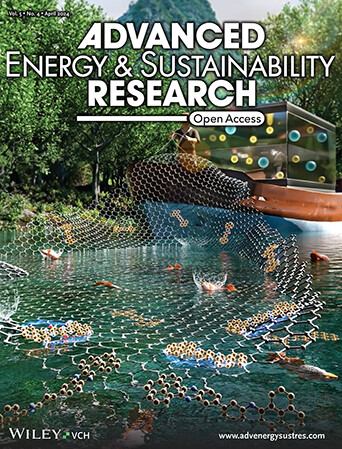
The present study demonstrated one new concept in single-compartment soil microbial fuel cells (s-MFCs) to save tap water irrigation required to preserve the battery working for prolonged periods. The study employed poly(N-isopropylacrylamide) and poly(vinyl alcohol) as thermosensitive and super-hydrophilic hydrogels to retain the soil humidity. Under soil moisture stress, caused by natural or forced drying conditions (three scenarios tested), the battery operation autonomy gradually decayed, at a lower speed than MFC single-chamber without hydrogel membrane. In extreme heating conditions, i.e., reaching temperatures above the PNIPAAm/PVA LCST (32–33 °C), even though both cells had similar soil volumetric humidity of 14%–17% after 28 days of device operation, the hydrogel-based s-MFC reached a maximum power density of 0.071 μW/cm2 and current density of 1.24 μA/cm2, whereas the pristine cell remained with values relatively inferior (0.043 μW/cm2 and current density of 0.88 μA/cm2). The sensors installed in the soil, close to the separator hydrogel membrane, proved that temperature, humidity and volumetric conductivities were stable over 28 days in the hydrogel-based biobattery. Altogether, the superabsorbent hydrogel copolymer showed a capability for a gradual battery hydration, which represents a step-forward in s-MFC field for future investigations with such thermoresponsive materials.
期刊介绍:
Advanced Energy and Sustainability Research is an open access academic journal that focuses on publishing high-quality peer-reviewed research articles in the areas of energy harvesting, conversion, storage, distribution, applications, ecology, climate change, water and environmental sciences, and related societal impacts. The journal provides readers with free access to influential scientific research that has undergone rigorous peer review, a common feature of all journals in the Advanced series. In addition to original research articles, the journal publishes opinion, editorial and review articles designed to meet the needs of a broad readership interested in energy and sustainability science and related fields.
In addition, Advanced Energy and Sustainability Research is indexed in several abstracting and indexing services, including:
CAS: Chemical Abstracts Service (ACS)
Directory of Open Access Journals (DOAJ)
Emerging Sources Citation Index (Clarivate Analytics)
INSPEC (IET)
Web of Science (Clarivate Analytics).

 求助内容:
 应助结果提醒方式:


 京公网安备 11010802042870号


