{"title":"Indoor exposure to microplastics in dust: polymeric composition and health risks in a tropical savanna climatic region","authors":"Raja Sibhi M, Lekshmi Mohan V, Amit Passi","doi":"10.1007/s11869-026-02107-0","DOIUrl":null,"url":null,"abstract":"<div><p>Indoor dust bound microplastics (MPs) can be inadvertently inhaled or ingested, especially by children and infants. This study investigated MPs in indoor dust collected from an academic office and two residential dwellings in Tiruchirappalli, South India, representing contrasting urban microenvironments (occupational, traffic and industrial-influenced). Polymer identification using micro-Fourier infrared (µ-FTIR) spectroscopy revealed the dominance of polymers such as, polyethylene terephthalate (PET), nylon, polystyrene (PS), and polyethylene (PE) in indoor dust across all sites. MPs deposition differed significantly among the sites (Kruskal-Wallis, <i>p</i> = 0.027), with highest mean deposition recorded at academic office (Site A; 241 ± 23 particles/m<sup>2</sup>/day), followed by residence located near busy traffic area (Site C; 151 ± 24 particles/m<sup>2</sup>/day) and residence located near a small-scale industrial site with lesser traffic (Site B; 54 ± 3 particles/m<sup>2</sup>/day). The particle size also varied significantly among sites (<i>p</i> < 0.001), with Site A showing significantly smaller MPs (18.9 ± 11.2 μm) than Sites B and C (33–36 μm), likely due to greater occupant activity, lesser frequency of cleaning, and source diversity in the office environment. Site A recorded highest potential polyurethane (PU)- and polyvinyl chloride (PVC)- associated exposure risk (1750 hazard units), and Site C recorded a potential PU-associated hazard ranking (1500 hazard units), while Site B exhibited negligible polymer-associated potential hazard score, indicating that site classification (traffic vs. industrial) does not align with exposure risk. This study emphasizes the need for a comprehensive understanding and characterization of the sources of indoor MPs, as mere count alone cannot determine risk and inform targeted mitigation strategies.</p><h3>Graphical abstract</h3><div><figure><div><div><picture><source><img></source></picture></div></div></figure></div></div>","PeriodicalId":49109,"journal":{"name":"Air Quality Atmosphere and Health","volume":"19 10","pages":""},"PeriodicalIF":3.1000,"publicationDate":"2026-09-23","publicationTypes":"Journal Article","fieldsOfStudy":null,"isOpenAccess":false,"openAccessPdf":"","citationCount":"0","resultStr":null,"platform":"Semanticscholar","paperid":null,"PeriodicalName":"Air Quality Atmosphere and Health","FirstCategoryId":"93","ListUrlMain":"https://link.springer.com/article/10.1007/s11869-026-02107-0","RegionNum":4,"RegionCategory":"环境科学与生态学","ArticlePicture":[],"TitleCN":null,"AbstractTextCN":null,"PMCID":null,"EPubDate":"","PubModel":"","JCR":"Q3","JCRName":"ENVIRONMENTAL SCIENCES","Score":null,"Total":0}
引用次数: 0
Abstract
Indoor dust bound microplastics (MPs) can be inadvertently inhaled or ingested, especially by children and infants. This study investigated MPs in indoor dust collected from an academic office and two residential dwellings in Tiruchirappalli, South India, representing contrasting urban microenvironments (occupational, traffic and industrial-influenced). Polymer identification using micro-Fourier infrared (µ-FTIR) spectroscopy revealed the dominance of polymers such as, polyethylene terephthalate (PET), nylon, polystyrene (PS), and polyethylene (PE) in indoor dust across all sites. MPs deposition differed significantly among the sites (Kruskal-Wallis, p = 0.027), with highest mean deposition recorded at academic office (Site A; 241 ± 23 particles/m2/day), followed by residence located near busy traffic area (Site C; 151 ± 24 particles/m2/day) and residence located near a small-scale industrial site with lesser traffic (Site B; 54 ± 3 particles/m2/day). The particle size also varied significantly among sites (p < 0.001), with Site A showing significantly smaller MPs (18.9 ± 11.2 μm) than Sites B and C (33–36 μm), likely due to greater occupant activity, lesser frequency of cleaning, and source diversity in the office environment. Site A recorded highest potential polyurethane (PU)- and polyvinyl chloride (PVC)- associated exposure risk (1750 hazard units), and Site C recorded a potential PU-associated hazard ranking (1500 hazard units), while Site B exhibited negligible polymer-associated potential hazard score, indicating that site classification (traffic vs. industrial) does not align with exposure risk. This study emphasizes the need for a comprehensive understanding and characterization of the sources of indoor MPs, as mere count alone cannot determine risk and inform targeted mitigation strategies.
期刊介绍:
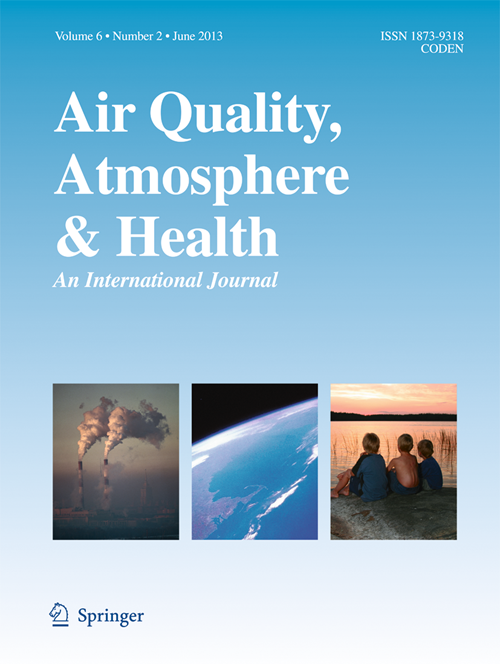
Air Quality, Atmosphere, and Health is a multidisciplinary journal which, by its very name, illustrates the broad range of work it publishes and which focuses on atmospheric consequences of human activities and their implications for human and ecological health.
It offers research papers, critical literature reviews and commentaries, as well as special issues devoted to topical subjects or themes.
International in scope, the journal presents papers that inform and stimulate a global readership, as the topic addressed are global in their import. Consequently, we do not encourage submission of papers involving local data that relate to local problems. Unless they demonstrate wide applicability, these are better submitted to national or regional journals.
Air Quality, Atmosphere & Health addresses such topics as acid precipitation; airborne particulate matter; air quality monitoring and management; exposure assessment; risk assessment; indoor air quality; atmospheric chemistry; atmospheric modeling and prediction; air pollution climatology; climate change and air quality; air pollution measurement; atmospheric impact assessment; forest-fire emissions; atmospheric science; greenhouse gases; health and ecological effects; clean air technology; regional and global change and satellite measurements.
This journal benefits a diverse audience of researchers, public health officials and policy makers addressing problems that call for solutions based in evidence from atmospheric and exposure assessment scientists, epidemiologists, and risk assessors. Publication in the journal affords the opportunity to reach beyond defined disciplinary niches to this broader readership.

 求助内容:
 应助结果提醒方式:


 京公网安备 11010802042870号


