Brenda Resendiz-Diaz, Emma Sadler, Colin Roger Crick
{"title":"Sustainable Plant-Based Water Repellent Coatings Using Hydrophobic Pine and Palm Pollen","authors":"Brenda Resendiz-Diaz, Emma Sadler, Colin Roger Crick","doi":"10.1002/admi.70630","DOIUrl":null,"url":null,"abstract":"<p>The environmental concerns associated with plastic and fluorocarbon-based materials have driven the search for sustainable options, particularly in the development of highly water-repellent coatings. Plant-based materials offer a promising solution due to their biodegradability and sustainability. In this study, we developed highly water-repellent coatings using treated pine and palm pollen. Superhydrophobicity was achieved by integrating a hydrophobic plant-based wax with a micro-scale rough structure formed by the pollen. To enhance their surface chemistry, the two pollen species underwent acid treatment, which effectively removed proteins and altered the wettability of the sporopollenin-based structures. The modified pollen was then combined with two plant-based waxes, carnauba and soybean, to fabricate the final coatings. The resulting surfaces demonstrated remarkable water repellence, achieving the highest water contact angles of ∼158° and sliding angles of <6° with the pine pollen/carnauba wax formulations. In contrast, the palm pollen/carnauba wax formulations achieved the highest water contact angle of ∼151° and sliding angle of 13°. Furthermore, this study investigates the influence of both broken and unbroken pollen structures on coating performance. These results demonstrate the potential of plant-derived materials as environmentally friendly alternatives for water-repellent coating applications.</p>","PeriodicalId":115,"journal":{"name":"Advanced Materials Interfaces","volume":"13 18","pages":""},"PeriodicalIF":4.5000,"publicationDate":"2026-09-25","publicationTypes":"Journal Article","fieldsOfStudy":null,"isOpenAccess":false,"openAccessPdf":"https://onlinelibrary.wiley.com/doi/epdf/10.1002/admi.70630","citationCount":"0","resultStr":null,"platform":"Semanticscholar","paperid":null,"PeriodicalName":"Advanced Materials Interfaces","FirstCategoryId":"88","ListUrlMain":"https://onlinelibrary.wiley.com/doi/10.1002/admi.70630","RegionNum":3,"RegionCategory":"材料科学","ArticlePicture":[],"TitleCN":null,"AbstractTextCN":null,"PMCID":null,"EPubDate":"2026/8/19 0:00:00","PubModel":"Epub","JCR":"Q2","JCRName":"CHEMISTRY, MULTIDISCIPLINARY","Score":null,"Total":0}
引用次数: 0
Abstract
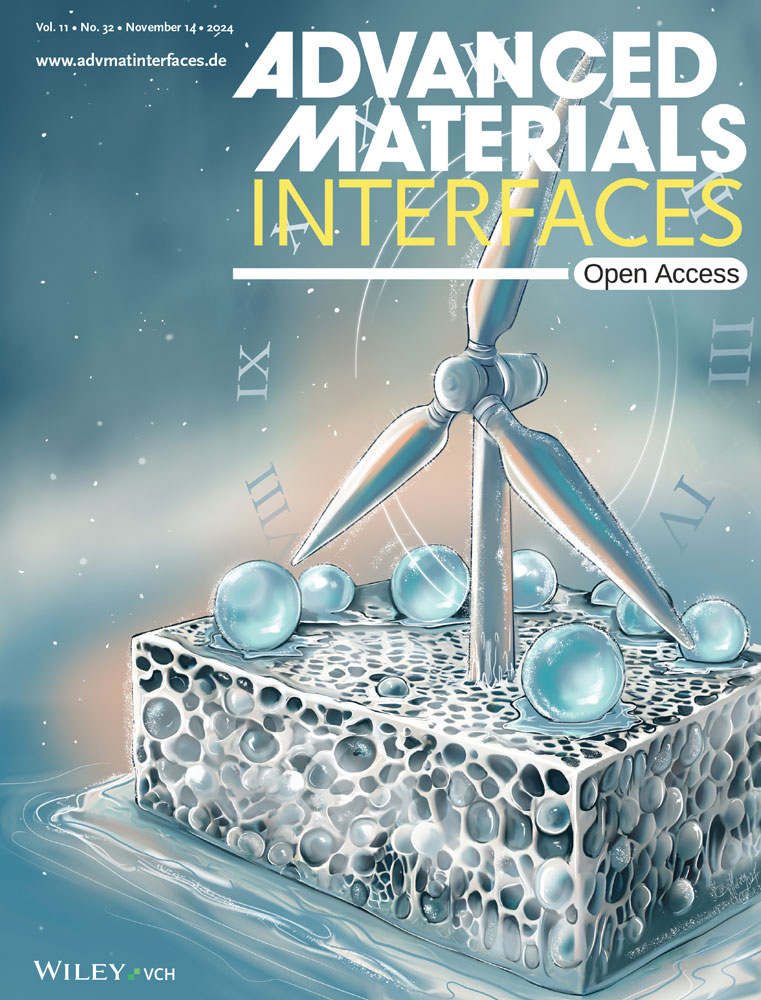
The environmental concerns associated with plastic and fluorocarbon-based materials have driven the search for sustainable options, particularly in the development of highly water-repellent coatings. Plant-based materials offer a promising solution due to their biodegradability and sustainability. In this study, we developed highly water-repellent coatings using treated pine and palm pollen. Superhydrophobicity was achieved by integrating a hydrophobic plant-based wax with a micro-scale rough structure formed by the pollen. To enhance their surface chemistry, the two pollen species underwent acid treatment, which effectively removed proteins and altered the wettability of the sporopollenin-based structures. The modified pollen was then combined with two plant-based waxes, carnauba and soybean, to fabricate the final coatings. The resulting surfaces demonstrated remarkable water repellence, achieving the highest water contact angles of ∼158° and sliding angles of <6° with the pine pollen/carnauba wax formulations. In contrast, the palm pollen/carnauba wax formulations achieved the highest water contact angle of ∼151° and sliding angle of 13°. Furthermore, this study investigates the influence of both broken and unbroken pollen structures on coating performance. These results demonstrate the potential of plant-derived materials as environmentally friendly alternatives for water-repellent coating applications.
期刊介绍:
Advanced Materials Interfaces publishes top-level research on interface technologies and effects. Considering any interface formed between solids, liquids, and gases, the journal ensures an interdisciplinary blend of physics, chemistry, materials science, and life sciences. Advanced Materials Interfaces was launched in 2014 and received an Impact Factor of 4.834 in 2018.
The scope of Advanced Materials Interfaces is dedicated to interfaces and surfaces that play an essential role in virtually all materials and devices. Physics, chemistry, materials science and life sciences blend to encourage new, cross-pollinating ideas, which will drive forward our understanding of the processes at the interface.
Advanced Materials Interfaces covers all topics in interface-related research:
Oil / water separation,
Applications of nanostructured materials,
2D materials and heterostructures,
Surfaces and interfaces in organic electronic devices,
Catalysis and membranes,
Self-assembly and nanopatterned surfaces,
Composite and coating materials,
Biointerfaces for technical and medical applications.
Advanced Materials Interfaces provides a forum for topics on surface and interface science with a wide choice of formats: Reviews, Full Papers, and Communications, as well as Progress Reports and Research News.

 求助内容:
 应助结果提醒方式:


 京公网安备 11010802042870号


