Wencheng Su, Chao Wang, Huiyan Zeng, Jianwen Wang, Long Gu, Mengxian Li, Liting Deng, Chi-Ying Vanessa Li, Chunzhen Yang
{"title":"Recycling Ni-Rich NCM Cathode Materials From Spent Li-Ion Batteries as Efficient Electrocatalyst for Urea Oxidation","authors":"Wencheng Su, Chao Wang, Huiyan Zeng, Jianwen Wang, Long Gu, Mengxian Li, Liting Deng, Chi-Ying Vanessa Li, Chunzhen Yang","doi":"10.1002/eem2.70314","DOIUrl":null,"url":null,"abstract":"<p>The burgeoning electric vehicle industry has intensified the demand for high-energy Ni-Co-Mn (NCM) cathodes, yet their end-of-life management remains a critical environmental challenge. Here, we show that spent high-Ni NCM (LiNi<sub>0.92</sub>Co<sub>0.05</sub>Mn<sub>0.03</sub>O<sub>2</sub>) cathode materials can be directly upcycled into robust urea oxidation (UOR) catalysts. A facile solvent-only delamination converts discarded cathodes into printable inks; drop-casting onto carbon paper yields electrodes delivering ~10 mA mg<sup>−1</sup> at 1.50 V versus RHE. Operando synchrotron X-ray diffraction reveals that K<sup>+</sup> ions spontaneously intercalate into Li-deficient interlayers, expanding the (003) interplanar spacing from 4.7 to 7.1 Å. An electrochemical–chemical (E–C) reaction mechanism is proposed, in which Ni<sup>3+</sup> species are electrochemically generated on the catalyst surface and are then chemically reduced during urea oxidation, a process promoted by K<sup>+</sup> intercalation. This lattice-engineered redox process stabilizes the layered framework and suppresses metal dissolution, ensuring >24 h of continuous urea electrolysis. The work offers a circular economy solution for battery waste treatment while providing atomistic design principles for next-generation, earth-abundant environmental catalysts.</p>","PeriodicalId":11554,"journal":{"name":"Energy & Environmental Materials","volume":"9 6","pages":""},"PeriodicalIF":13.8000,"publicationDate":"2026-09-23","publicationTypes":"Journal Article","fieldsOfStudy":null,"isOpenAccess":false,"openAccessPdf":"https://onlinelibrary.wiley.com/doi/epdf/10.1002/eem2.70314","citationCount":"0","resultStr":null,"platform":"Semanticscholar","paperid":null,"PeriodicalName":"Energy & Environmental Materials","FirstCategoryId":"88","ListUrlMain":"https://onlinelibrary.wiley.com/doi/10.1002/eem2.70314","RegionNum":2,"RegionCategory":"材料科学","ArticlePicture":[],"TitleCN":null,"AbstractTextCN":null,"PMCID":null,"EPubDate":"2026/3/2 0:00:00","PubModel":"Epub","JCR":"Q1","JCRName":"MATERIALS SCIENCE, MULTIDISCIPLINARY","Score":null,"Total":0}
引用次数: 0
Abstract
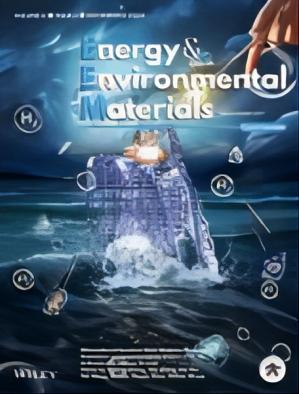
The burgeoning electric vehicle industry has intensified the demand for high-energy Ni-Co-Mn (NCM) cathodes, yet their end-of-life management remains a critical environmental challenge. Here, we show that spent high-Ni NCM (LiNi0.92Co0.05Mn0.03O2) cathode materials can be directly upcycled into robust urea oxidation (UOR) catalysts. A facile solvent-only delamination converts discarded cathodes into printable inks; drop-casting onto carbon paper yields electrodes delivering ~10 mA mg−1 at 1.50 V versus RHE. Operando synchrotron X-ray diffraction reveals that K+ ions spontaneously intercalate into Li-deficient interlayers, expanding the (003) interplanar spacing from 4.7 to 7.1 Å. An electrochemical–chemical (E–C) reaction mechanism is proposed, in which Ni3+ species are electrochemically generated on the catalyst surface and are then chemically reduced during urea oxidation, a process promoted by K+ intercalation. This lattice-engineered redox process stabilizes the layered framework and suppresses metal dissolution, ensuring >24 h of continuous urea electrolysis. The work offers a circular economy solution for battery waste treatment while providing atomistic design principles for next-generation, earth-abundant environmental catalysts.
期刊介绍:
Energy & Environmental Materials (EEM) is an international journal published by Zhengzhou University in collaboration with John Wiley & Sons, Inc. The journal aims to publish high quality research related to materials for energy harvesting, conversion, storage, and transport, as well as for creating a cleaner environment. EEM welcomes research work of significant general interest that has a high impact on society-relevant technological advances. The scope of the journal is intentionally broad, recognizing the complexity of issues and challenges related to energy and environmental materials. Therefore, interdisciplinary work across basic science and engineering disciplines is particularly encouraged. The areas covered by the journal include, but are not limited to, materials and composites for photovoltaics and photoelectrochemistry, bioprocessing, batteries, fuel cells, supercapacitors, clean air, and devices with multifunctionality. The readership of the journal includes chemical, physical, biological, materials, and environmental scientists and engineers from academia, industry, and policy-making.

 求助内容:
 应助结果提醒方式:


 京公网安备 11010802042870号


