Maojie Hu, Youfa Wang, Yuxin Wang, Liqiushi Deng, Geoffrey I N Waterhouse, Vijaya Raghavan, Jin Wang
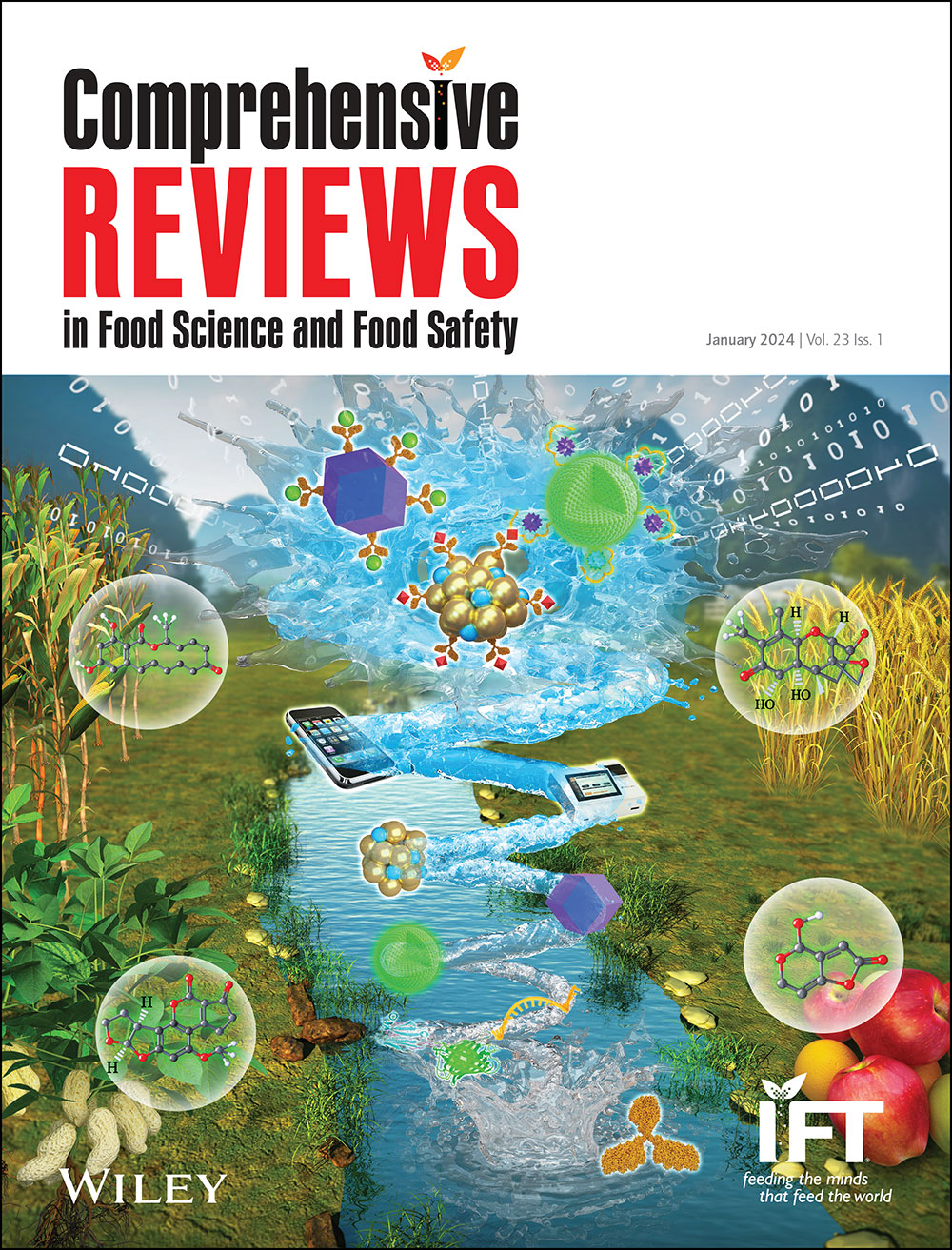
{"title":"Recent Advances in Food Allergens and Emerging Biosensing Technologies.","authors":"Maojie Hu, Youfa Wang, Yuxin Wang, Liqiushi Deng, Geoffrey I N Waterhouse, Vijaya Raghavan, Jin Wang","doi":"10.1111/1541-4337.70654","DOIUrl":null,"url":null,"abstract":"<p><p>Food allergies have become a worldwide public health issue, highlighting the critical need for rapid, sensitive, and field-deployable detection strategies. While traditional detection methods offer high accuracy, their high cost, operational complexity, and lengthy analysis time limit their applicability for rapid screening purposes. Emerging biosensing technologies offer innovative solutions. This review first outlined the characteristics of food allergens and conventional detection approaches and subsequently provided a systematic summary of recent developments in fluorescence, colorimetric, surface-enhanced Raman scattering, surface plasmon resonance, and electrochemical sensors, classified according to their signal transduction mechanisms. Furthermore, this review examined the underlying principles, signal amplification mechanisms, analytical performance, and practical validation of different sensor platforms in real-sample analysis. Current challenges include matrix interference, limited multiplexing, poor long-term stability, and the high cost of recognition elements. Future development directions encompass antifouling interfaces, high-throughput platforms, self-powered and wearable technologies, standardized evaluation frameworks, and artificial intelligence algorithms. This review aimed to offer both a theoretical framework and directional guidance to inform future studies and practical implementations of rapid food allergen detection technologies.</p>","PeriodicalId":155,"journal":{"name":"Comprehensive Reviews in Food Science and Food Safety","volume":"25 5","pages":"e70654"},"PeriodicalIF":15.6000,"publicationDate":"2026-09-01","publicationTypes":"Journal Article","fieldsOfStudy":null,"isOpenAccess":false,"openAccessPdf":"https://www.ncbi.nlm.nih.gov/pmc/articles/PMC13598900/pdf/","citationCount":"0","resultStr":null,"platform":"Semanticscholar","paperid":null,"PeriodicalName":"Comprehensive Reviews in Food Science and Food Safety","FirstCategoryId":"97","ListUrlMain":"https://doi.org/10.1111/1541-4337.70654","RegionNum":1,"RegionCategory":"农林科学","ArticlePicture":[],"TitleCN":null,"AbstractTextCN":null,"PMCID":null,"EPubDate":"","PubModel":"","JCR":"Q1","JCRName":"FOOD SCIENCE & TECHNOLOGY","Score":null,"Total":0}
引用次数: 0
Abstract
Food allergies have become a worldwide public health issue, highlighting the critical need for rapid, sensitive, and field-deployable detection strategies. While traditional detection methods offer high accuracy, their high cost, operational complexity, and lengthy analysis time limit their applicability for rapid screening purposes. Emerging biosensing technologies offer innovative solutions. This review first outlined the characteristics of food allergens and conventional detection approaches and subsequently provided a systematic summary of recent developments in fluorescence, colorimetric, surface-enhanced Raman scattering, surface plasmon resonance, and electrochemical sensors, classified according to their signal transduction mechanisms. Furthermore, this review examined the underlying principles, signal amplification mechanisms, analytical performance, and practical validation of different sensor platforms in real-sample analysis. Current challenges include matrix interference, limited multiplexing, poor long-term stability, and the high cost of recognition elements. Future development directions encompass antifouling interfaces, high-throughput platforms, self-powered and wearable technologies, standardized evaluation frameworks, and artificial intelligence algorithms. This review aimed to offer both a theoretical framework and directional guidance to inform future studies and practical implementations of rapid food allergen detection technologies.
期刊介绍:
Comprehensive Reviews in Food Science and Food Safety (CRFSFS) is an online peer-reviewed journal established in 2002. It aims to provide scientists with unique and comprehensive reviews covering various aspects of food science and technology.
CRFSFS publishes in-depth reviews addressing the chemical, microbiological, physical, sensory, and nutritional properties of foods, as well as food processing, engineering, analytical methods, and packaging. Manuscripts should contribute new insights and recommendations to the scientific knowledge on the topic. The journal prioritizes recent developments and encourages critical assessment of experimental design and interpretation of results.
Topics related to food safety, such as preventive controls, ingredient contaminants, storage, food authenticity, and adulteration, are considered. Reviews on food hazards must demonstrate validity and reliability in real food systems, not just in model systems. Additionally, reviews on nutritional properties should provide a realistic perspective on how foods influence health, considering processing and storage effects on bioactivity.
The journal also accepts reviews on consumer behavior, risk assessment, food regulations, and post-harvest physiology. Authors are encouraged to consult the Editor in Chief before submission to ensure topic suitability. Systematic reviews and meta-analyses on analytical and sensory methods, quality control, and food safety approaches are welcomed, with authors advised to follow IFIS Good review practice guidelines.

 求助内容:
 应助结果提醒方式:


 京公网安备 11010802042870号


