
Titanium-rich phase stability in subducting oceanic crust and implications for molybdenum and water cycles
IF 4.6
1区 地球科学
Q1 GEOLOGY
引用次数: 0
Abstract
Titanium-rich phases in subducting oceanic crust are key hosts for high field strength elements (HFSEs) and molybdenum, and potential carriers of water to the deep mantle. We constrained their stability through high-pressure experiments (4−12 GPa, 1000−1200 °C) on anhydrous and hydrous basaltic compositions. Rutile transforms to an α-PbO2-type Fe−Ti oxyhydroxide (α-phase) above ∼6 GPa, and Ti-bearing ε-FeOOH (ε-phase) appears at 12 GPa and 1000 °C in hydrous systems. At 1200 °C, the α-phase appears at 6 GPa in hydrous mid-ocean ridge basalt (MORB), but only at 8 GPa in anhydrous MORB. Mo compatibility decreases in the sequence rutile > α-phase > ε-phase (DMoα/rutile = 0.2−1, DMoε/α = 0.2; DMo—Mo partition coefficient), consistent with mineral−melt partitioning (DMorutile/melt = 1.3−27, DMoα/melt = 0.8−3.5), indicating progressive Mo release during subduction. Both α- and ε-phases incorporate significant H2O, enabling deep water transport beyond lawsonite stability. These phase relations and partitioning data provide essential constraints for modeling coupled HFSEs, Mo, and H2O cycling through subduction zones.俯冲洋壳富钛相稳定性及其对钼和水循环的影响
本文章由计算机程序翻译,如有差异,请以英文原文为准。
求助全文
约1分钟内获得全文
求助全文
来源期刊
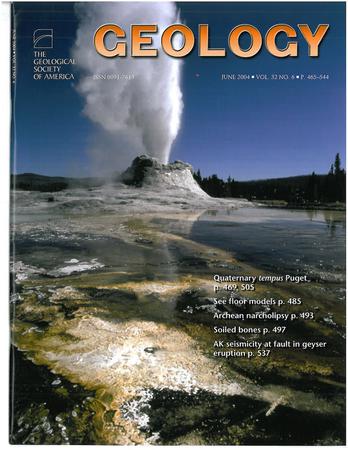
Geology
地学-地质学
CiteScore
10.00
自引率
3.40%
发文量
228
审稿时长
6.2 months
期刊介绍:
Published since 1973, Geology features rapid publication of about 23 refereed short (four-page) papers each month. Articles cover all earth-science disciplines and include new investigations and provocative topics. Professional geologists and university-level students in the earth sciences use this widely read journal to keep up with scientific research trends. The online forum section facilitates author-reader dialog. Includes color and occasional large-format illustrations on oversized loose inserts.
 求助内容:
 应助结果提醒方式:


 京公网安备 11010802042870号


