
A commensal-derived sugar protects against obesity by regulating immunometabolism
IF 23.2
1区 医学
Q1 MICROBIOLOGY
引用次数: 0
Abstract
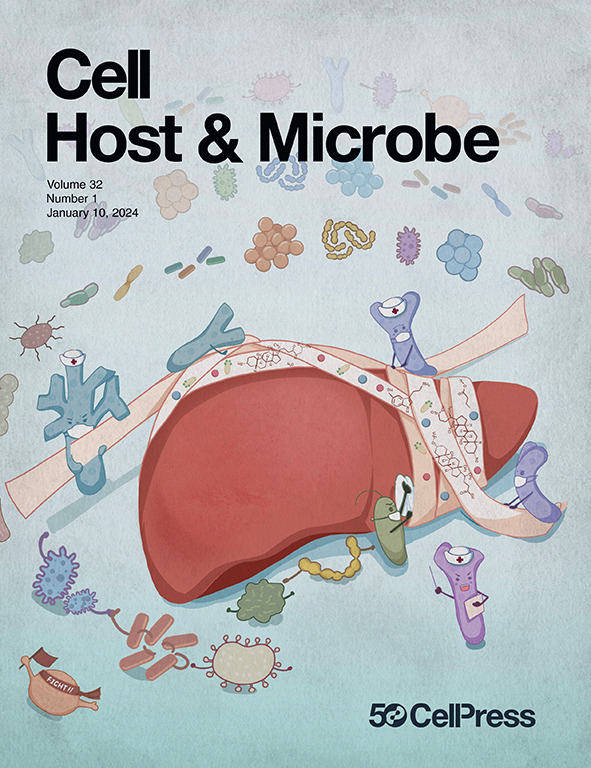
Obesity is a worsening global epidemic that is partially regulated by the microbiota through unknown factors. We discovered a human commensal bacterium, Clostridium immunis, which prevents and treats obesity in mice by secreting a phosphocholine-modified exopolysaccharide. Loss- and gain-of-function bacterial mutants involving the phosphocholine biosynthesis locus (licABC) revealed that the phosphocholine moiety is required to protect against metabolic disease. This C. immunis exopolysaccharide decreases small-intestinal and visceral fat levels of IL-22, which increases metabolic activity specifically in visceral adipose tissue; C. immunis lacks activity against obesity when IL-22 or group 3 innate lymphoid cells, predominant secretors of IL-22, are absent. Importantly, phosphocholine biosynthesis genes are less abundant in humans with obesity or hypertriglyceridemia, suggesting conserved functions of bacterial phosphocholine. These results define a bacterial molecule—and its key structural motif—that provides immunometabolic control of obesity. More broadly, they highlight a clinically translatable strategy to reduce visceral fat.

一种来自植物的糖通过调节免疫代谢来防止肥胖
肥胖是一种日益恶化的全球流行病,部分受微生物群通过未知因素调节。我们发现了一种人类共生细菌——免疫梭菌,它通过分泌一种磷胆碱修饰的外多糖来预防和治疗小鼠肥胖。涉及磷酸胆碱生物合成位点(licABC)的功能丧失和功能获得细菌突变表明,磷酸胆碱部分是防止代谢性疾病所必需的。该免疫C.胞外多糖降低小肠和内脏脂肪IL-22水平,从而增加内脏脂肪组织的代谢活性;当IL-22或3组先天淋巴样细胞(IL-22的主要分泌细胞)缺失时,C. immune缺乏抗肥胖的活性。重要的是,在肥胖或高甘油三酯血症患者中,磷胆碱生物合成基因较少,这表明细菌磷胆碱具有保守功能。这些结果确定了一种细菌分子及其关键结构基序,它提供了对肥胖的免疫代谢控制。更广泛地说,他们强调了一种临床可转化的减少内脏脂肪的策略。
本文章由计算机程序翻译,如有差异,请以英文原文为准。
求助全文
约1分钟内获得全文
求助全文
来源期刊
Cell host & microbe
生物-微生物学
CiteScore
45.10
自引率
1.70%
发文量
201
审稿时长
4-8 weeks
期刊介绍:
Cell Host & Microbe is a scientific journal that was launched in March 2007. The journal aims to provide a platform for scientists to exchange ideas and concepts related to the study of microbes and their interaction with host organisms at a molecular, cellular, and immune level. It publishes novel findings on a wide range of microorganisms including bacteria, fungi, parasites, and viruses. The journal focuses on the interface between the microbe and its host, whether the host is a vertebrate, invertebrate, or plant, and whether the microbe is pathogenic, non-pathogenic, or commensal. The integrated study of microbes and their interactions with each other, their host, and the cellular environment they inhabit is a unifying theme of the journal. The published work in Cell Host & Microbe is expected to be of exceptional significance within its field and also of interest to researchers in other areas. In addition to primary research articles, the journal features expert analysis, commentary, and reviews on current topics of interest in the field.
 求助内容:
 应助结果提醒方式:


 京公网安备 11010802042870号


