{"title":"Formation of near-vertical trenches and fins with flat {-201} sidewalls on (512) β-Ga<sub>2</sub>O<sub>3</sub> via TMAH wet etching.","authors":"Takayoshi Oshima","doi":"10.1080/14686996.2026.2726186","DOIUrl":null,"url":null,"abstract":"<p><p>We achieved the formation of near-vertical trenches and fins with exceptionally flat {-201}-faceted sidewalls on (512) β-Ga<sub>2</sub>O<sub>3</sub> substrates by crystallographic wet etching in 25-wt% tetramethylammonium hydroxide (TMAH). Since wet-etched {-201} surfaces exhibit atomically flat step-and-terrace morphologies, substrate orientations perpendicular to the {-201} plane and having high wet-etch rates are expected to enable smooth vertical trench/fin formation by wet etching alone. To identify such orientations, we measured the in-plane dependence of the side-etch rate on a (-201) substrate and found that side etching was most enhanced near the (512) and equivalent planes. We therefore investigated the wet-etch characteristics of (512) substrates. The planar etch rate increased exponentially with temperature, reaching 0.724 μm h<sup>-1</sup> at 90°C, indicating surface-reaction-limited behavior with an activation energy of 83.3 kJ mol<sup>-1</sup> (0.863 eV). Near-vertical etching was achieved only for etching windows aligned along the [1-92] direction, parallel to the intersection between the (-201) and (512) planes. The developed {-201}-faceted sidewalls were flat and slightly inclined from the (512) surface normal by approximately 1.8°, in good agreement with the crystallographically estimated angle of 1.70°, suggesting that perfectly vertical etching could be achieved using 1.70°-miscut (512) substrates.</p>","PeriodicalId":21588,"journal":{"name":"Science and Technology of Advanced Materials","volume":"27 1","pages":"2726186"},"PeriodicalIF":6.6000,"publicationDate":"2026-09-11","publicationTypes":"Journal Article","fieldsOfStudy":null,"isOpenAccess":false,"openAccessPdf":"https://www.ncbi.nlm.nih.gov/pmc/articles/PMC13592009/pdf/","citationCount":"0","resultStr":null,"platform":"Semanticscholar","paperid":null,"PeriodicalName":"Science and Technology of Advanced Materials","FirstCategoryId":"88","ListUrlMain":"https://doi.org/10.1080/14686996.2026.2726186","RegionNum":3,"RegionCategory":"材料科学","ArticlePicture":[],"TitleCN":null,"AbstractTextCN":null,"PMCID":null,"EPubDate":"2026/1/1 0:00:00","PubModel":"eCollection","JCR":"Q1","JCRName":"MATERIALS SCIENCE, MULTIDISCIPLINARY","Score":null,"Total":0}
引用次数: 0
Abstract
We achieved the formation of near-vertical trenches and fins with exceptionally flat {-201}-faceted sidewalls on (512) β-Ga2O3 substrates by crystallographic wet etching in 25-wt% tetramethylammonium hydroxide (TMAH). Since wet-etched {-201} surfaces exhibit atomically flat step-and-terrace morphologies, substrate orientations perpendicular to the {-201} plane and having high wet-etch rates are expected to enable smooth vertical trench/fin formation by wet etching alone. To identify such orientations, we measured the in-plane dependence of the side-etch rate on a (-201) substrate and found that side etching was most enhanced near the (512) and equivalent planes. We therefore investigated the wet-etch characteristics of (512) substrates. The planar etch rate increased exponentially with temperature, reaching 0.724 μm h-1 at 90°C, indicating surface-reaction-limited behavior with an activation energy of 83.3 kJ mol-1 (0.863 eV). Near-vertical etching was achieved only for etching windows aligned along the [1-92] direction, parallel to the intersection between the (-201) and (512) planes. The developed {-201}-faceted sidewalls were flat and slightly inclined from the (512) surface normal by approximately 1.8°, in good agreement with the crystallographically estimated angle of 1.70°, suggesting that perfectly vertical etching could be achieved using 1.70°-miscut (512) substrates.
期刊介绍:
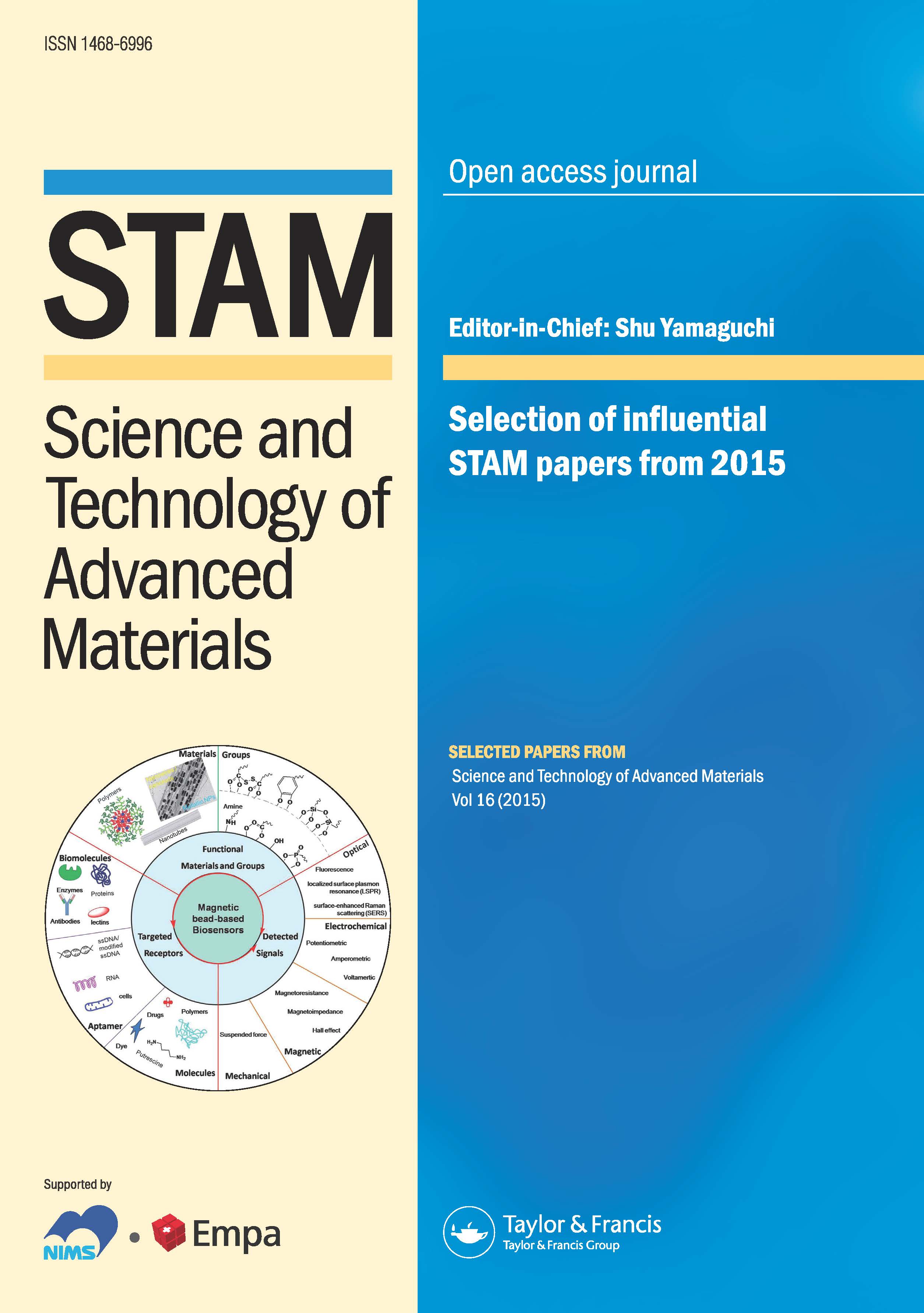
Science and Technology of Advanced Materials (STAM) is a leading open access, international journal for outstanding research articles across all aspects of materials science. Our audience is the international community across the disciplines of materials science, physics, chemistry, biology as well as engineering.
The journal covers a broad spectrum of topics including functional and structural materials, synthesis and processing, theoretical analyses, characterization and properties of materials. Emphasis is placed on the interdisciplinary nature of materials science and issues at the forefront of the field, such as energy and environmental issues, as well as medical and bioengineering applications.
Of particular interest are research papers on the following topics:
Materials informatics and materials genomics
Materials for 3D printing and additive manufacturing
Nanostructured/nanoscale materials and nanodevices
Bio-inspired, biomedical, and biological materials; nanomedicine, and novel technologies for clinical and medical applications
Materials for energy and environment, next-generation photovoltaics, and green technologies
Advanced structural materials, materials for extreme conditions.

 求助内容:
 应助结果提醒方式:


 京公网安备 11010802042870号


