Rodolfo D Vicetti Miguel, Mohan Liu, Jeremy V Smedley, Thomas L Cherpes
{"title":"Targeting EphA2 with a novel EFNA3-mimetic peptide enhances vaginal epithelial barrier function: Running title: EFNA3-MAP enhancing the vaginal epithelial barrier.","authors":"Rodolfo D Vicetti Miguel, Mohan Liu, Jeremy V Smedley, Thomas L Cherpes","doi":"10.1016/j.mucimm.2026.100406","DOIUrl":null,"url":null,"abstract":"<p><p>Barrier protection provided by vaginal stratified squamous epithelium (SSE) is supported by estrogen (E)-mediated stimulation of ephrin-Eph signaling that promote desmosome expression and function. Conversely, loss of E induced by use of the contraceptive depot-medroxyprogesterone acetate (DMPA) or menopause reduces desmosome expression and weakens this epithelial barrier. We previously reported treating mice with DMPA lowers expression of the desmosomal cadherin desmoglein-1 (DSG1) in vaginal SSE by dampening EFNA3-mediated signaling whereas these effects are partially reversed by intravaginal administration of recombinant EFNA3 (rEFNA3) protein. Herein we extended these results, developing an EFNA3-mimetic agonist peptide (EFNA3-MAP) that engages the EphA2 receptor in vitro. In vivo, EFNA3-MAP penetrated vaginal SSE more effectively than rEFNA3 and restored DSG1 levels and vaginal epithelial thickness in DMPA-treated mice. It also reduced susceptibility of these mice to genital infection with bacterial and viral pathogens. In separate studies, we showed that EFNA3-MAP bioactivity depended on G-H loop aromatic residues and EphA2 engagement and that topical EFNA3-MAP restored vaginal epithelial thickness and DSG1 expression in DMPA-treated rhesus macaques. Together, current studies establish EFNA3-EphA2 signaling as a key regulator of vaginal SSE health and offer strong rationale to explore if EFNA3-MAP similarly enhances cutaneous SSE barrier function.</p>","PeriodicalId":18877,"journal":{"name":"Mucosal Immunology","volume":" ","pages":"100406"},"PeriodicalIF":5.5000,"publicationDate":"2026-09-21","publicationTypes":"Journal Article","fieldsOfStudy":null,"isOpenAccess":false,"openAccessPdf":"","citationCount":"0","resultStr":null,"platform":"Semanticscholar","paperid":null,"PeriodicalName":"Mucosal Immunology","FirstCategoryId":"3","ListUrlMain":"https://doi.org/10.1016/j.mucimm.2026.100406","RegionNum":2,"RegionCategory":"医学","ArticlePicture":[],"TitleCN":null,"AbstractTextCN":null,"PMCID":null,"EPubDate":"","PubModel":"","JCR":"Q1","JCRName":"IMMUNOLOGY","Score":null,"Total":0}
引用次数: 0
Abstract
Barrier protection provided by vaginal stratified squamous epithelium (SSE) is supported by estrogen (E)-mediated stimulation of ephrin-Eph signaling that promote desmosome expression and function. Conversely, loss of E induced by use of the contraceptive depot-medroxyprogesterone acetate (DMPA) or menopause reduces desmosome expression and weakens this epithelial barrier. We previously reported treating mice with DMPA lowers expression of the desmosomal cadherin desmoglein-1 (DSG1) in vaginal SSE by dampening EFNA3-mediated signaling whereas these effects are partially reversed by intravaginal administration of recombinant EFNA3 (rEFNA3) protein. Herein we extended these results, developing an EFNA3-mimetic agonist peptide (EFNA3-MAP) that engages the EphA2 receptor in vitro. In vivo, EFNA3-MAP penetrated vaginal SSE more effectively than rEFNA3 and restored DSG1 levels and vaginal epithelial thickness in DMPA-treated mice. It also reduced susceptibility of these mice to genital infection with bacterial and viral pathogens. In separate studies, we showed that EFNA3-MAP bioactivity depended on G-H loop aromatic residues and EphA2 engagement and that topical EFNA3-MAP restored vaginal epithelial thickness and DSG1 expression in DMPA-treated rhesus macaques. Together, current studies establish EFNA3-EphA2 signaling as a key regulator of vaginal SSE health and offer strong rationale to explore if EFNA3-MAP similarly enhances cutaneous SSE barrier function.
期刊介绍:
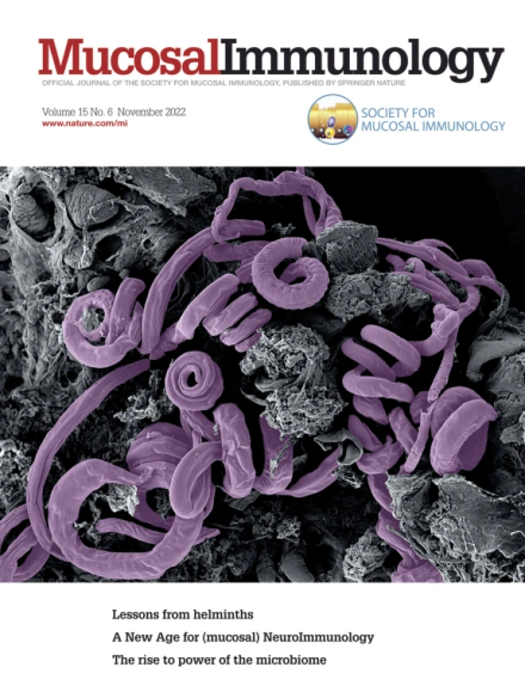
Mucosal Immunology, the official publication of the Society of Mucosal Immunology (SMI), serves as a forum for both basic and clinical scientists to discuss immunity and inflammation involving mucosal tissues. It covers gastrointestinal, pulmonary, nasopharyngeal, oral, ocular, and genitourinary immunology through original research articles, scholarly reviews, commentaries, editorials, and letters. The journal gives equal consideration to basic, translational, and clinical studies and also serves as a primary communication channel for the SMI governing board and its members, featuring society news, meeting announcements, policy discussions, and job/training opportunities advertisements.

 求助内容:
 应助结果提醒方式:


 京公网安备 11010802042870号


