Johannes Fiedler, Sabrina D Eder, Justas Zalieckas
{"title":"Graphene-nanodiamond membranes for atomic-impact sensing: design and fluorescence readout limits.","authors":"Johannes Fiedler, Sabrina D Eder, Justas Zalieckas","doi":"10.1039/d6na00363j","DOIUrl":null,"url":null,"abstract":"<p><p>Hybrid nanomaterial platforms that combine mechanically compliant two-dimensional membranes with optically active quantum emitters offer an attractive route towards ultrasensitive particle detection. Here, we investigate a sensor concept based on a graphene membrane suspended over a nanoscale aperture and functionalised with fluorescent nanodiamonds. The impact of an incoming atom transfers momentum to the membrane and excites an out-of-plane mechanical motion, which is transduced into an optical signal through the nanodiamond fluorescence. We develop a quantitative upper-bound model linking atomic momentum transfer, the mechanical response of the nanodiamond-loaded membrane, and the resulting optical transduction. Design maps for the mechanical resonance frequency and collision-induced oscillation amplitude reveal single-impact displacements in the femtometre-to-sub-picometre range for helium atoms. Even under favourable mechanical, collision, and optical conditions, the corresponding relative fluorescence modulation remains below 10<sup>-6</sup> throughout the investigated parameter space and reaches only a few 10<sup>-7</sup> under the most favourable conditions. Combined with photon-counting statistics, these results show that direct fluorescence-intensity detection of individual atomic impacts is impractical in the considered configuration. Importantly, the analysis identifies optical displacement transduction, rather than the absence of a mechanical response, as the principal limitation. The predicted absolute displacements approach the scale accessible to state-of-the-art graphene optomechanical measurements, making interferometric or cavity-based displacement readout a more promising direction, although single-impact detectability remains dependent on bandwidth and noise. Our results establish quantitative feasibility bounds for graphene-nanodiamond atomic-impact sensors and identify the readout mechanism as the central design parameter for future hybrid nano-mechanical sensing architectures.</p>","PeriodicalId":18806,"journal":{"name":"Nanoscale Advances","volume":" ","pages":"6220-6228"},"PeriodicalIF":6.3000,"publicationDate":"2026-09-17","publicationTypes":"Journal Article","fieldsOfStudy":null,"isOpenAccess":false,"openAccessPdf":"https://www.ncbi.nlm.nih.gov/pmc/articles/PMC13592093/pdf/","citationCount":"0","resultStr":null,"platform":"Semanticscholar","paperid":null,"PeriodicalName":"Nanoscale Advances","FirstCategoryId":"88","ListUrlMain":"https://doi.org/10.1039/d6na00363j","RegionNum":3,"RegionCategory":"材料科学","ArticlePicture":[],"TitleCN":null,"AbstractTextCN":null,"PMCID":null,"EPubDate":"2026/10/27 0:00:00","PubModel":"eCollection","JCR":"Q2","JCRName":"CHEMISTRY, MULTIDISCIPLINARY","Score":null,"Total":0}
引用次数: 0
Abstract
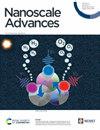
Hybrid nanomaterial platforms that combine mechanically compliant two-dimensional membranes with optically active quantum emitters offer an attractive route towards ultrasensitive particle detection. Here, we investigate a sensor concept based on a graphene membrane suspended over a nanoscale aperture and functionalised with fluorescent nanodiamonds. The impact of an incoming atom transfers momentum to the membrane and excites an out-of-plane mechanical motion, which is transduced into an optical signal through the nanodiamond fluorescence. We develop a quantitative upper-bound model linking atomic momentum transfer, the mechanical response of the nanodiamond-loaded membrane, and the resulting optical transduction. Design maps for the mechanical resonance frequency and collision-induced oscillation amplitude reveal single-impact displacements in the femtometre-to-sub-picometre range for helium atoms. Even under favourable mechanical, collision, and optical conditions, the corresponding relative fluorescence modulation remains below 10-6 throughout the investigated parameter space and reaches only a few 10-7 under the most favourable conditions. Combined with photon-counting statistics, these results show that direct fluorescence-intensity detection of individual atomic impacts is impractical in the considered configuration. Importantly, the analysis identifies optical displacement transduction, rather than the absence of a mechanical response, as the principal limitation. The predicted absolute displacements approach the scale accessible to state-of-the-art graphene optomechanical measurements, making interferometric or cavity-based displacement readout a more promising direction, although single-impact detectability remains dependent on bandwidth and noise. Our results establish quantitative feasibility bounds for graphene-nanodiamond atomic-impact sensors and identify the readout mechanism as the central design parameter for future hybrid nano-mechanical sensing architectures.

 求助内容:
 应助结果提醒方式:


 京公网安备 11010802042870号


