{"title":"Developments in Mast Cell Research.","authors":"Adrian M Piliponsky, Teal S Hallstrand","doi":"10.1016/j.jaci.2026.09.008","DOIUrl":null,"url":null,"abstract":"<p><p>This review summarizes major advances in mast cell (MC) research published between January 2024 and December 2025. Recent discoveries have reshaped our understanding of MC biology, revealing previously unrecognized roles in brain development, mucosal immunity, neuroimmune communication, and cancer. High-resolution structural studies have provided new insights into high affinity receptor for immunoglobulin (Ig)E (FcεRI) signaling, while emerging evidence has expanded the functional repertoire of inflammasome components and established Mas-related G-protein coupled receptor member (MRGPRX)2 as a central receptor mediating IgE-independent MC activation. Single-cell transcriptomic and spatial profiling studies have uncovered remarkable MC heterogeneity, identifying specialized populations with distinct homeostatic and pathogenic functions across tissues. These findings have also redefined the contribution of MCs to early-life allergic disease, anaphylaxis, pain, infection, and tumor immunity, highlighting their context-dependent functions. In parallel, major therapeutic advances-including antibodies targeting the KIT-stem cell factor (SCF) axis, next-generation anti-IgE therapies, Bruton's tyrosine kinase (BTK) inhibitors, and strategies targeting type 2 inflammatory pathways-are accelerating the development of more selective treatments for MC-driven disorders. Advances in experimental platforms, including human skin MC cultures, receptor-humanized and humanized mouse models, and computational pathology, are further expanding the tools available to investigate MC biology and accelerate translational research. Together, these conceptual, technological, and therapeutic advances are shaping the next generation of MC-targeted therapies.</p>","PeriodicalId":14936,"journal":{"name":"Journal of Allergy and Clinical Immunology","volume":" ","pages":""},"PeriodicalIF":11.7000,"publicationDate":"2026-09-21","publicationTypes":"Journal Article","fieldsOfStudy":null,"isOpenAccess":false,"openAccessPdf":"https://www.ncbi.nlm.nih.gov/pmc/articles/PMC13633653/pdf/","citationCount":"0","resultStr":null,"platform":"Semanticscholar","paperid":null,"PeriodicalName":"Journal of Allergy and Clinical Immunology","FirstCategoryId":"3","ListUrlMain":"https://doi.org/10.1016/j.jaci.2026.09.008","RegionNum":1,"RegionCategory":"医学","ArticlePicture":[],"TitleCN":null,"AbstractTextCN":null,"PMCID":null,"EPubDate":"","PubModel":"","JCR":"Q1","JCRName":"ALLERGY","Score":null,"Total":0}
引用次数: 0
Abstract
This review summarizes major advances in mast cell (MC) research published between January 2024 and December 2025. Recent discoveries have reshaped our understanding of MC biology, revealing previously unrecognized roles in brain development, mucosal immunity, neuroimmune communication, and cancer. High-resolution structural studies have provided new insights into high affinity receptor for immunoglobulin (Ig)E (FcεRI) signaling, while emerging evidence has expanded the functional repertoire of inflammasome components and established Mas-related G-protein coupled receptor member (MRGPRX)2 as a central receptor mediating IgE-independent MC activation. Single-cell transcriptomic and spatial profiling studies have uncovered remarkable MC heterogeneity, identifying specialized populations with distinct homeostatic and pathogenic functions across tissues. These findings have also redefined the contribution of MCs to early-life allergic disease, anaphylaxis, pain, infection, and tumor immunity, highlighting their context-dependent functions. In parallel, major therapeutic advances-including antibodies targeting the KIT-stem cell factor (SCF) axis, next-generation anti-IgE therapies, Bruton's tyrosine kinase (BTK) inhibitors, and strategies targeting type 2 inflammatory pathways-are accelerating the development of more selective treatments for MC-driven disorders. Advances in experimental platforms, including human skin MC cultures, receptor-humanized and humanized mouse models, and computational pathology, are further expanding the tools available to investigate MC biology and accelerate translational research. Together, these conceptual, technological, and therapeutic advances are shaping the next generation of MC-targeted therapies.
期刊介绍:
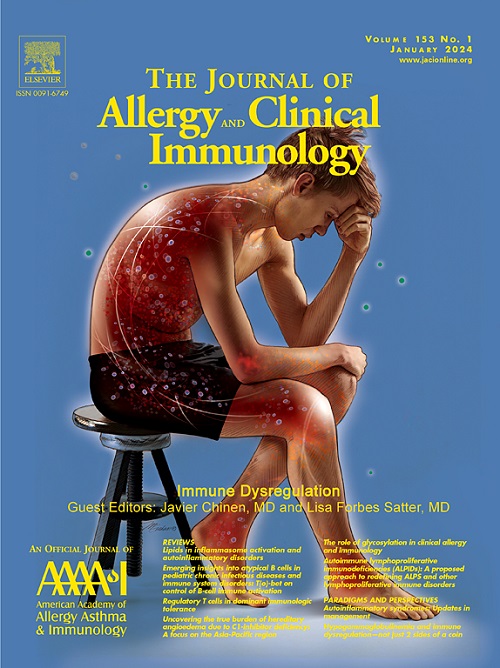
The Journal of Allergy and Clinical Immunology is a prestigious publication that features groundbreaking research in the fields of Allergy, Asthma, and Immunology. This influential journal publishes high-impact research papers that explore various topics, including asthma, food allergy, allergic rhinitis, atopic dermatitis, primary immune deficiencies, occupational and environmental allergy, and other allergic and immunologic diseases. The articles not only report on clinical trials and mechanistic studies but also provide insights into novel therapies, underlying mechanisms, and important discoveries that contribute to our understanding of these diseases. By sharing this valuable information, the journal aims to enhance the diagnosis and management of patients in the future.

 求助内容:
 应助结果提醒方式:


 京公网安备 11010802042870号


