{"title":"Screening Property Rights for Innovation","authors":"William Matcham, Mark Schankerman","doi":"10.3982/ECTA22363","DOIUrl":null,"url":null,"abstract":"<p>We develop a dynamic structural model of patent screening incorporating incentives, intrinsic motivation, and multiround negotiation. We use natural language processing to create a measure of patent distance, which together with detailed data on examiner decisions, enables us to estimate the model and study strategic decisions by applicants and examiners. Using the estimated model, we quantify the effectiveness of the U.S. Patent Office and evaluate counterfactual policy reforms. We find that patent screening is moderately effective, given the existing standards for patentability. Examiners exhibit substantial intrinsic motivation that strongly improves screening quality. We quantify the annual social costs of patent screening at $15.38bn, equivalent to 5% of total private sector R&D in the U.S. and show that reforms limiting the number of rounds of negotiation significantly reduce social costs.</p>","PeriodicalId":50556,"journal":{"name":"Econometrica","volume":"94 5","pages":"1849-1886"},"PeriodicalIF":6.2000,"publicationDate":"2026-09-22","publicationTypes":"Journal Article","fieldsOfStudy":null,"isOpenAccess":false,"openAccessPdf":"https://onlinelibrary.wiley.com/doi/epdf/10.3982/ECTA22363","citationCount":"0","resultStr":null,"platform":"Semanticscholar","paperid":null,"PeriodicalName":"Econometrica","FirstCategoryId":"96","ListUrlMain":"https://onlinelibrary.wiley.com/doi/10.3982/ECTA22363","RegionNum":1,"RegionCategory":"经济学","ArticlePicture":[],"TitleCN":null,"AbstractTextCN":null,"PMCID":null,"EPubDate":"","PubModel":"","JCR":"Q1","JCRName":"ECONOMICS","Score":null,"Total":0}
引用次数: 0
Abstract
We develop a dynamic structural model of patent screening incorporating incentives, intrinsic motivation, and multiround negotiation. We use natural language processing to create a measure of patent distance, which together with detailed data on examiner decisions, enables us to estimate the model and study strategic decisions by applicants and examiners. Using the estimated model, we quantify the effectiveness of the U.S. Patent Office and evaluate counterfactual policy reforms. We find that patent screening is moderately effective, given the existing standards for patentability. Examiners exhibit substantial intrinsic motivation that strongly improves screening quality. We quantify the annual social costs of patent screening at $15.38bn, equivalent to 5% of total private sector R&D in the U.S. and show that reforms limiting the number of rounds of negotiation significantly reduce social costs.
期刊介绍:
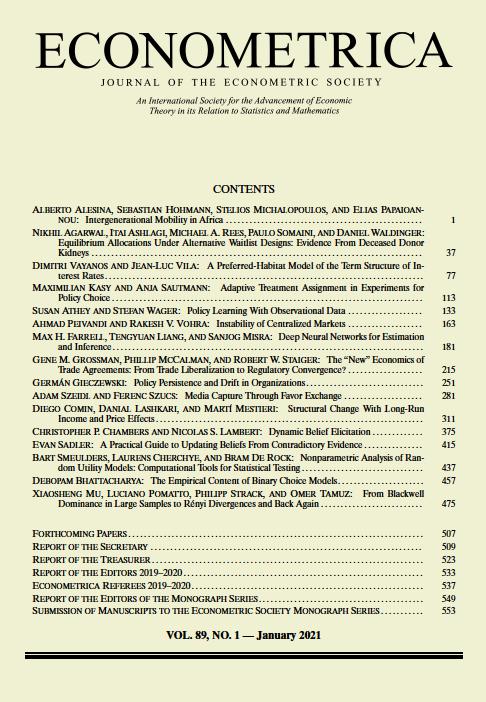
Econometrica publishes original articles in all branches of economics - theoretical and empirical, abstract and applied, providing wide-ranging coverage across the subject area. It promotes studies that aim at the unification of the theoretical-quantitative and the empirical-quantitative approach to economic problems and that are penetrated by constructive and rigorous thinking. It explores a unique range of topics each year - from the frontier of theoretical developments in many new and important areas, to research on current and applied economic problems, to methodologically innovative, theoretical and applied studies in econometrics.
Econometrica maintains a long tradition that submitted articles are refereed carefully and that detailed and thoughtful referee reports are provided to the author as an aid to scientific research, thus ensuring the high calibre of papers found in Econometrica. An international board of editors, together with the referees it has selected, has succeeded in substantially reducing editorial turnaround time, thereby encouraging submissions of the highest quality.
We strongly encourage recent Ph. D. graduates to submit their work to Econometrica. Our policy is to take into account the fact that recent graduates are less experienced in the process of writing and submitting papers.

 求助内容:
 应助结果提醒方式:


 京公网安备 11010802042870号


