Sieun Lee, Jaewook Yoo, Seokjin Oh, Hongseung Lee, Seongbin Lim, Minah Park, Seohyeon Park, Sojin Jung, Donghyeon Lee, Soohyun Lim, Dongsun Shin, Junhui Park, Bong-ki Jung, Taewan Kim, Hagyoul Bae
{"title":"Neutron-Induced Defect-Driven Degradation of Ferroelectric Memory and Neuromorphic Synapses in α-In2Se3 FeS-FETs","authors":"Sieun Lee, Jaewook Yoo, Seokjin Oh, Hongseung Lee, Seongbin Lim, Minah Park, Seohyeon Park, Sojin Jung, Donghyeon Lee, Soohyun Lim, Dongsun Shin, Junhui Park, Bong-ki Jung, Taewan Kim, Hagyoul Bae","doi":"10.1021/acsaelm.6c01048","DOIUrl":null,"url":null,"abstract":"<p>Reliable ferroelectric semiconductor devices are essential for memory and neuromorphic technologies; however, neutron-induced degradation pathways remain unclear. Here, we establish an integrated experimental framework, linking defect characterization with device-level electrical and synaptic evaluations to investigate neutron irradiation effects on α-In<sub>2</sub>Se<sub>3</sub> ferroelectric semiconductor field-effect transistors (FeS-FETs). After neutron irradiation, energy-dispersive spectroscopy (EDS) reveals irradiation-induced compositional changes, while electrical analysis indicates an increased acceptor-like trap density (<em>D</em><sub>A</sub>(E)). These defect-related trap states disrupt polarization-dependent charge transport, leading to a substantial drain current reduction (∼88.95%), and degrade the memory-window-to-sweep-range ratio (MW/SR) (∼48.20%) and endurance characteristics. Synaptic functionality is also impaired, with increased nonlinearity and reduced dynamic range, which propagate to array-level synaptic weight uncertainty and degrade neural network inference accuracy. Overall, our results suggest that defect-related trap states are a key contributor to neutron-induced degradation in α-In<sub>2</sub>Se<sub>3</sub> FeS-FETs. By clarifying this degradation pathway, this work provides insight into defect-related degradation mechanisms that may guide the future design of radiation-resilient ferroelectric memory and neuromorphic electronics.</p>","PeriodicalId":3,"journal":{"name":"ACS Applied Electronic Materials","volume":"8 18","pages":"7780–7789"},"PeriodicalIF":4.7000,"publicationDate":"2026-09-22","publicationTypes":"Journal Article","fieldsOfStudy":null,"isOpenAccess":false,"openAccessPdf":"","citationCount":"0","resultStr":null,"platform":"Semanticscholar","paperid":null,"PeriodicalName":"ACS Applied Electronic Materials","FirstCategoryId":"88","ListUrlMain":"https://pubs.acs.org/doi/10.1021/acsaelm.6c01048","RegionNum":3,"RegionCategory":"材料科学","ArticlePicture":[],"TitleCN":null,"AbstractTextCN":null,"PMCID":null,"EPubDate":"2026/9/14 0:00:00","PubModel":"Epub","JCR":"Q1","JCRName":"ENGINEERING, ELECTRICAL & ELECTRONIC","Score":null,"Total":0}
引用次数: 0
Abstract
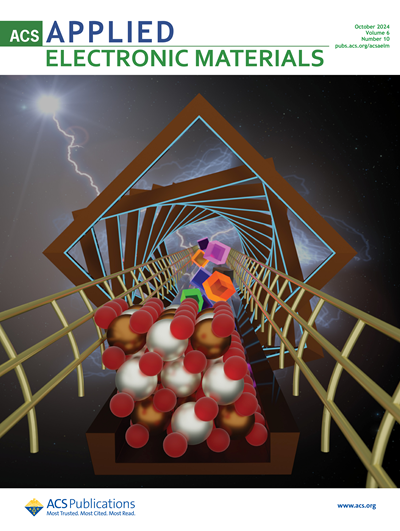
Reliable ferroelectric semiconductor devices are essential for memory and neuromorphic technologies; however, neutron-induced degradation pathways remain unclear. Here, we establish an integrated experimental framework, linking defect characterization with device-level electrical and synaptic evaluations to investigate neutron irradiation effects on α-In2Se3 ferroelectric semiconductor field-effect transistors (FeS-FETs). After neutron irradiation, energy-dispersive spectroscopy (EDS) reveals irradiation-induced compositional changes, while electrical analysis indicates an increased acceptor-like trap density (DA(E)). These defect-related trap states disrupt polarization-dependent charge transport, leading to a substantial drain current reduction (∼88.95%), and degrade the memory-window-to-sweep-range ratio (MW/SR) (∼48.20%) and endurance characteristics. Synaptic functionality is also impaired, with increased nonlinearity and reduced dynamic range, which propagate to array-level synaptic weight uncertainty and degrade neural network inference accuracy. Overall, our results suggest that defect-related trap states are a key contributor to neutron-induced degradation in α-In2Se3 FeS-FETs. By clarifying this degradation pathway, this work provides insight into defect-related degradation mechanisms that may guide the future design of radiation-resilient ferroelectric memory and neuromorphic electronics.
期刊介绍:
ACS Applied Electronic Materials is an interdisciplinary journal publishing original research covering all aspects of electronic materials. The journal is devoted to reports of new and original experimental and theoretical research of an applied nature that integrate knowledge in the areas of materials science, engineering, optics, physics, and chemistry into important applications of electronic materials. Sample research topics that span the journal's scope are inorganic, organic, ionic and polymeric materials with properties that include conducting, semiconducting, superconducting, insulating, dielectric, magnetic, optoelectronic, piezoelectric, ferroelectric and thermoelectric.
Indexed/Abstracted:
Web of Science SCIE
Scopus
CAS
INSPEC
Portico

 求助内容:
 应助结果提醒方式:


 京公网安备 11010802042870号


