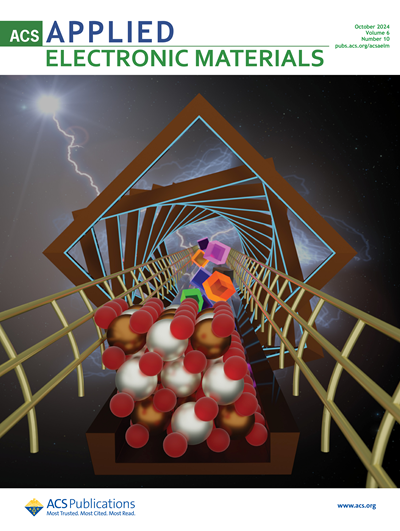
{"title":"Electrochemical Doping and Electronic Phase Transition of Thin-Film Perovskite LaNiO3 at Room Temperature","authors":"Yibo Sun, Yuxi Zheng, Mohan Zhao, Xuefeng Zhang, Gang Li, Xiaofei Guan","doi":"10.1021/acsaelm.6c01417","DOIUrl":null,"url":null,"abstract":"<p>Rare-earth nickelates (<em>R</em>NiO<sub>3</sub>) offer great promise for applications in emergent electronic devices owing to their tunable electrical properties. LaNiO<sub>3</sub> offers processing and operational advantages over heavier <em>R</em>NiO<sub>3</sub> due to its easier synthesis and superior stability. However, the experimental exploration of modulation strategies and the mechanistic understanding of electronic phase transition in thin-film LaNiO<sub>3</sub> remain incomplete. Herein, we demonstrate the electrochemical doping of cations (Li<sup>+</sup>, Zn<sup>2+</sup>, Mg<sup>2+</sup>, and Al<sup>3+</sup>) with different radii and valence states into LaNiO<sub>3</sub> thin films prepared by magnetron sputtering and air annealing. A significant increase of resistivity was observed upon ion intercalation into LaNiO<sub>3</sub> under a positive gate voltage (3 V). X-ray photoelectron spectroscopy (XPS) and synchrotron radiation-based X-ray absorption near-edge structure (XANES) have been conducted to unveil the effect of electrochemical doping on the electronic structure change. Specifically, the peak intensity ratio change of Ni L-edge XAS confirms the reduction of the nominal valence of nickel from +3 to +2 after electrochemical doping. The decrease of the relative intensity of the oxygen K-edge pre-edge also confirms the increased electron occupation in Ni 3d–O 2p orbitals and suggests enhanced electron localization. Moreover, first-principles density functional theory (DFT) calculations reveal that the metal–insulator transition of LaNiO<sub>3</sub> was attributed more to the Coulombic repulsion caused by electron doping rather than to the structure distortion.</p>","PeriodicalId":3,"journal":{"name":"ACS Applied Electronic Materials","volume":"8 18","pages":"8011–8022"},"PeriodicalIF":4.7000,"publicationDate":"2026-09-22","publicationTypes":"Journal Article","fieldsOfStudy":null,"isOpenAccess":false,"openAccessPdf":"","citationCount":"0","resultStr":null,"platform":"Semanticscholar","paperid":null,"PeriodicalName":"ACS Applied Electronic Materials","FirstCategoryId":"88","ListUrlMain":"https://pubs.acs.org/doi/10.1021/acsaelm.6c01417","RegionNum":3,"RegionCategory":"材料科学","ArticlePicture":[],"TitleCN":null,"AbstractTextCN":null,"PMCID":null,"EPubDate":"2026/9/7 0:00:00","PubModel":"Epub","JCR":"Q1","JCRName":"ENGINEERING, ELECTRICAL & ELECTRONIC","Score":null,"Total":0}
引用次数: 0
Abstract
Rare-earth nickelates (RNiO3) offer great promise for applications in emergent electronic devices owing to their tunable electrical properties. LaNiO3 offers processing and operational advantages over heavier RNiO3 due to its easier synthesis and superior stability. However, the experimental exploration of modulation strategies and the mechanistic understanding of electronic phase transition in thin-film LaNiO3 remain incomplete. Herein, we demonstrate the electrochemical doping of cations (Li+, Zn2+, Mg2+, and Al3+) with different radii and valence states into LaNiO3 thin films prepared by magnetron sputtering and air annealing. A significant increase of resistivity was observed upon ion intercalation into LaNiO3 under a positive gate voltage (3 V). X-ray photoelectron spectroscopy (XPS) and synchrotron radiation-based X-ray absorption near-edge structure (XANES) have been conducted to unveil the effect of electrochemical doping on the electronic structure change. Specifically, the peak intensity ratio change of Ni L-edge XAS confirms the reduction of the nominal valence of nickel from +3 to +2 after electrochemical doping. The decrease of the relative intensity of the oxygen K-edge pre-edge also confirms the increased electron occupation in Ni 3d–O 2p orbitals and suggests enhanced electron localization. Moreover, first-principles density functional theory (DFT) calculations reveal that the metal–insulator transition of LaNiO3 was attributed more to the Coulombic repulsion caused by electron doping rather than to the structure distortion.
期刊介绍:
ACS Applied Electronic Materials is an interdisciplinary journal publishing original research covering all aspects of electronic materials. The journal is devoted to reports of new and original experimental and theoretical research of an applied nature that integrate knowledge in the areas of materials science, engineering, optics, physics, and chemistry into important applications of electronic materials. Sample research topics that span the journal's scope are inorganic, organic, ionic and polymeric materials with properties that include conducting, semiconducting, superconducting, insulating, dielectric, magnetic, optoelectronic, piezoelectric, ferroelectric and thermoelectric.
Indexed/Abstracted:
Web of Science SCIE
Scopus
CAS
INSPEC
Portico

 求助内容:
 应助结果提醒方式:


 京公网安备 11010802042870号


