Aqueous Processing of Ni-Rich Layered Oxides: Impact of Native Surface Layer on Crystal Water and Feasible Sulfate-Based Processing Additive Strategies
Simon Albers, Jens Timmermann, Marcel Heidbuechel, Stephen L. Dorn, Stefan van Wickeren, Julius Buchmann, Ardavan Makvandi, Martin Peterlechner, Gerhard Wilde, Anna I. Gerlitz, Dominik Voigt, Martin Winter, Johannes Kasnatscheew
{"title":"Aqueous Processing of Ni-Rich Layered Oxides: Impact of Native Surface Layer on Crystal Water and Feasible Sulfate-Based Processing Additive Strategies","authors":"Simon Albers, Jens Timmermann, Marcel Heidbuechel, Stephen L. Dorn, Stefan van Wickeren, Julius Buchmann, Ardavan Makvandi, Martin Peterlechner, Gerhard Wilde, Anna I. Gerlitz, Dominik Voigt, Martin Winter, Johannes Kasnatscheew","doi":"10.1002/aesr.70269","DOIUrl":null,"url":null,"abstract":"<p>Aqueous processing of conventional Ni-rich layered oxide cathodes (here LiNi<sub>0.83</sub>Co<sub>0.12</sub>Mn<sub>0.05</sub>O<sub>2</sub>, NCM) can be a sustainable alternative to conventional organic solvent-based processing. However, the LiOH-based native surface layer of NCM dissolves in water and increases pH of the electrode paste, which can cause Al corrosion after slurry coating on the current collector. In contrast, a decreased pH via, e.g., acid addition increases risk of NCM dissolution. Here, this dilemma is partly circumvented via a decreased acid exposure, i.e., by adding H<sub>2</sub>SO<sub>4</sub> directly before the slurry coating, which also yields the literature-known Li<sub>2</sub>SO<sub>4</sub> surface layer on final NCM. The mechanism of this beneficial measure is further investigated by systematically varying the cations of the sulfates as slurry additives. Without these processing additives, the recrystallization of LiOH in course of drying is concluded to deposit as inhomogeneous agglomerates, which increases content of detrimental crystal water. The addition of Li<sub>2</sub>SO<sub>4</sub>, Na<sub>2</sub>SO<sub>4</sub>, or MgSO<sub>4</sub> as slurry additives—contrary to sulfates with, e.g., Ni<sup>2+</sup>, Co<sup>2+</sup>, Mn<sup>2+</sup>, Al<sup>3+</sup>—are shown to suppress the detrimental LiOH agglomerates as these cations are better soluble with OH<sup>−</sup> and can effectively interfere with the detrimental LiOH recrystallization process in the final, i.e., almost solvent-free, drying stage within the cathode composite.</p>","PeriodicalId":29794,"journal":{"name":"Advanced Energy and Sustainability Research","volume":"7 9","pages":""},"PeriodicalIF":6.4000,"publicationDate":"2026-09-18","publicationTypes":"Journal Article","fieldsOfStudy":null,"isOpenAccess":false,"openAccessPdf":"https://onlinelibrary.wiley.com/doi/epdf/10.1002/aesr.70269","citationCount":"0","resultStr":null,"platform":"Semanticscholar","paperid":null,"PeriodicalName":"Advanced Energy and Sustainability Research","FirstCategoryId":"1085","ListUrlMain":"https://onlinelibrary.wiley.com/doi/10.1002/aesr.70269","RegionNum":0,"RegionCategory":null,"ArticlePicture":[],"TitleCN":null,"AbstractTextCN":null,"PMCID":null,"EPubDate":"","PubModel":"","JCR":"Q2","JCRName":"ENERGY & FUELS","Score":null,"Total":0}
引用次数: 0
Abstract
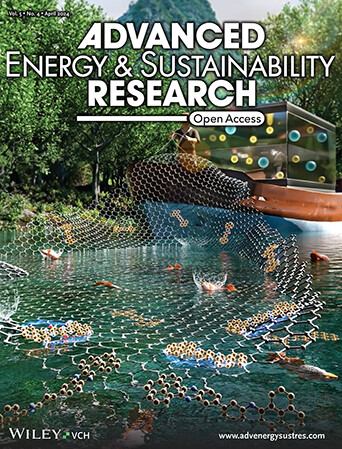
Aqueous processing of conventional Ni-rich layered oxide cathodes (here LiNi0.83Co0.12Mn0.05O2, NCM) can be a sustainable alternative to conventional organic solvent-based processing. However, the LiOH-based native surface layer of NCM dissolves in water and increases pH of the electrode paste, which can cause Al corrosion after slurry coating on the current collector. In contrast, a decreased pH via, e.g., acid addition increases risk of NCM dissolution. Here, this dilemma is partly circumvented via a decreased acid exposure, i.e., by adding H2SO4 directly before the slurry coating, which also yields the literature-known Li2SO4 surface layer on final NCM. The mechanism of this beneficial measure is further investigated by systematically varying the cations of the sulfates as slurry additives. Without these processing additives, the recrystallization of LiOH in course of drying is concluded to deposit as inhomogeneous agglomerates, which increases content of detrimental crystal water. The addition of Li2SO4, Na2SO4, or MgSO4 as slurry additives—contrary to sulfates with, e.g., Ni2+, Co2+, Mn2+, Al3+—are shown to suppress the detrimental LiOH agglomerates as these cations are better soluble with OH− and can effectively interfere with the detrimental LiOH recrystallization process in the final, i.e., almost solvent-free, drying stage within the cathode composite.
期刊介绍:
Advanced Energy and Sustainability Research is an open access academic journal that focuses on publishing high-quality peer-reviewed research articles in the areas of energy harvesting, conversion, storage, distribution, applications, ecology, climate change, water and environmental sciences, and related societal impacts. The journal provides readers with free access to influential scientific research that has undergone rigorous peer review, a common feature of all journals in the Advanced series. In addition to original research articles, the journal publishes opinion, editorial and review articles designed to meet the needs of a broad readership interested in energy and sustainability science and related fields.
In addition, Advanced Energy and Sustainability Research is indexed in several abstracting and indexing services, including:
CAS: Chemical Abstracts Service (ACS)
Directory of Open Access Journals (DOAJ)
Emerging Sources Citation Index (Clarivate Analytics)
INSPEC (IET)
Web of Science (Clarivate Analytics).

 求助内容:
 应助结果提醒方式:


 京公网安备 11010802042870号


