
Self-organizing human dual neural organoids model regional disease defects and teratogenicity

IF 9.2 1区 生物学 Q1 CELL BIOLOGY
Xiaoxiang Lu,Siyuan Chu,Jianfeng Wei,Jinkui Zhu,Wei Zhou,Yantong Liu,Xurui Feng,Xinrui Zhang,Mengqian Wang,Mingjuan Li,Jie Gao,Linlin Jiang,Wei Pang,Yao Yin,Ziling Chen,Yajing Cao,Qinzhi Zhang,Sisi Chen,Shaojie Ma,Yangfei Xiang
{"title":"Self-organizing human dual neural organoids model regional disease defects and teratogenicity","authors":"Xiaoxiang Lu,Siyuan Chu,Jianfeng Wei,Jinkui Zhu,Wei Zhou,Yantong Liu,Xurui Feng,Xinrui Zhang,Mengqian Wang,Mingjuan Li,Jie Gao,Linlin Jiang,Wei Pang,Yao Yin,Ziling Chen,Yajing Cao,Qinzhi Zhang,Sisi Chen,Shaojie Ma,Yangfei Xiang","doi":"10.1016/j.devcel.2026.08.013","DOIUrl":null,"url":null,"abstract":"The human nervous system emerges during early embryogenesis through coordinated, self-organizing differentiation of peripheral and central lineages. A key event in this process is the emergence of neural crest from the dorsal neural tube, which gives rise to major peripheral nervous system (PNS) structures. However, current in vitro models face challenges in recapitulating this process, limiting mechanistic insights into human central-peripheral neurogenesis. Here, we report a method for generating human peripheral-central dual neural organoids (hPCOs), a self-organizing organoid system that recapitulates the co-development of peripheral sensory ganglia and dorsal spinal cord. Using hPCOs, we uncover an unexpected bidirectional role of Wnt signaling in orchestrating peripheral and central fate determination. Modeling with hPCOs reveals nociceptor defects in human congenital insensitivity to pain. Furthermore, integrating hPCOs with image analysis enables the visual assessment of teratogenic risks. Together, hPCOs provide a physiologically relevant platform for investigating human self-organized central nervous system (CNS)-PNS co-development, disease mechanisms, and drug discovery.","PeriodicalId":11157,"journal":{"name":"Developmental cell","volume":"22 1","pages":""},"PeriodicalIF":9.2000,"publicationDate":"2026-09-18","publicationTypes":"Journal Article","fieldsOfStudy":null,"isOpenAccess":false,"openAccessPdf":"","citationCount":"0","resultStr":null,"platform":"Semanticscholar","paperid":null,"PeriodicalName":"Developmental cell","FirstCategoryId":"99","ListUrlMain":"https://doi.org/10.1016/j.devcel.2026.08.013","RegionNum":1,"RegionCategory":"生物学","ArticlePicture":[],"TitleCN":null,"AbstractTextCN":null,"PMCID":null,"EPubDate":"","PubModel":"","JCR":"Q1","JCRName":"CELL BIOLOGY","Score":null,"Total":0}
引用次数: 0

Abstract

The human nervous system emerges during early embryogenesis through coordinated, self-organizing differentiation of peripheral and central lineages. A key event in this process is the emergence of neural crest from the dorsal neural tube, which gives rise to major peripheral nervous system (PNS) structures. However, current in vitro models face challenges in recapitulating this process, limiting mechanistic insights into human central-peripheral neurogenesis. Here, we report a method for generating human peripheral-central dual neural organoids (hPCOs), a self-organizing organoid system that recapitulates the co-development of peripheral sensory ganglia and dorsal spinal cord. Using hPCOs, we uncover an unexpected bidirectional role of Wnt signaling in orchestrating peripheral and central fate determination. Modeling with hPCOs reveals nociceptor defects in human congenital insensitivity to pain. Furthermore, integrating hPCOs with image analysis enables the visual assessment of teratogenic risks. Together, hPCOs provide a physiologically relevant platform for investigating human self-organized central nervous system (CNS)-PNS co-development, disease mechanisms, and drug discovery.

Abstract Image

自组织人类双神经类器官模型区域疾病缺陷和致畸性
人类神经系统在胚胎发生早期通过外周和中枢谱系的协调、自组织分化而形成。这个过程中的一个关键事件是神经嵴从背神经管出现,它产生了主要的周围神经系统(PNS)结构。然而,目前的体外模型在概括这一过程方面面临挑战,限制了对人类中枢-周围神经发生的机制见解。在这里,我们报告了一种生成人类外周-中枢双神经类器官(hPCOs)的方法,这是一种自我组织的类器官系统,概括了外周感觉神经节和背脊髓的共同发育。利用hpco,我们发现了Wnt信号在协调外周和中枢命运决定中的意想不到的双向作用。hPCOs模型揭示了人类先天性疼痛不敏感的伤害感受器缺陷。此外,将hpco与图像分析相结合,可以对致畸风险进行视觉评估。总之,hPCOs为研究人类自组织中枢神经系统(CNS)-PNS的共同发育、疾病机制和药物发现提供了一个生理学相关的平台。
本文章由计算机程序翻译,如有差异,请以英文原文为准。
求助全文
约1分钟内获得全文 求助全文
来源期刊
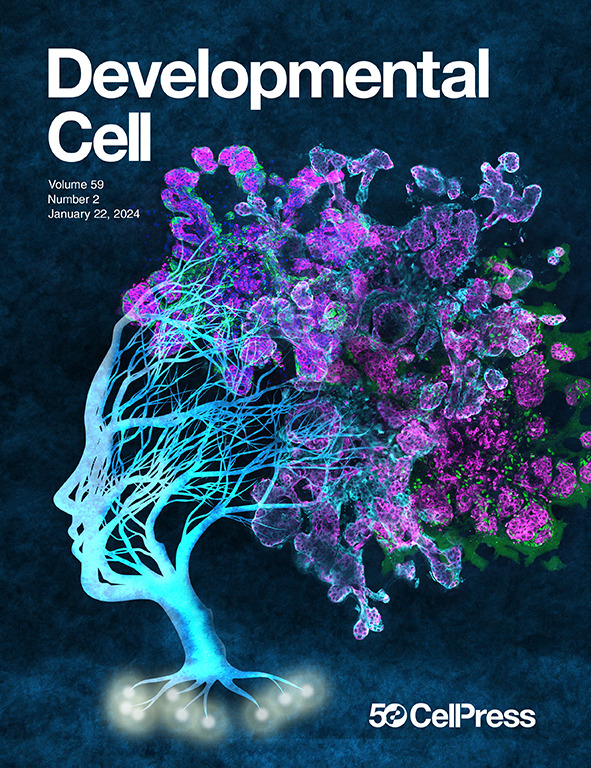
Developmental cell
Developmental cell 生物-发育生物学
CiteScore
18.90
自引率
1.70%
发文量
203
审稿时长
3-6 weeks
期刊介绍: Developmental Cell, established in 2001, is a comprehensive journal that explores a wide range of topics in cell and developmental biology. Our publication encompasses work across various disciplines within biology, with a particular emphasis on investigating the intersections between cell biology, developmental biology, and other related fields. Our primary objective is to present research conducted through a cell biological perspective, addressing the essential mechanisms governing cell function, cellular interactions, and responses to the environment. Moreover, we focus on understanding the collective behavior of cells, culminating in the formation of tissues, organs, and whole organisms, while also investigating the consequences of any malfunctions in these intricate processes.

×
引用
GB/T 7714-2015
复制
MLA
复制
APA
复制
导出至
BibTeX EndNote RefMan NoteFirst NoteExpress
×
提示
您的信息不完整,为了账户安全,请先补充。
现在去补充
×
提示
您因"违规操作"
具体请查看互助需知
我知道了
×
提示
确定
请完成安全验证×
copy
已复制链接
快去分享给好友吧!
我知道了
右上角分享
点击右上角分享
0
联系我们:info@booksci.cn Book学术提供免费学术资源搜索服务,方便国内外学者检索中英文文献。致力于提供最便捷和优质的服务体验。 Copyright © 2023 布克学术 All rights reserved.
京ICP备2023020795号-1
ghs 京公网安备 11010802042870号
Book学术文献互助
Book学术文献互助群
群 号:604180095
Book学术官方微信
小红书


