Mekala Sundaram, Nicole L Gottdenker, Patrick R Stephens
{"title":"Where is the elusive primary <i>ebolavirus</i> reservoir and how do we find It?","authors":"Mekala Sundaram, Nicole L Gottdenker, Patrick R Stephens","doi":"10.1093/biosci/biaf050","DOIUrl":null,"url":null,"abstract":"<p><p>An enduring mystery in <i>Ebolavirus</i> research is what host species maintain the virus in the wild. Despite the efforts of multiple research groups over decades, no primary reservoir has ever been identified. To the contrary, finding any evidence of infections in wild mammal populations is exceedingly rare. This is puzzling, given the wide range of species that ebolaviruses infect in laboratory and natural settings. We describe epidemiological, ecological, and immunological factors that have likely stymied the efforts of previous workers. We synthesize observations about host life history and seasonal variation in a key resource to provide recommendations for the geographic locations, species, and sampling regimes likely to prove most profitable for future sampling efforts. Our work also illustrates how a One Health perspective, which considers the dynamics of both wild animal hosts and the environments in which they are embedded, can lend clarity to otherwise seemingly intractable epidemiological problems.</p>","PeriodicalId":9003,"journal":{"name":"BioScience","volume":" ","pages":"biaf050"},"PeriodicalIF":9.5000,"publicationDate":"2025-04-21","publicationTypes":"Journal Article","fieldsOfStudy":null,"isOpenAccess":false,"openAccessPdf":"https://www.ncbi.nlm.nih.gov/pmc/articles/PMC13580389/pdf/","citationCount":"0","resultStr":null,"platform":"Semanticscholar","paperid":null,"PeriodicalName":"BioScience","FirstCategoryId":"99","ListUrlMain":"https://doi.org/10.1093/biosci/biaf050","RegionNum":1,"RegionCategory":"生物学","ArticlePicture":[],"TitleCN":null,"AbstractTextCN":null,"PMCID":null,"EPubDate":"","PubModel":"","JCR":"Q1","JCRName":"BIOLOGY","Score":null,"Total":0}
引用次数: 0
Abstract
An enduring mystery in Ebolavirus research is what host species maintain the virus in the wild. Despite the efforts of multiple research groups over decades, no primary reservoir has ever been identified. To the contrary, finding any evidence of infections in wild mammal populations is exceedingly rare. This is puzzling, given the wide range of species that ebolaviruses infect in laboratory and natural settings. We describe epidemiological, ecological, and immunological factors that have likely stymied the efforts of previous workers. We synthesize observations about host life history and seasonal variation in a key resource to provide recommendations for the geographic locations, species, and sampling regimes likely to prove most profitable for future sampling efforts. Our work also illustrates how a One Health perspective, which considers the dynamics of both wild animal hosts and the environments in which they are embedded, can lend clarity to otherwise seemingly intractable epidemiological problems.
期刊介绍:
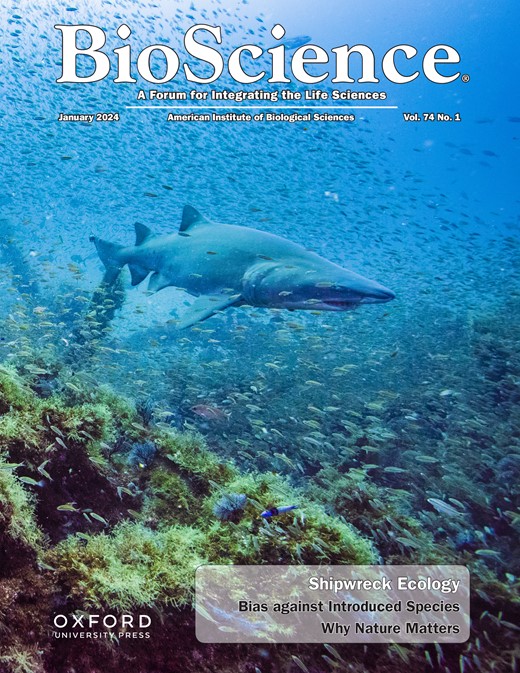
BioScience is a monthly journal that has been in publication since 1964. It provides readers with authoritative and current overviews of biological research. The journal is peer-reviewed and heavily cited, making it a reliable source for researchers, educators, and students. In addition to research articles, BioScience also covers topics such as biology education, public policy, history, and the fundamental principles of the biological sciences. This makes the content accessible to a wide range of readers. The journal includes professionally written feature articles that explore the latest advancements in biology. It also features discussions on professional issues, book reviews, news about the American Institute of Biological Sciences (AIBS), and columns on policy (Washington Watch) and education (Eye on Education).

 求助内容:
 应助结果提醒方式:


 京公网安备 11010802042870号


