Renae Wilkinson, Richard Cowden, Howard Koh, Jack Tsai
{"title":"Housing-related payment hardship and associations with health and well-being: a 15-year longitudinal study in a National Sample of U.S. adults.","authors":"Renae Wilkinson, Richard Cowden, Howard Koh, Jack Tsai","doi":"10.1093/aje/kwag231","DOIUrl":null,"url":null,"abstract":"<p><p>Many U.S. households face growing difficulty affording housing and related costs, with some missing payments for housing or utilities due to limited resources. Sparse research has examined how housing-related payment hardship relates to well-being over the life course. We used three waves of the National Longitudinal Study of Adolescent to Adult Health (Add Health; n = 7673) to estimate associations of two housing-related payment hardship exposures (inability to pay rent/mortgage and utilities) in early adulthood (Wave IV; 2008-2009) with 36 health and well-being outcomes 15 years later (Wave VI; 2022-2025). We used an outcome-wide analytic approach, adjusting for sociodemographic characteristics and prior values of outcomes and exposures (Wave III; 2001-2002). Results after Bonferroni correction indicated both exposures were associated with worse outcomes in physical health (eg, self-rated health), health behavior (eg, smoking), psychological distress (eg, anxiety), psychological well-being (eg, life evaluation), social distress (eg, discrimination), and socioeconomic factors (eg, financial distress). Associations with social well-being and prosocial outcomes were weaker. Our findings strengthen evidence that housing-related payment hardship is both an economic and public health concern. Policies and interventions that reduce housing payment difficulties in early adulthood before severe instability or homelessness emerges may promote longer-term health, well-being, and socioeconomic stability.</p>","PeriodicalId":7472,"journal":{"name":"American journal of epidemiology","volume":" ","pages":""},"PeriodicalIF":4.1000,"publicationDate":"2026-09-18","publicationTypes":"Journal Article","fieldsOfStudy":null,"isOpenAccess":false,"openAccessPdf":"","citationCount":"0","resultStr":null,"platform":"Semanticscholar","paperid":null,"PeriodicalName":"American journal of epidemiology","FirstCategoryId":"3","ListUrlMain":"https://doi.org/10.1093/aje/kwag231","RegionNum":2,"RegionCategory":"医学","ArticlePicture":[],"TitleCN":null,"AbstractTextCN":null,"PMCID":null,"EPubDate":"","PubModel":"","JCR":"Q1","JCRName":"PUBLIC, ENVIRONMENTAL & OCCUPATIONAL HEALTH","Score":null,"Total":0}
引用次数: 0
Abstract
Many U.S. households face growing difficulty affording housing and related costs, with some missing payments for housing or utilities due to limited resources. Sparse research has examined how housing-related payment hardship relates to well-being over the life course. We used three waves of the National Longitudinal Study of Adolescent to Adult Health (Add Health; n = 7673) to estimate associations of two housing-related payment hardship exposures (inability to pay rent/mortgage and utilities) in early adulthood (Wave IV; 2008-2009) with 36 health and well-being outcomes 15 years later (Wave VI; 2022-2025). We used an outcome-wide analytic approach, adjusting for sociodemographic characteristics and prior values of outcomes and exposures (Wave III; 2001-2002). Results after Bonferroni correction indicated both exposures were associated with worse outcomes in physical health (eg, self-rated health), health behavior (eg, smoking), psychological distress (eg, anxiety), psychological well-being (eg, life evaluation), social distress (eg, discrimination), and socioeconomic factors (eg, financial distress). Associations with social well-being and prosocial outcomes were weaker. Our findings strengthen evidence that housing-related payment hardship is both an economic and public health concern. Policies and interventions that reduce housing payment difficulties in early adulthood before severe instability or homelessness emerges may promote longer-term health, well-being, and socioeconomic stability.
期刊介绍:
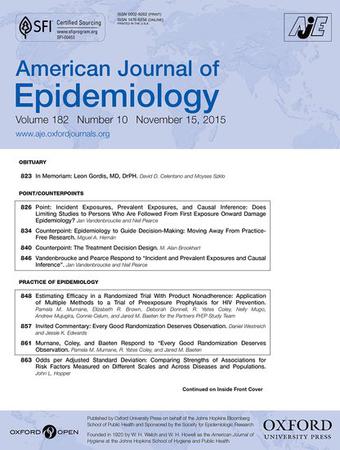
The American Journal of Epidemiology is the oldest and one of the premier epidemiologic journals devoted to the publication of empirical research findings, opinion pieces, and methodological developments in the field of epidemiologic research.
It is a peer-reviewed journal aimed at both fellow epidemiologists and those who use epidemiologic data, including public health workers and clinicians.

 求助内容:
 应助结果提醒方式:


 京公网安备 11010802042870号


