Jun-Yu Li, Fu-Qi Mi, Jiang-Jie Zhang, Tao Huang, Zi-Yi Guo, Qiao Yao, Liang-Liang Yan, Teng Zhang
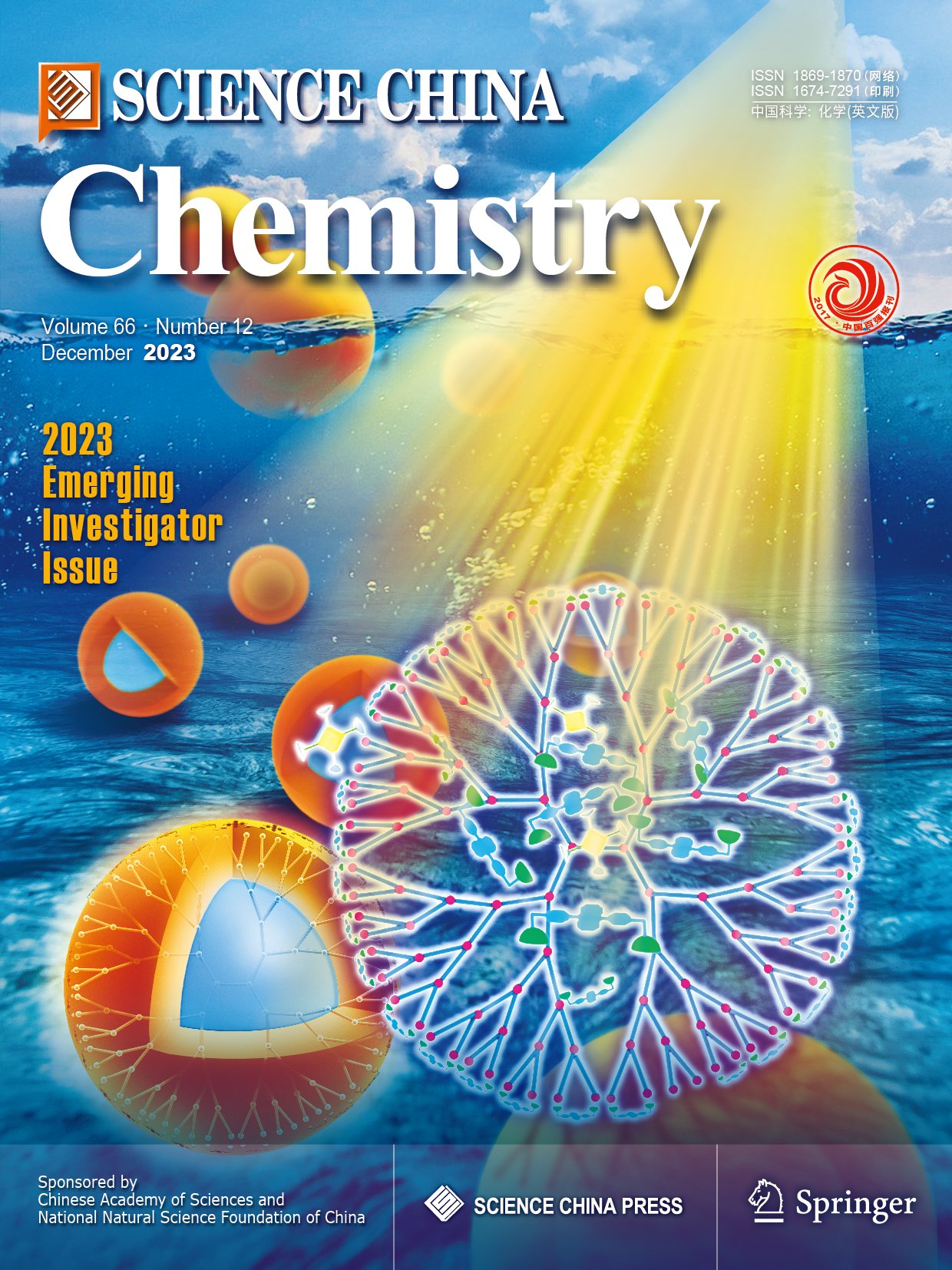
{"title":"Binuclear copper catalytic sites confined in a metal-organic framework for monooxygenase-mimetic C(sp3)–H oxidation","authors":"Jun-Yu Li, Fu-Qi Mi, Jiang-Jie Zhang, Tao Huang, Zi-Yi Guo, Qiao Yao, Liang-Liang Yan, Teng Zhang","doi":"10.1007/s11426-026-3415-4","DOIUrl":null,"url":null,"abstract":"<div><p>The ultimate catalytic activity of metalloenzymes relies on both primary and secondary coordination spheres of the active site, which is hard to mimic in synthetic catalytic systems. Introduction of flexible tetramethylethylenediamine (TMEDA) side chains to a UiO-67 metal-organic framework (MOF) enables the installation of non-covalently interacted, self-adaptive binuclear copper sites that synergistically activate O<sub>2</sub>, and the confined MOF pore space rich in aromatic functionalities engages organic substrates through multiple non-covalent interactions. Taking advantage of both structural features, the resulting UiO-67-TMEDA-Cu catalyst replicates the catalytic pocket of methane monooxygenase and drives aerobic C(sp<sup>3</sup>)–H oxidation under mild, additive-free conditions, exhibiting activity significantly surpassing that of its mononuclear analog and a homogeneous binuclear control catalyst lacking spatial confinement. Kinetic studies and theoretical calculations revealed that the binuclear copper pair catalyst exhibited higher activity than its mononuclear counterpart by lowering the energy demands of O–O bond cleavage and hydrogen atom abstraction, while the MOF cavity further reduces the binding energy between organic substrates and Cu<sub>2</sub> sites. This work thus demonstrates the great potential of engineering non-covalently interacted, synergistic metal pairs within MOFs to achieve enzyme-like selectivity and activity for advanced catalytic transformations.</p><div><figure><div><div><picture><source><img></source></picture></div></div></figure></div></div>","PeriodicalId":772,"journal":{"name":"Science China Chemistry","volume":"69 9","pages":"5095 - 5102"},"PeriodicalIF":9.8000,"publicationDate":"2026-07-24","publicationTypes":"Journal Article","fieldsOfStudy":null,"isOpenAccess":false,"openAccessPdf":"","citationCount":"0","resultStr":null,"platform":"Semanticscholar","paperid":null,"PeriodicalName":"Science China Chemistry","FirstCategoryId":"1","ListUrlMain":"https://link.springer.com/article/10.1007/s11426-026-3415-4","RegionNum":1,"RegionCategory":"化学","ArticlePicture":[],"TitleCN":null,"AbstractTextCN":null,"PMCID":null,"EPubDate":"","PubModel":"","JCR":"Q1","JCRName":"CHEMISTRY, MULTIDISCIPLINARY","Score":null,"Total":0}
引用次数: 0
Abstract
The ultimate catalytic activity of metalloenzymes relies on both primary and secondary coordination spheres of the active site, which is hard to mimic in synthetic catalytic systems. Introduction of flexible tetramethylethylenediamine (TMEDA) side chains to a UiO-67 metal-organic framework (MOF) enables the installation of non-covalently interacted, self-adaptive binuclear copper sites that synergistically activate O2, and the confined MOF pore space rich in aromatic functionalities engages organic substrates through multiple non-covalent interactions. Taking advantage of both structural features, the resulting UiO-67-TMEDA-Cu catalyst replicates the catalytic pocket of methane monooxygenase and drives aerobic C(sp3)–H oxidation under mild, additive-free conditions, exhibiting activity significantly surpassing that of its mononuclear analog and a homogeneous binuclear control catalyst lacking spatial confinement. Kinetic studies and theoretical calculations revealed that the binuclear copper pair catalyst exhibited higher activity than its mononuclear counterpart by lowering the energy demands of O–O bond cleavage and hydrogen atom abstraction, while the MOF cavity further reduces the binding energy between organic substrates and Cu2 sites. This work thus demonstrates the great potential of engineering non-covalently interacted, synergistic metal pairs within MOFs to achieve enzyme-like selectivity and activity for advanced catalytic transformations.
期刊介绍:
Science China Chemistry, co-sponsored by the Chinese Academy of Sciences and the National Natural Science Foundation of China and published by Science China Press, publishes high-quality original research in both basic and applied chemistry. Indexed by Science Citation Index, it is a premier academic journal in the field.
Categories of articles include:
Highlights. Brief summaries and scholarly comments on recent research achievements in any field of chemistry.
Perspectives. Concise reports on thelatest chemistry trends of interest to scientists worldwide, including discussions of research breakthroughs and interpretations of important science and funding policies.
Reviews. In-depth summaries of representative results and achievements of the past 5–10 years in selected topics based on or closely related to the research expertise of the authors, providing a thorough assessment of the significance, current status, and future research directions of the field.

 求助内容:
 应助结果提醒方式:


 京公网安备 11010802042870号


