
Data‐Driven Discovery of MOF–Polymer Synergies Enabling High‐Performance Solid‐State Sodium Batteries

IF 29.1 1区 材料科学 Q1 CHEMISTRY, MULTIDISCIPLINARY
Si Zhao, Yiwei Lv, Lituo Zheng, Luzhuo Chen, Bing Lin, Mingdeng Wei, Sanjay Mathur, Zhensheng Hong
{"title":"Data‐Driven Discovery of MOF–Polymer Synergies Enabling High‐Performance Solid‐State Sodium Batteries","authors":"Si Zhao, Yiwei Lv, Lituo Zheng, Luzhuo Chen, Bing Lin, Mingdeng Wei, Sanjay Mathur, Zhensheng Hong","doi":"10.1002/adma.75031","DOIUrl":null,"url":null,"abstract":"Solid‐state batteries (SSBs) are widely regarded as a promising next‐generation energy storage technology owing to their intrinsic safety and high energy density. Solid polymer electrolytes (SPEs) have been esteemed as a cost‐effective route to realize commercial SSBs, however, it's hindered by the low ionic conductivity at room temperature. Here, we present a data‐driven strategy to screen a broad library of M‐MOF‐74 structures and identify Zn‐MOF‐74 as an optimal filler for poly(vinylidene difluoride)‐based electrolytes after comprehensive structure‐conductivity correlation analysis and performance prediction. The SPE‐Zn‐MOF electrolyte achieves an ionic conductivity of 1.02 × 10 <jats:sup>−3</jats:sup> S cm <jats:sup>−1</jats:sup> at room temperature and a high Na <jats:sup>+</jats:sup> transference number (t <jats:sub>Na+</jats:sub> ) of 0.84. Various structural characterizations reveal that Zn‐MOF‐74 suppresses the formation of PVDF microcrystallinity and anomalously inhibits the re‐crystallinity of polymer during cycling, which also promotes anion dissociation through Lewis‐acidic metal sites and the formation of NaF‐rich interphase. These synergies extend the electrochemical stability window up to 5.1 V and support prolonged cycling stability beyond 4000 h in Na||Na cells. When integrated with layered oxide or Na <jats:sub>3</jats:sub> V <jats:sub>2</jats:sub> (PO <jats:sub>4</jats:sub> ) <jats:sub>3</jats:sub> cathodes, the optimized SPE enables both full cells achieving superior cycling stability and excellent rate capability at room temperature.","PeriodicalId":114,"journal":{"name":"Advanced Materials","volume":"47 1","pages":""},"PeriodicalIF":29.1000,"publicationDate":"2026-09-17","publicationTypes":"Journal Article","fieldsOfStudy":null,"isOpenAccess":false,"openAccessPdf":"","citationCount":"0","resultStr":null,"platform":"Semanticscholar","paperid":null,"PeriodicalName":"Advanced Materials","FirstCategoryId":"88","ListUrlMain":"https://doi.org/10.1002/adma.75031","RegionNum":1,"RegionCategory":"材料科学","ArticlePicture":[],"TitleCN":null,"AbstractTextCN":null,"PMCID":null,"EPubDate":"","PubModel":"","JCR":"Q1","JCRName":"CHEMISTRY, MULTIDISCIPLINARY","Score":null,"Total":0}
引用次数: 0

Abstract

Solid‐state batteries (SSBs) are widely regarded as a promising next‐generation energy storage technology owing to their intrinsic safety and high energy density. Solid polymer electrolytes (SPEs) have been esteemed as a cost‐effective route to realize commercial SSBs, however, it's hindered by the low ionic conductivity at room temperature. Here, we present a data‐driven strategy to screen a broad library of M‐MOF‐74 structures and identify Zn‐MOF‐74 as an optimal filler for poly(vinylidene difluoride)‐based electrolytes after comprehensive structure‐conductivity correlation analysis and performance prediction. The SPE‐Zn‐MOF electrolyte achieves an ionic conductivity of 1.02 × 10 −3 S cm −1 at room temperature and a high Na + transference number (t Na+ ) of 0.84. Various structural characterizations reveal that Zn‐MOF‐74 suppresses the formation of PVDF microcrystallinity and anomalously inhibits the re‐crystallinity of polymer during cycling, which also promotes anion dissociation through Lewis‐acidic metal sites and the formation of NaF‐rich interphase. These synergies extend the electrochemical stability window up to 5.1 V and support prolonged cycling stability beyond 4000 h in Na||Na cells. When integrated with layered oxide or Na 3 V 2 (PO 4 ) 3 cathodes, the optimized SPE enables both full cells achieving superior cycling stability and excellent rate capability at room temperature.
mof -聚合物协同作用的数据驱动发现,可实现高性能固态钠电池
固态电池(SSBs)由于其固有的安全性和高能量密度而被广泛认为是一种有前途的新一代储能技术。固体聚合物电解质(spe)一直被认为是实现商用固态电池的一种经济有效的途径,然而,它受到室温下低离子电导率的阻碍。在这里,我们提出了一种数据驱动的策略来筛选M‐MOF‐74结构的广泛库,并通过综合的结构-电导率相关性分析和性能预测,确定Zn‐MOF‐74是聚偏二氟乙烯基电解质的最佳填料。在室温下,SPE - Zn - MOF电解质的离子电导率为1.02 × 10⁻³ S cm−1,Na+转移数(t Na+)为0.84。各种结构表征表明,Zn - MOF - 74抑制PVDF微结晶度的形成,并在循环过程中异常抑制聚合物的再结晶度,这也促进了阴离子通过刘易斯酸性金属位点解离和富NaF间相的形成。这些协同作用将电化学稳定性窗口扩展到5.1 V,并支持在Na||Na电池中超过4000 h的长周期稳定性。当与层状氧化物或na3v2 (po4) 3阴极集成时,优化后的SPE使全电池在室温下具有优异的循环稳定性和出色的倍率能力。
本文章由计算机程序翻译,如有差异,请以英文原文为准。
求助全文
约1分钟内获得全文 求助全文
来源期刊
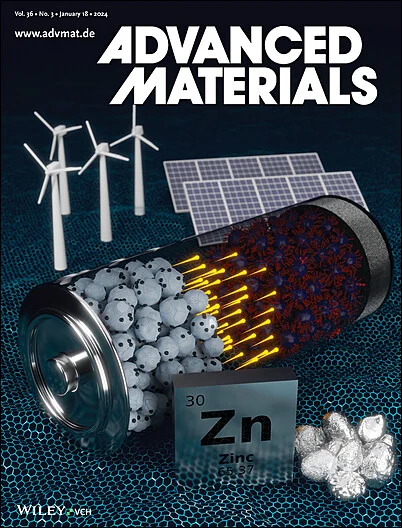
Advanced Materials
Advanced Materials 工程技术-材料科学:综合
CiteScore
43.00
自引率
4.10%
发文量
2182
审稿时长
2 months
期刊介绍: Advanced Materials, one of the world's most prestigious journals and the foundation of the Advanced portfolio, is the home of choice for best-in-class materials science for more than 30 years. Following this fast-growing and interdisciplinary field, we are considering and publishing the most important discoveries on any and all materials from materials scientists, chemists, physicists, engineers as well as health and life scientists and bringing you the latest results and trends in modern materials-related research every week.

×
引用
GB/T 7714-2015
复制
MLA
复制
APA
复制
导出至
BibTeX EndNote RefMan NoteFirst NoteExpress
×
提示
您的信息不完整,为了账户安全,请先补充。
现在去补充
×
提示
您因"违规操作"
具体请查看互助需知
我知道了
×
提示
确定
请完成安全验证×
copy
已复制链接
快去分享给好友吧!
我知道了
右上角分享
点击右上角分享
0
联系我们:info@booksci.cn Book学术提供免费学术资源搜索服务,方便国内外学者检索中英文文献。致力于提供最便捷和优质的服务体验。 Copyright © 2023 布克学术 All rights reserved.
京ICP备2023020795号-1
ghs 京公网安备 11010802042870号
Book学术文献互助
Book学术文献互助群
群 号:604180095
Book学术官方微信
小红书


