Anthony Valero, Julien Barbe, Elisa Alves Silva, Artenis Bendo, Patrick Grysan, Adrian M. Philippe, Julien Bardon, Emanuele Barborini, Guillaume Lamblin
{"title":"High-Surface-Area Carbon Nanotubes-Copper Composite Foils for Lighter Advanced Anodic Current Collector for Lithium-Ion Batteries","authors":"Anthony Valero, Julien Barbe, Elisa Alves Silva, Artenis Bendo, Patrick Grysan, Adrian M. Philippe, Julien Bardon, Emanuele Barborini, Guillaume Lamblin","doi":"10.1002/aesr.70253","DOIUrl":null,"url":null,"abstract":"<p>While playing a pivotal role in battery performance, affecting energy density, cycling life, and safety, the anodic current collector of lithium-ion batteries (LIBs) is largely overlooked in the literature. Copper, the dominant material for anode current collectors, contributes to approximately 8.1% of the battery weight yet does not participate in energy storage, limiting overall energy density. Reducing weight and thickness of copper foils optimizes the gravimetric energy density of LIBs, but challenges in processability hinder the production of thinner foils. This study presents a novel fabrication method to integrate multi-walled carbon nanotubes (MWCNTs) inside copper to potentially develop a lightweight, thin, and efficient current collector. The composite is fabricated by coating MWCNTs with polydopamine (PDA), spray-depositing onto an industrial support layer, and infilling the porous nanostructure via copper electroplating. This process enables the production of composite foils with surface areas up to 400 cm<sup>2</sup>—potentially addressing industry needs for scalable, high-performance current collectors—and achieves a thickness of 4.5 µm and density of 6.4 g cm<sup>−3</sup>. Moreover, electrochemical performance of the material as anode current collector in half-cell battery architecture showed improvements in gravimetric capacity of up to 7.3%, with stable cycling and efficiency.</p>","PeriodicalId":29794,"journal":{"name":"Advanced Energy and Sustainability Research","volume":"7 9","pages":""},"PeriodicalIF":6.4000,"publicationDate":"2026-09-10","publicationTypes":"Journal Article","fieldsOfStudy":null,"isOpenAccess":false,"openAccessPdf":"https://onlinelibrary.wiley.com/doi/epdf/10.1002/aesr.70253","citationCount":"0","resultStr":null,"platform":"Semanticscholar","paperid":null,"PeriodicalName":"Advanced Energy and Sustainability Research","FirstCategoryId":"1085","ListUrlMain":"https://onlinelibrary.wiley.com/doi/10.1002/aesr.70253","RegionNum":0,"RegionCategory":null,"ArticlePicture":[],"TitleCN":null,"AbstractTextCN":null,"PMCID":null,"EPubDate":"","PubModel":"","JCR":"Q2","JCRName":"ENERGY & FUELS","Score":null,"Total":0}
引用次数: 0
Abstract
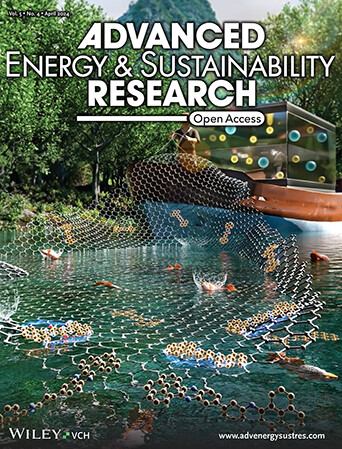
While playing a pivotal role in battery performance, affecting energy density, cycling life, and safety, the anodic current collector of lithium-ion batteries (LIBs) is largely overlooked in the literature. Copper, the dominant material for anode current collectors, contributes to approximately 8.1% of the battery weight yet does not participate in energy storage, limiting overall energy density. Reducing weight and thickness of copper foils optimizes the gravimetric energy density of LIBs, but challenges in processability hinder the production of thinner foils. This study presents a novel fabrication method to integrate multi-walled carbon nanotubes (MWCNTs) inside copper to potentially develop a lightweight, thin, and efficient current collector. The composite is fabricated by coating MWCNTs with polydopamine (PDA), spray-depositing onto an industrial support layer, and infilling the porous nanostructure via copper electroplating. This process enables the production of composite foils with surface areas up to 400 cm2—potentially addressing industry needs for scalable, high-performance current collectors—and achieves a thickness of 4.5 µm and density of 6.4 g cm−3. Moreover, electrochemical performance of the material as anode current collector in half-cell battery architecture showed improvements in gravimetric capacity of up to 7.3%, with stable cycling and efficiency.
期刊介绍:
Advanced Energy and Sustainability Research is an open access academic journal that focuses on publishing high-quality peer-reviewed research articles in the areas of energy harvesting, conversion, storage, distribution, applications, ecology, climate change, water and environmental sciences, and related societal impacts. The journal provides readers with free access to influential scientific research that has undergone rigorous peer review, a common feature of all journals in the Advanced series. In addition to original research articles, the journal publishes opinion, editorial and review articles designed to meet the needs of a broad readership interested in energy and sustainability science and related fields.
In addition, Advanced Energy and Sustainability Research is indexed in several abstracting and indexing services, including:
CAS: Chemical Abstracts Service (ACS)
Directory of Open Access Journals (DOAJ)
Emerging Sources Citation Index (Clarivate Analytics)
INSPEC (IET)
Web of Science (Clarivate Analytics).

 求助内容:
 应助结果提醒方式:


 京公网安备 11010802042870号


