V. Sathya, R. Jagatheesan, D. Gopi, C. Christopher, R. Nagalakshmi
{"title":"Carbon-Based Electrodes in Electro-Organic Synthesis: Materials, Applications, and Perspectives","authors":"V. Sathya, R. Jagatheesan, D. Gopi, C. Christopher, R. Nagalakshmi","doi":"10.1002/elan.70216","DOIUrl":null,"url":null,"abstract":"<p>Carbon-based electrodes are widely used in electro-organic synthesis due to their excellent conductivity, stability, and tunable surface properties. This review highlights the roles of glassy carbon, graphite, carbon felt, carbon nanotubes, and graphene in promoting key oxidative and reductive transformations. The influence of surface morphology, functionalization, and electron transfer kinetics on reaction efficiency and selectivity is discussed. Recent advances in C<span></span>H activation, cross-coupling, and functional group interconversions using carbon electrodes are summarized. The benefits of these materials for sustainable synthesis and scalable processes are emphasized, along with current challenges and future directions in electrode design.</p>","PeriodicalId":162,"journal":{"name":"Electroanalysis","volume":"38 9","pages":""},"PeriodicalIF":2.6000,"publicationDate":"2026-09-06","publicationTypes":"Journal Article","fieldsOfStudy":null,"isOpenAccess":false,"openAccessPdf":"","citationCount":"0","resultStr":null,"platform":"Semanticscholar","paperid":null,"PeriodicalName":"Electroanalysis","FirstCategoryId":"92","ListUrlMain":"https://onlinelibrary.wiley.com/doi/10.1002/elan.70216","RegionNum":3,"RegionCategory":"化学","ArticlePicture":[],"TitleCN":null,"AbstractTextCN":null,"PMCID":null,"EPubDate":"","PubModel":"","JCR":"Q2","JCRName":"CHEMISTRY, ANALYTICAL","Score":null,"Total":0}
引用次数: 0
Abstract
Carbon-based electrodes are widely used in electro-organic synthesis due to their excellent conductivity, stability, and tunable surface properties. This review highlights the roles of glassy carbon, graphite, carbon felt, carbon nanotubes, and graphene in promoting key oxidative and reductive transformations. The influence of surface morphology, functionalization, and electron transfer kinetics on reaction efficiency and selectivity is discussed. Recent advances in CH activation, cross-coupling, and functional group interconversions using carbon electrodes are summarized. The benefits of these materials for sustainable synthesis and scalable processes are emphasized, along with current challenges and future directions in electrode design.
期刊介绍:
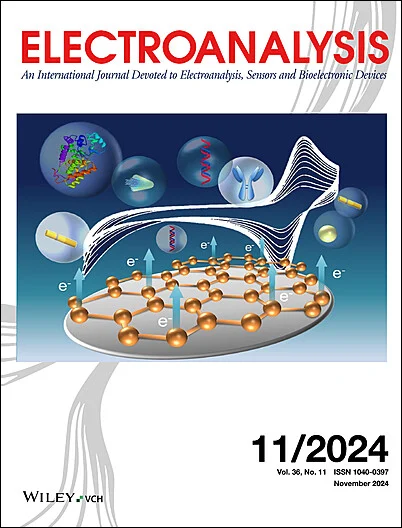
Electroanalysis is an international, peer-reviewed journal covering all branches of electroanalytical chemistry, including both fundamental and application papers as well as reviews dealing with new electrochemical sensors and biosensors, nanobioelectronics devices, analytical voltammetry, potentiometry, new electrochemical detection schemes based on novel nanomaterials, fuel cells and biofuel cells, and important practical applications.
Serving as a vital communication link between the research labs and the field, Electroanalysis helps you to quickly adapt the latest innovations into practical clinical, environmental, food analysis, industrial and energy-related applications. Electroanalysis provides the most comprehensive coverage of the field and is the number one source for information on electroanalytical chemistry, electrochemical sensors and biosensors and fuel/biofuel cells.

 求助内容:
 应助结果提醒方式:


 京公网安备 11010802042870号


