Sinmanus Vimonpatranon, Sydney K Mika, Alina P S Pang, Kawthar Machmach, Noemia S Lima, Sucheta Godbole, Chayada Sajjaweerawan, Elizabeth R Longtine, Amy R Henry, Farida Laboune, Ellie Metz, Nisakorn Ratnaratorn, Yuwadee Phuang-Ngern, Carlo Sacdalan, Julie A Ake, Barbara L Shacklett, Johan K Sandberg, Rungsun Rerknimitr, Nittaya Phanuphak, Sandhya Vasan, Daniel C Douek, Michael J Corley, Alexandra Schuetz, Dominic Paquin-Proulx
{"title":"Mucosal-associated invariant T cells respond to colonic microbiome alterations during acute HIV infection.","authors":"Sinmanus Vimonpatranon, Sydney K Mika, Alina P S Pang, Kawthar Machmach, Noemia S Lima, Sucheta Godbole, Chayada Sajjaweerawan, Elizabeth R Longtine, Amy R Henry, Farida Laboune, Ellie Metz, Nisakorn Ratnaratorn, Yuwadee Phuang-Ngern, Carlo Sacdalan, Julie A Ake, Barbara L Shacklett, Johan K Sandberg, Rungsun Rerknimitr, Nittaya Phanuphak, Sandhya Vasan, Daniel C Douek, Michael J Corley, Alexandra Schuetz, Dominic Paquin-Proulx","doi":"10.1016/j.mucimm.2026.100403","DOIUrl":null,"url":null,"abstract":"<p><p>Mucosal-associated invariant T (MAIT) cells are an unconventional subset of T cells that respond to vitamin B2 metabolites from a range of bacteria and fungi. We have previously reported that peripheral MAIT cells are activated during acute HIV infection (AHI) in a manner associated with markers of microbial translocation. Here, we characterized peripheral and colonic MAIT cells from people with HIV (PWH) during AHI and after ART initiated during AHI or chronic HIV infection (CHI) and investigated their interplay with the colonic microbiome. During AHI, both peripheral and colonic MAIT cells were activated and showed evidence of proliferation. MAIT cell activation in blood and colon were unrelated to viral load and to each other, suggesting compartmentalized responses. Colonic CD4 MAIT cells were reduced and their reduction was associated with viral load, suggesting a direct viral effect. In vitro experiments confirmed that CD4 MAIT cells are susceptible to HIV-1 infection. Finally, changes in colonic microbiome composition were evident already during AHI and were associated with peripheral blood MAIT cell activation and effector maturation. Thus, these findings indicate that viral replication and colonic microbiome perturbation are associated with distinct, compartment-specific components of the MAIT cell response during AHI.</p>","PeriodicalId":18877,"journal":{"name":"Mucosal Immunology","volume":" ","pages":"100403"},"PeriodicalIF":5.5000,"publicationDate":"2026-09-10","publicationTypes":"Journal Article","fieldsOfStudy":null,"isOpenAccess":false,"openAccessPdf":"https://www.ncbi.nlm.nih.gov/pmc/articles/PMC13647192/pdf/","citationCount":"0","resultStr":null,"platform":"Semanticscholar","paperid":null,"PeriodicalName":"Mucosal Immunology","FirstCategoryId":"3","ListUrlMain":"https://doi.org/10.1016/j.mucimm.2026.100403","RegionNum":2,"RegionCategory":"医学","ArticlePicture":[],"TitleCN":null,"AbstractTextCN":null,"PMCID":null,"EPubDate":"","PubModel":"","JCR":"Q1","JCRName":"IMMUNOLOGY","Score":null,"Total":0}
引用次数: 0
Abstract
Mucosal-associated invariant T (MAIT) cells are an unconventional subset of T cells that respond to vitamin B2 metabolites from a range of bacteria and fungi. We have previously reported that peripheral MAIT cells are activated during acute HIV infection (AHI) in a manner associated with markers of microbial translocation. Here, we characterized peripheral and colonic MAIT cells from people with HIV (PWH) during AHI and after ART initiated during AHI or chronic HIV infection (CHI) and investigated their interplay with the colonic microbiome. During AHI, both peripheral and colonic MAIT cells were activated and showed evidence of proliferation. MAIT cell activation in blood and colon were unrelated to viral load and to each other, suggesting compartmentalized responses. Colonic CD4 MAIT cells were reduced and their reduction was associated with viral load, suggesting a direct viral effect. In vitro experiments confirmed that CD4 MAIT cells are susceptible to HIV-1 infection. Finally, changes in colonic microbiome composition were evident already during AHI and were associated with peripheral blood MAIT cell activation and effector maturation. Thus, these findings indicate that viral replication and colonic microbiome perturbation are associated with distinct, compartment-specific components of the MAIT cell response during AHI.
期刊介绍:
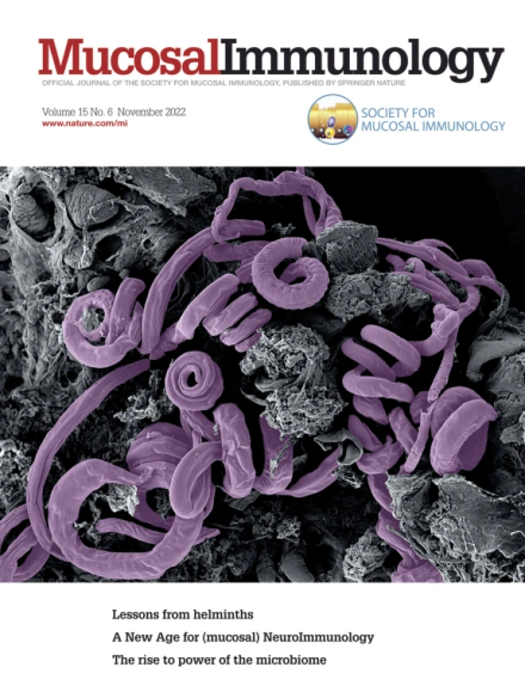
Mucosal Immunology, the official publication of the Society of Mucosal Immunology (SMI), serves as a forum for both basic and clinical scientists to discuss immunity and inflammation involving mucosal tissues. It covers gastrointestinal, pulmonary, nasopharyngeal, oral, ocular, and genitourinary immunology through original research articles, scholarly reviews, commentaries, editorials, and letters. The journal gives equal consideration to basic, translational, and clinical studies and also serves as a primary communication channel for the SMI governing board and its members, featuring society news, meeting announcements, policy discussions, and job/training opportunities advertisements.

 求助内容:
 应助结果提醒方式:


 京公网安备 11010802042870号


