Marizen R Ramirez, N Jeanie Santaularia Gomez, Andrew Ryan, Octav Chipara, Karen Heimer, Corinne Peek-Asa, Shelly Campo, Padmini Snirivasan, Bao Nhia Xiong, Alexis Grimes Trotter, Anthony Paik
{"title":"Multi-mode design for studying cyber aggression in texts, Facebook and Twitter messages among middle school youth.","authors":"Marizen R Ramirez, N Jeanie Santaularia Gomez, Andrew Ryan, Octav Chipara, Karen Heimer, Corinne Peek-Asa, Shelly Campo, Padmini Snirivasan, Bao Nhia Xiong, Alexis Grimes Trotter, Anthony Paik","doi":"10.1093/aje/kwag222","DOIUrl":null,"url":null,"abstract":"<p><p>With the explosion of the internet, cyber aggression has become one of the fastest growing forms of interpersonal violence. Methods used to understand aggressive communications content have been limited primarily to surveys. Here, we present multiple methods - panel surveys, electronic capture of social media, and Ecological Momentary Assessments - to characterize both behavioral and perceptual components of cyber aggression in a study of youth from two Iowa middle schools during the 2014-2015 school year. Youth completed a survey, and a sub-sample of smartphone owners installed an electronic application that collected over 150,000 text messages, Twitter posts, and Facebook posts. The sub-sample also participated in ecological momentary assessments to collect self-reported experiences of cyber aggression. To code for aggressive content in this large sample of messages, a case-control sampling strategy was used to identify a series of \"case\" messages from youth who reported aggression and \"control\" messages from youth who reported no aggression. We further present recruitment protocols, data management and qualitative coding methods as well as descriptive characteristics of the student cohort and nested sample of messages. These methods have potential use in future studies of \"big data\" captured from social media.</p>","PeriodicalId":7472,"journal":{"name":"American journal of epidemiology","volume":" ","pages":""},"PeriodicalIF":4.1000,"publicationDate":"2026-09-10","publicationTypes":"Journal Article","fieldsOfStudy":null,"isOpenAccess":false,"openAccessPdf":"","citationCount":"0","resultStr":null,"platform":"Semanticscholar","paperid":null,"PeriodicalName":"American journal of epidemiology","FirstCategoryId":"3","ListUrlMain":"https://doi.org/10.1093/aje/kwag222","RegionNum":2,"RegionCategory":"医学","ArticlePicture":[],"TitleCN":null,"AbstractTextCN":null,"PMCID":null,"EPubDate":"","PubModel":"","JCR":"Q1","JCRName":"PUBLIC, ENVIRONMENTAL & OCCUPATIONAL HEALTH","Score":null,"Total":0}
引用次数: 0
Abstract
With the explosion of the internet, cyber aggression has become one of the fastest growing forms of interpersonal violence. Methods used to understand aggressive communications content have been limited primarily to surveys. Here, we present multiple methods - panel surveys, electronic capture of social media, and Ecological Momentary Assessments - to characterize both behavioral and perceptual components of cyber aggression in a study of youth from two Iowa middle schools during the 2014-2015 school year. Youth completed a survey, and a sub-sample of smartphone owners installed an electronic application that collected over 150,000 text messages, Twitter posts, and Facebook posts. The sub-sample also participated in ecological momentary assessments to collect self-reported experiences of cyber aggression. To code for aggressive content in this large sample of messages, a case-control sampling strategy was used to identify a series of "case" messages from youth who reported aggression and "control" messages from youth who reported no aggression. We further present recruitment protocols, data management and qualitative coding methods as well as descriptive characteristics of the student cohort and nested sample of messages. These methods have potential use in future studies of "big data" captured from social media.
期刊介绍:
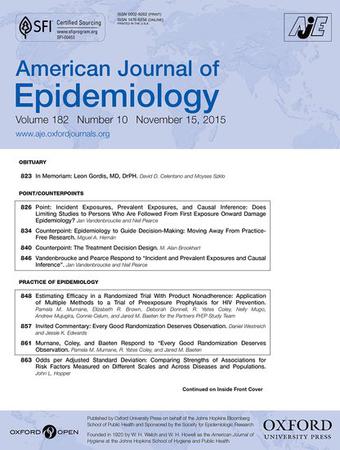
The American Journal of Epidemiology is the oldest and one of the premier epidemiologic journals devoted to the publication of empirical research findings, opinion pieces, and methodological developments in the field of epidemiologic research.
It is a peer-reviewed journal aimed at both fellow epidemiologists and those who use epidemiologic data, including public health workers and clinicians.

 求助内容:
 应助结果提醒方式:


 京公网安备 11010802042870号


