Hazem Elkady, Aisha A. Alsfouk, Eslam B. Elkaeed, Walid E. Elgammal, Hazem A. Mahdy, Ahmed Nofal, Ibrahim H. Eissa, Dalal Z. Husein, Fatma G. Amin, Ahmed M. Metwaly
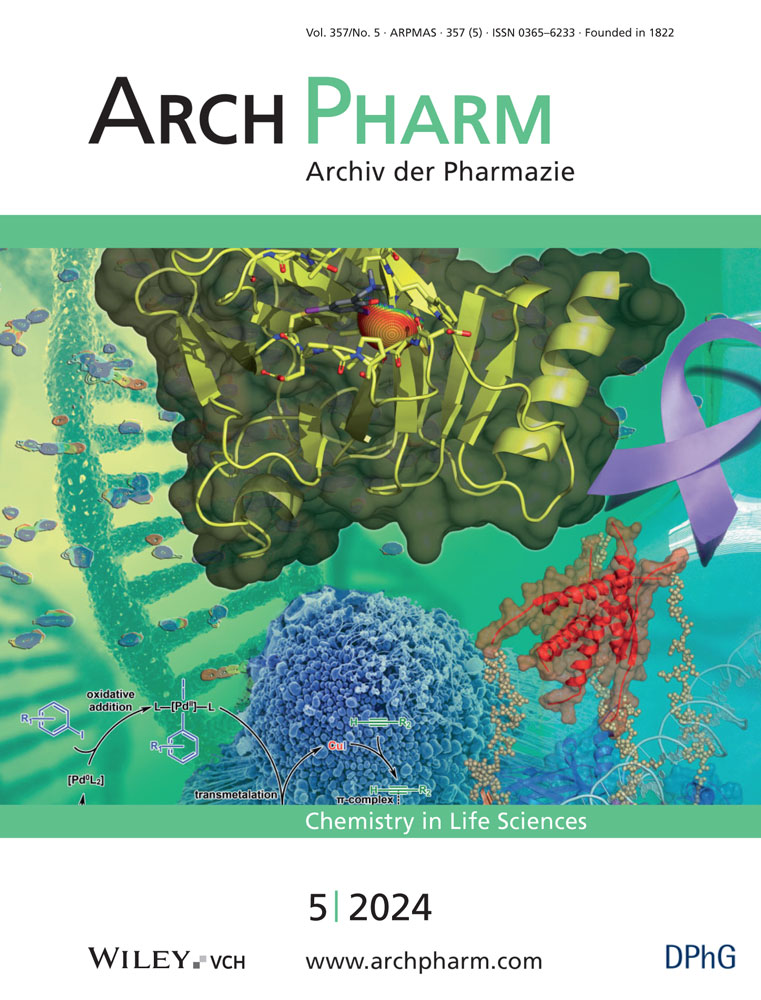
{"title":"New Chromene Derivatives as Promising VEGFR-2 Inhibitors: Experimental Cytotoxicity and Comprehensive Computational Characterization","authors":"Hazem Elkady, Aisha A. Alsfouk, Eslam B. Elkaeed, Walid E. Elgammal, Hazem A. Mahdy, Ahmed Nofal, Ibrahim H. Eissa, Dalal Z. Husein, Fatma G. Amin, Ahmed M. Metwaly","doi":"10.1002/ardp.70328","DOIUrl":null,"url":null,"abstract":"<div>\n \n <p>A new series of chromene derivatives (<b>12–19</b>) was rationally designed as potential inhibitors of vascular endothelial growth factor receptor-2 (VEGFR-2) by integrating essential pharmacophoric and structural features. The target compounds were synthesized and structurally confirmed using spectroscopic techniques. Their in vitro antiproliferative activities were evaluated against a panel of human cancer cell lines (MCF-7, MDA-MB-231, HepG-2, and HCT-116) alongside normal human cells (WI-38 and WISH), in addition to a VEGFR-2 enzyme inhibition assay. Among the synthesized derivatives, compound <b>17</b> emerged as the most potent candidate, displaying low micromolar IC<sub>50</sub> values across all tested cancer cell lines and superior VEGFR-2 inhibitory activity (IC<sub>50</sub> = 0.518 µM) compared with the reference drug sorafenib (IC<sub>50</sub> = 0.809 µM). Mechanistic investigations revealed that compound <b>17</b> induced pronounced cell cycle arrest and triggered apoptosis, as demonstrated by Annexin V–FITC/PI flow cytometric analysis. Computationally, Density Functional Theory (DFT) calculations demonstrated favorable electronic properties for compound <b>17,</b> supporting effective ligand–receptor interactions. Molecular docking and 100-ns molecular dynamics (MD) simulations, complemented by MM-GBSA binding free energy calculations, Protein–Ligand Interaction Fingerprinting (Pro-LIF), Principal Component Analysis (PCA-T), and Free Energy Landscape (FEL) analyses, confirmed the stability and favorable binding energetics of compound <b>17</b> within the VEGFR-2 active site. Furthermore, in silico ADME–Tox profiling predicted acceptable pharmacokinetic behavior and a favorable safety profile. Collectively, these experimental and computational findings identify compound <b>17</b> as a promising and mechanistically well-characterized VEGFR-2 inhibitor, warranting further in vivo investigation.</p></div>","PeriodicalId":128,"journal":{"name":"Archiv der Pharmazie","volume":"359 9","pages":""},"PeriodicalIF":3.5000,"publicationDate":"2026-09-09","publicationTypes":"Journal Article","fieldsOfStudy":null,"isOpenAccess":false,"openAccessPdf":"","citationCount":"0","resultStr":null,"platform":"Semanticscholar","paperid":null,"PeriodicalName":"Archiv der Pharmazie","FirstCategoryId":"3","ListUrlMain":"https://onlinelibrary.wiley.com/doi/10.1002/ardp.70328","RegionNum":3,"RegionCategory":"医学","ArticlePicture":[],"TitleCN":null,"AbstractTextCN":null,"PMCID":null,"EPubDate":"","PubModel":"","JCR":"Q2","JCRName":"CHEMISTRY, MEDICINAL","Score":null,"Total":0}
引用次数: 0
Abstract
A new series of chromene derivatives (12–19) was rationally designed as potential inhibitors of vascular endothelial growth factor receptor-2 (VEGFR-2) by integrating essential pharmacophoric and structural features. The target compounds were synthesized and structurally confirmed using spectroscopic techniques. Their in vitro antiproliferative activities were evaluated against a panel of human cancer cell lines (MCF-7, MDA-MB-231, HepG-2, and HCT-116) alongside normal human cells (WI-38 and WISH), in addition to a VEGFR-2 enzyme inhibition assay. Among the synthesized derivatives, compound 17 emerged as the most potent candidate, displaying low micromolar IC50 values across all tested cancer cell lines and superior VEGFR-2 inhibitory activity (IC50 = 0.518 µM) compared with the reference drug sorafenib (IC50 = 0.809 µM). Mechanistic investigations revealed that compound 17 induced pronounced cell cycle arrest and triggered apoptosis, as demonstrated by Annexin V–FITC/PI flow cytometric analysis. Computationally, Density Functional Theory (DFT) calculations demonstrated favorable electronic properties for compound 17, supporting effective ligand–receptor interactions. Molecular docking and 100-ns molecular dynamics (MD) simulations, complemented by MM-GBSA binding free energy calculations, Protein–Ligand Interaction Fingerprinting (Pro-LIF), Principal Component Analysis (PCA-T), and Free Energy Landscape (FEL) analyses, confirmed the stability and favorable binding energetics of compound 17 within the VEGFR-2 active site. Furthermore, in silico ADME–Tox profiling predicted acceptable pharmacokinetic behavior and a favorable safety profile. Collectively, these experimental and computational findings identify compound 17 as a promising and mechanistically well-characterized VEGFR-2 inhibitor, warranting further in vivo investigation.
期刊介绍:
Archiv der Pharmazie - Chemistry in Life Sciences is an international journal devoted to research and development in all fields of pharmaceutical and medicinal chemistry. Emphasis is put on papers combining synthetic organic chemistry, structural biology, molecular modelling, bioorganic chemistry, natural products chemistry, biochemistry or analytical methods with pharmaceutical or medicinal aspects such as biological activity. The focus of this journal is put on original research papers, but other scientifically valuable contributions (e.g. reviews, minireviews, highlights, symposia contributions, discussions, and essays) are also welcome.

 求助内容:
 应助结果提醒方式:


 京公网安备 11010802042870号


