
The dual roles of uterine monocytes in regulation of tissue homeostasis throughout reproductive cycles in health and disease
IF 26.5
1区 医学
Q1 IMMUNOLOGY
引用次数: 0
Abstract
Inflammation occurs during the recurring cycles of tissue degradation, repair and remodeling in the uterus, but the mechanisms by which the immune system contributes to uterine tissue integrity are unclear. We reveal that uterine monocytes have dual roles in both tissue remodeling and inflammation, depending on the reproductive cycle stage. Circulating inflammatory monocytes infiltrated the uterus before their differentiation into proinflammatory or pro-repair macrophages, depending on interferon-γ and transforming growth factor-β, respectively. Human monocyte numbers peaked before the window of implantation, when an inflammatory environment is required for embryo implantation. Uterine monocytes exhibited cytotoxic properties, regulating epithelial cell apoptosis. Bioinformatic analyses of receptor–ligand interactions indicated that monocytes dominated interactions between myeloid cells and fibroblasts. These pathways were disrupted in uterine fibrosis, marked by excess inflammatory monocytes or macrophages and a loss of rhythmicity through reproductive cycles. These data reveal a key role for monocytes and their progeny in the regulation of uterine tissue homeostasis. Mann and colleagues reveal key roles for monocytes in replenishing the subsets of uterine macrophages involved in tissue remodeling and inflammation. These processes maintain tissue homeostasis in healthy reproductive cycles, but are disrupted in reproductive disease.子宫单核细胞在健康和疾病生殖周期中调节组织稳态的双重作用。
炎症发生在子宫组织降解、修复和重塑的循环过程中,但免疫系统对子宫组织完整性的作用机制尚不清楚。我们发现子宫单核细胞在组织重塑和炎症中具有双重作用,这取决于生殖周期阶段。循环炎性单核细胞浸润子宫,然后分化为促炎或促修复巨噬细胞,分别依赖干扰素-γ和转化生长因子-β。人类单核细胞数量在胚胎植入窗口前达到峰值,此时需要炎症环境。子宫单核细胞表现出细胞毒性,调节上皮细胞凋亡。受体-配体相互作用的生物信息学分析表明,单核细胞主导髓细胞和成纤维细胞之间的相互作用。这些通路在子宫纤维化中被破坏,表现为炎性单核细胞或巨噬细胞过多,生殖周期节律性丧失。这些数据揭示了单核细胞及其后代在调节子宫组织稳态中的关键作用。
本文章由计算机程序翻译,如有差异,请以英文原文为准。
求助全文
约1分钟内获得全文
求助全文
来源期刊
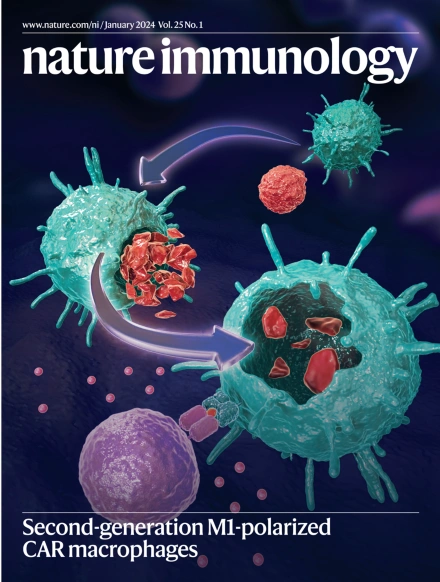
Nature Immunology
医学-免疫学
CiteScore
40.00
自引率
2.30%
发文量
248
审稿时长
4-8 weeks
期刊介绍:
Nature Immunology is a monthly journal that publishes the highest quality research in all areas of immunology. The editorial decisions are made by a team of full-time professional editors. The journal prioritizes work that provides translational and/or fundamental insight into the workings of the immune system. It covers a wide range of topics including innate immunity and inflammation, development, immune receptors, signaling and apoptosis, antigen presentation, gene regulation and recombination, cellular and systemic immunity, vaccines, immune tolerance, autoimmunity, tumor immunology, and microbial immunopathology. In addition to publishing significant original research, Nature Immunology also includes comments, News and Views, research highlights, matters arising from readers, and reviews of the literature. The journal serves as a major conduit of top-quality information for the immunology community.
 求助内容:
 应助结果提醒方式:


 京公网安备 11010802042870号


