
Probing Molecular Chirality via Linear Dichroism of Molecule‐Loaded Anisotropic Plasmonic Slots
IF 6.8
2区 物理与天体物理
Q1 MATERIALS SCIENCE, MULTIDISCIPLINARY
引用次数: 0
Abstract
ABSTRACT Conventional chiroptical spectroscopy relies on circularly polarized light (CPL), yet inherent retardance errors in CPL generation compromise signal fidelity and introduce artifacts from crosstalk with linear dichroism and birefringence. Here, we theoretically propose Chiroptical sensing via Linear dichroism of Anisotropic Plasmonic Slots (CLAPS), a CPL‐free chiroptical sensing scheme that employs two linearly polarized light (LPL) beams tilted with respect to the orientation axis of a plasmonic slot array filled with chiral analytes. Molecular optical activity perturbs the surface lattice resonance (SLR) of the array, producing a measurable reflectance difference between the two tilted LPL beams. Using an anisotropic chiral reflection model and numerical simulations, we reveal that the weak cross‐polarized reflection carrying chirality information is modulated by the strong co‐polarized response of the array. CLAPS circumvents the need for high‐purity CPL, offering a practically accessible route to trace‐level chiral molecule detection.利用装载分子的各向异性等离子体槽的线性二色性探测分子手性
传统的光谱学依赖于圆偏振光(CPL),但CPL产生过程中固有的延迟误差会损害信号保真度,并引入线性二色性和双折射串扰的伪影。在这里,我们从理论上提出了通过各向异性等离子体槽(CLAPS)的线性二色性进行chiroptic传感,这是一种无CPL的chiroptic传感方案,该方案使用两个线性偏振光(LPL)光束相对于充满手性分析物的等离子体槽阵列的方向轴倾斜。分子的光学活性扰乱了阵列的表面晶格共振(SLR),在两个倾斜的LPL光束之间产生可测量的反射率差异。利用各向异性手性反射模型和数值模拟,我们发现携带手性信息的弱交叉极化反射被阵列的强共极化响应调制。CLAPS规避了对高纯度CPL的需求,为痕量手性分子检测提供了一种切实可行的途径。
本文章由计算机程序翻译,如有差异,请以英文原文为准。
求助全文
约1分钟内获得全文
求助全文
来源期刊
Nanophotonics
NANOSCIENCE & NANOTECHNOLOGY-MATERIALS SCIENCE, MULTIDISCIPLINARY
CiteScore
13.50
自引率
6.70%
发文量
358
审稿时长
7 weeks
期刊介绍:
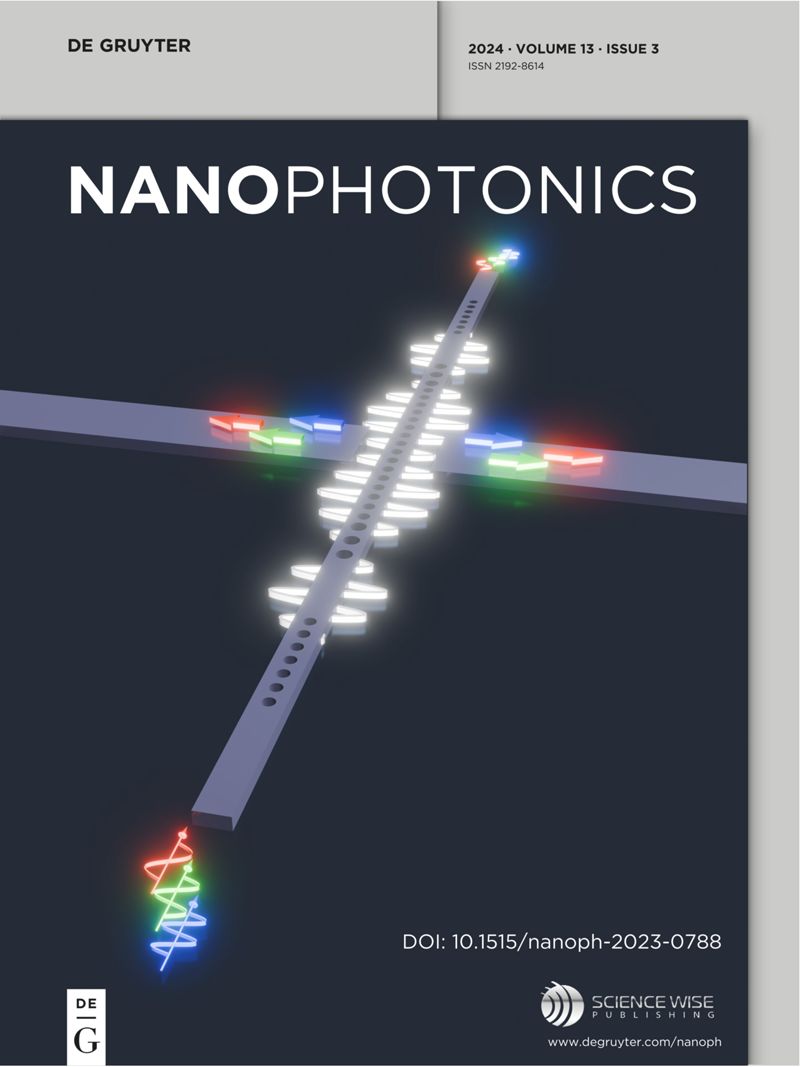
Nanophotonics, published in collaboration with Sciencewise, is a prestigious journal that showcases recent international research results, notable advancements in the field, and innovative applications. It is regarded as one of the leading publications in the realm of nanophotonics and encompasses a range of article types including research articles, selectively invited reviews, letters, and perspectives.
The journal specifically delves into the study of photon interaction with nano-structures, such as carbon nano-tubes, nano metal particles, nano crystals, semiconductor nano dots, photonic crystals, tissue, and DNA. It offers comprehensive coverage of the most up-to-date discoveries, making it an essential resource for physicists, engineers, and material scientists.
 求助内容:
 应助结果提醒方式:


 京公网安备 11010802042870号


