
Nationwide Assessment of De Facto Wastewater Reuse Reveals Vulnerable Drinking Water Systems and Infrastructure Gaps
IF 12.2
1区 环境科学与生态学
Q1 ENGINEERING, ENVIRONMENTAL
引用次数: 0
Abstract
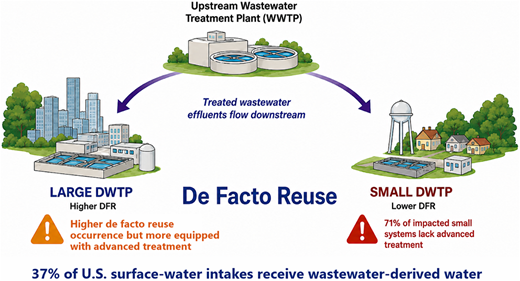
Unplanned wastewater reuse, or de facto reuse (DFR), improves surface water supply resiliency but can introduce nutrients and emerging contaminants into drinking water sources. Previous national DFR assessments excluded thousands of smaller drinking water systems that serve ≤10,000 people. By expanding the De Facto Reuse Incidence in our Nation’s Consumable Supply (DRINCS) model into DRINCS2.0 to include all 6,881 U.S. surface water intakes serving ∼232 million people, we identify a previously unrecognized national infrastructure gap. DRINCS2.0 uses updated high-resolution hydrography data and post-2020 water and wastewater facility details. Although large systems serving >10,000 people experience higher DFR frequency (41% versus 34%) and magnitude (medians of 2.0% versus 1.2%), 71% of impacted small systems (≤10,000 people) lack advanced treatment (i.e., activated carbon, ozone, and reverse osmosis) capable of treating pollutants of wastewater origin, compared with 43% of large systems. Higher DFR was associated with increased PFAS occurrence in treated drinking water obtained from EPA UCMR5 data sets. Sociodemographic analysis further showed that populations with greater socioeconomic vulnerability were more likely to receive drinking water from systems impacted by DFR without advanced treatment. This study provides the most comprehensive national assessment of DFR to date and offers a screening framework to prioritize monitoring and treatment upgrades for emerging contaminants.
全国范围内对实际废水回用的评估揭示了脆弱的饮用水系统和基础设施差距
无计划的废水回用或事实上的废水回用(DFR)提高了地表水供应的弹性,但可能将营养物质和新出现的污染物引入饮用水水源。以前的国家DFR评估排除了数千个服务于≤10,000人的小型饮用水系统。通过将我国消耗品供应(DRINCS)的实际再利用发生率模型扩展到DRINCS2.0,以包括为约2.32亿人服务的所有6,881个美国地表水摄入量,我们发现了以前未被认识到的国家基础设施差距。DRINCS2.0使用更新的高分辨率水文数据和2020年后的水和废水设施细节。虽然服务于100万人口的大型系统的DFR频率(41%对34%)和幅度(中位数为2.0%对1.2%)更高,但71%受影响的小型系统(≤10,000人)缺乏能够处理废水来源污染物的高级处理(即活性炭、臭氧和反渗透),而大型系统的这一比例为43%。从EPA UCMR5数据集获得的处理过的饮用水中,较高的DFR与PFAS发生率增加有关。社会人口统计分析进一步表明,社会经济脆弱性较大的人群更有可能从受DFR影响的系统中获得饮用水,而没有进行高级处理。这项研究提供了迄今为止最全面的DFR国家评估,并提供了一个筛选框架,以优先监测和处理新出现的污染物。
本文章由计算机程序翻译,如有差异,请以英文原文为准。
求助全文
约1分钟内获得全文
求助全文
来源期刊
环境科学与技术
环境科学-工程:环境
CiteScore
17.50
自引率
9.60%
发文量
12359
审稿时长
2.8 months
期刊介绍:
Environmental Science & Technology (ES&T) is a co-sponsored academic and technical magazine by the Hubei Provincial Environmental Protection Bureau and the Hubei Provincial Academy of Environmental Sciences.
Environmental Science & Technology (ES&T) holds the status of Chinese core journals, scientific papers source journals of China, Chinese Science Citation Database source journals, and Chinese Academic Journal Comprehensive Evaluation Database source journals. This publication focuses on the academic field of environmental protection, featuring articles related to environmental protection and technical advancements.
 求助内容:
求助内容: 应助结果提醒方式:

 京公网安备 11010802042870号


