Concentration dependent fate of tebuconazole applied as a commercial formulation and identification of transformation products in a one-year mesocosm study.
Valeska Contardo-Jara, Stefan Bader, Björn Kusebauch, Johannes Ranke, Silvia Mohr, Ulrike Scholz, Steffen Carl, Stefan Meinecke
{"title":"Concentration dependent fate of tebuconazole applied as a commercial formulation and identification of transformation products in a one-year mesocosm study.","authors":"Valeska Contardo-Jara, Stefan Bader, Björn Kusebauch, Johannes Ranke, Silvia Mohr, Ulrike Scholz, Steffen Carl, Stefan Meinecke","doi":"10.1016/j.scitotenv.2026.182286","DOIUrl":null,"url":null,"abstract":"<p><p>Determining the half-lives of plant protection products and biocides is essential for assessing their environmental persistence and regulatory risk. However, there is no standardized approach defining how many data sets should be considered or whether influencing factors such as substance concentration must be included. For pesticides that are primarily degraded microbially, concentration can significantly influence degradation rates. Elevated levels may exert toxic effects on microorganisms, thereby slowing degradation. This is relevant for the fungicide tebuconazole, which has a broad mode of action including antimicrobial toxicity. Within a comprehensive mesocosm study, concentration-dependent degradation of a commercial tebuconazole formulation was investigated. Eight freshwater stream-pond mesocosms containing flow-through and stagnant zones were established and dosed once with 0, 5, 50, 100, 500, 1000, and 5000 μg/L tebuconazole. Over one year, concentrations in water from all systems and in sediment layers of selected treatments were monitored using GC-MS/MS. Dissipation times for water, sediment, and the overall system were calculated using a newly developed hierarchical kinetic model that incorporated concentration as a covariate, alongside standard degradation models with different error models. A clear concentration dependency was observed: dissipation time increased from 176 days at the lowest concentration to 1079 days at the highest. Transfer to sediment was minimal (<5% within one year). Relevant transformation products were detected and partially quantified in water via LC-MS/MS, but their low quantities allowed them to be excluded from kinetic modeling.</p>","PeriodicalId":422,"journal":{"name":"Science of the Total Environment","volume":"1051 ","pages":"182286"},"PeriodicalIF":8.0000,"publicationDate":"2026-09-04","publicationTypes":"Journal Article","fieldsOfStudy":null,"isOpenAccess":false,"openAccessPdf":"","citationCount":"0","resultStr":null,"platform":"Semanticscholar","paperid":null,"PeriodicalName":"Science of the Total Environment","FirstCategoryId":"93","ListUrlMain":"https://doi.org/10.1016/j.scitotenv.2026.182286","RegionNum":1,"RegionCategory":"环境科学与生态学","ArticlePicture":[],"TitleCN":null,"AbstractTextCN":null,"PMCID":null,"EPubDate":"","PubModel":"","JCR":"Q1","JCRName":"ENVIRONMENTAL SCIENCES","Score":null,"Total":0}
引用次数: 0
Abstract
Determining the half-lives of plant protection products and biocides is essential for assessing their environmental persistence and regulatory risk. However, there is no standardized approach defining how many data sets should be considered or whether influencing factors such as substance concentration must be included. For pesticides that are primarily degraded microbially, concentration can significantly influence degradation rates. Elevated levels may exert toxic effects on microorganisms, thereby slowing degradation. This is relevant for the fungicide tebuconazole, which has a broad mode of action including antimicrobial toxicity. Within a comprehensive mesocosm study, concentration-dependent degradation of a commercial tebuconazole formulation was investigated. Eight freshwater stream-pond mesocosms containing flow-through and stagnant zones were established and dosed once with 0, 5, 50, 100, 500, 1000, and 5000 μg/L tebuconazole. Over one year, concentrations in water from all systems and in sediment layers of selected treatments were monitored using GC-MS/MS. Dissipation times for water, sediment, and the overall system were calculated using a newly developed hierarchical kinetic model that incorporated concentration as a covariate, alongside standard degradation models with different error models. A clear concentration dependency was observed: dissipation time increased from 176 days at the lowest concentration to 1079 days at the highest. Transfer to sediment was minimal (<5% within one year). Relevant transformation products were detected and partially quantified in water via LC-MS/MS, but their low quantities allowed them to be excluded from kinetic modeling.
期刊介绍:
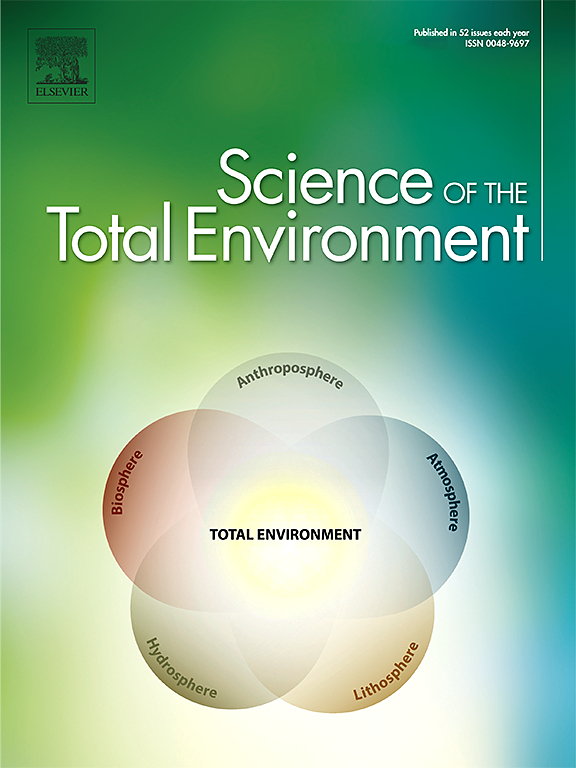
The Science of the Total Environment is an international journal dedicated to scientific research on the environment and its interaction with humanity. It covers a wide range of disciplines and seeks to publish innovative, hypothesis-driven, and impactful research that explores the entire environment, including the atmosphere, lithosphere, hydrosphere, biosphere, and anthroposphere.
The journal's updated Aims & Scope emphasizes the importance of interdisciplinary environmental research with broad impact. Priority is given to studies that advance fundamental understanding and explore the interconnectedness of multiple environmental spheres. Field studies are preferred, while laboratory experiments must demonstrate significant methodological advancements or mechanistic insights with direct relevance to the environment.

 求助内容:
求助内容: 应助结果提醒方式:

 京公网安备 11010802042870号


