Solveig Pospiech, Maarit Middleton, Janne Kinnunen, Anne Taivalkoski, Raimon Tolosana-Delgado
{"title":"Influence of bedrock and soil properties on elemental composition of conifers in boreal zone.","authors":"Solveig Pospiech, Maarit Middleton, Janne Kinnunen, Anne Taivalkoski, Raimon Tolosana-Delgado","doi":"10.1016/j.scitotenv.2026.182098","DOIUrl":null,"url":null,"abstract":"<p><p>The plant ionome reflects an interplay between biological requirements and environmental sources, including soil, bedrock, groundwater, and atmospheric dust, as well as factors controlling the bioavailability. Understanding the sources and processes that shape plant ionome is essential for a range of applications, including environmental monitoring, geological mapping, and mineral exploration. The boreal region presents a scenario where the prevalence of allochthonous glacial sediments decouples soil geochemistry from its bedrock source, complicating geological mapping. We investigated the influence of geological and environmental characteristics on the ionomes of Norway spruce, Scots pine, and common juniper in the boreal zone. Samples included bark, twigs, and needles collected from 93 sampling stations across a northern boreal mature forest. Compositional statistical analysis revealed significant effects of edaphic and bedrock properties on conifer ionomes, though responses varied by species and tissue type. Soil moisture and organic matter content strongly influenced cobalt, molybdenum, barium, manganese, but also lead, rubidium, strontium and nickel concentrations. Bedrock geology influenced cobalt, nickel, calcium, magnesium, copper, and lead, detectable even beneath the till cover. A primary challenge lies in determining the specific source for elements originating from both soil and bedrock or mainly one of the sources. Notably, gold‑cobalt mineralisation signals were preserved in Norway spruce bark despite the overlying sediments. These findings demonstrate the utility of conifer ionomes for geological mapping despite complex surficial geology.</p>","PeriodicalId":422,"journal":{"name":"Science of the Total Environment","volume":"1051 ","pages":"182098"},"PeriodicalIF":8.0000,"publicationDate":"2026-09-04","publicationTypes":"Journal Article","fieldsOfStudy":null,"isOpenAccess":false,"openAccessPdf":"","citationCount":"0","resultStr":null,"platform":"Semanticscholar","paperid":null,"PeriodicalName":"Science of the Total Environment","FirstCategoryId":"93","ListUrlMain":"https://doi.org/10.1016/j.scitotenv.2026.182098","RegionNum":1,"RegionCategory":"环境科学与生态学","ArticlePicture":[],"TitleCN":null,"AbstractTextCN":null,"PMCID":null,"EPubDate":"","PubModel":"","JCR":"Q1","JCRName":"ENVIRONMENTAL SCIENCES","Score":null,"Total":0}
引用次数: 0
Abstract
The plant ionome reflects an interplay between biological requirements and environmental sources, including soil, bedrock, groundwater, and atmospheric dust, as well as factors controlling the bioavailability. Understanding the sources and processes that shape plant ionome is essential for a range of applications, including environmental monitoring, geological mapping, and mineral exploration. The boreal region presents a scenario where the prevalence of allochthonous glacial sediments decouples soil geochemistry from its bedrock source, complicating geological mapping. We investigated the influence of geological and environmental characteristics on the ionomes of Norway spruce, Scots pine, and common juniper in the boreal zone. Samples included bark, twigs, and needles collected from 93 sampling stations across a northern boreal mature forest. Compositional statistical analysis revealed significant effects of edaphic and bedrock properties on conifer ionomes, though responses varied by species and tissue type. Soil moisture and organic matter content strongly influenced cobalt, molybdenum, barium, manganese, but also lead, rubidium, strontium and nickel concentrations. Bedrock geology influenced cobalt, nickel, calcium, magnesium, copper, and lead, detectable even beneath the till cover. A primary challenge lies in determining the specific source for elements originating from both soil and bedrock or mainly one of the sources. Notably, gold‑cobalt mineralisation signals were preserved in Norway spruce bark despite the overlying sediments. These findings demonstrate the utility of conifer ionomes for geological mapping despite complex surficial geology.
期刊介绍:
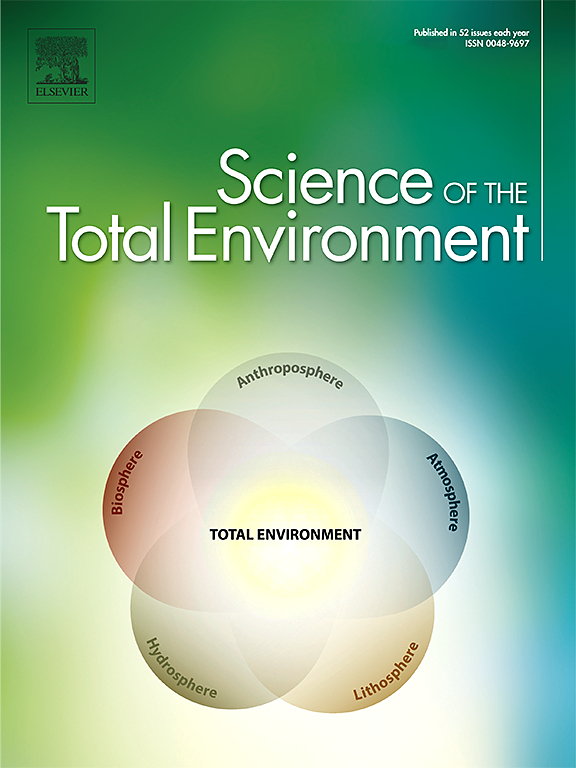
The Science of the Total Environment is an international journal dedicated to scientific research on the environment and its interaction with humanity. It covers a wide range of disciplines and seeks to publish innovative, hypothesis-driven, and impactful research that explores the entire environment, including the atmosphere, lithosphere, hydrosphere, biosphere, and anthroposphere.
The journal's updated Aims & Scope emphasizes the importance of interdisciplinary environmental research with broad impact. Priority is given to studies that advance fundamental understanding and explore the interconnectedness of multiple environmental spheres. Field studies are preferred, while laboratory experiments must demonstrate significant methodological advancements or mechanistic insights with direct relevance to the environment.

 求助内容:
求助内容: 应助结果提醒方式:

 京公网安备 11010802042870号


