
Aging microenvironment induces CD8+ T cell exhaustion by suppressing hepatic β-hydroxybutyrylate synthesis
IF 37
1区 生物学
Q1 CELL BIOLOGY
引用次数: 0
Abstract
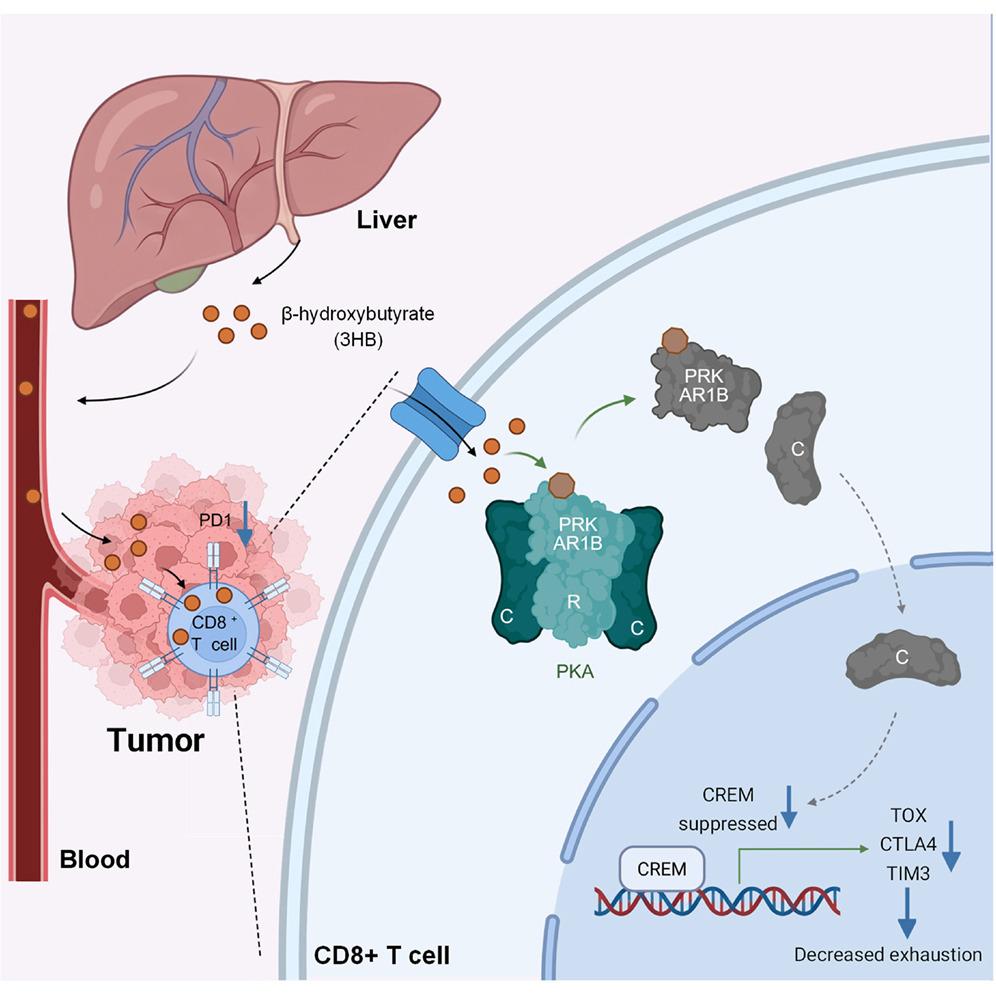
The metabolic mechanisms by which aging blunts CD8+ T cell antitumor and pathogen defense remain unknown. We demonstrate that the aged microenvironment induces CD8+ T cell exhaustion by reducing β-hydroxybutyrate (3HB) bioavailability. Aging represses hepatic BDH1-dependent 3HB synthesis, restricting SLC16A1-mediated 3HB uptake. Hepatic BDH1 ablation recapitulates age-associated CD8+ T cell dysfunction, compromising antiviral and antitumor immunity, whereas 3HB supplementation reverses these deficits via protein β-hydroxybutyrylation. Using a 3HB-derived chemical probe, 3Halk, together with functional screening, we identify PRKAR1B as a primary effector of 3HB signaling. PRKAR1B β-hydroxybutyrylation inhibits the transcription factor cyclic AMP (cAMP)-responsive element modulator (CREM), which activates T cell exhaustion-related gene expression. Age-associated 3HB depletion enhances CREM-dependent transcription, sustaining CD8+ T cell exhaustion. Consistently, the aged microenvironment compromises chimeric antigen receptor (CAR) T antitumor activity, which is substantially restored by 3HB treatment. Collectively, this study uncovers a hepatic metabolism-derived 3HB-CREM axis governing CD8+ T cell immunosenescence, highlighting 3HB as a viable immunorestorative strategy to improve immunotherapy outcomes in aged individuals.
衰老微环境通过抑制肝脏β-羟基丁酸酯合成诱导CD8+ T细胞衰竭
衰老减弱CD8+ T细胞抗肿瘤和病原体防御的代谢机制尚不清楚。我们证明老化的微环境通过降低β-羟基丁酸(3HB)的生物利用度诱导CD8+ T细胞衰竭。衰老抑制肝脏bdh1依赖性3HB合成,限制slc16a1介导的3HB摄取。肝BDH1消融重现了年龄相关的CD8+ T细胞功能障碍,损害了抗病毒和抗肿瘤免疫,而3HB补充通过蛋白β-羟基丁基化逆转了这些缺陷。使用3HB衍生的化学探针3Halk,结合功能筛选,我们确定PRKAR1B是3HB信号传导的主要效应因子。PRKAR1B β-羟基丁基化抑制转录因子环AMP (cAMP)-响应元件调节器(CREM),其激活T细胞衰竭相关基因表达。年龄相关的3HB缺失增强crem依赖性转录,维持CD8+ T细胞衰竭。与此一致的是,衰老的微环境损害了嵌合抗原受体(CAR) T抗肿瘤活性,而这种活性通过3HB治疗可以基本恢复。总的来说,这项研究揭示了肝脏代谢衍生的3HB- crem轴调控CD8+ T细胞免疫衰老,强调3HB是一种可行的免疫恢复策略,可以改善老年人的免疫治疗结果。
本文章由计算机程序翻译,如有差异,请以英文原文为准。
求助全文
约1分钟内获得全文
求助全文
来源期刊
Cell metabolism
生物-内分泌学与代谢
CiteScore
48.60
自引率
1.40%
发文量
173
审稿时长
2.5 months
期刊介绍:
Cell Metabolism is a top research journal established in 2005 that focuses on publishing original and impactful papers in the field of metabolic research.It covers a wide range of topics including diabetes, obesity, cardiovascular biology, aging and stress responses, circadian biology, and many others.
Cell Metabolism aims to contribute to the advancement of metabolic research by providing a platform for the publication and dissemination of high-quality research and thought-provoking articles.
 求助内容:
求助内容: 应助结果提醒方式:

 京公网安备 11010802042870号


