Yanying He, Xianli Yang, Yingxin Jin, Quan Li, Shujun Zhang, Yingrui Liu, Yufen Wang, Tingting Zhu, Yindong Tong, Yingxin Zhao, Tao Liu, Yiwen Liu
{"title":"Polylactic acid microplastics increase N<sub>2</sub>O emissions from mainstream biological nitrogen removal systems: overlooked concern.","authors":"Yanying He, Xianli Yang, Yingxin Jin, Quan Li, Shujun Zhang, Yingrui Liu, Yufen Wang, Tingting Zhu, Yindong Tong, Yingxin Zhao, Tao Liu, Yiwen Liu","doi":"10.1016/j.biortech.2026.135744","DOIUrl":null,"url":null,"abstract":"<p><p>Despite being marketed as environmentally benign alternatives for conventional synthetic polymers, biodegradable plastics inevitably generate large amounts of microplastics, posing currently overlooked yet potentially significant environmental risks. This study selected polylactic acid microplastics (PLA-MPs) as model biodegradable microplastics to investigate their effects on nitrous oxide (N<sub>2</sub>O) emissions from a mainstream biological nitrogen removal system. Long-term exposure to PLA-MPs at environmentally relevant level (0.5 mg/L) increased the N<sub>2</sub>O emission factor by 28.9%, and inhibited maximum nitrification and denitrification activities by 13.4%-20.9% and 4.9%-16.7%, respectively, while the nitrate reduction rate increased by 9.9%. Under elevated stress (5 mg/L), the N<sub>2</sub>O emissions increased by 32.4%, but the extent of maximum activity inhibition was comparable to that at 0.5 mg/L. Isotopic analysis revealed that PLA-MPs promoted the NH<sub>2</sub>OH oxidation pathway and consequently enhanced the N<sub>2</sub>O-producing capacity of nitrifiers, while nitrite accumulation during nitrification remained largely unaffected. During denitrification, however, PLA-MPs disrupted the balance of nitrogen oxide reduction steps, leading to elevated accumulation of both nitrite and N<sub>2</sub>O. PLA‑MPs altered the composition and structure of extracellular polymeric substances, which was accompanied by increased sludge particle size and hydrophobicity. Concurrently, shifts in the relative abundances of key microorganisms and enzyme-encoding genes involved in electron transfer, electron consumption, and metal transmembrane transport were observed. Together, these changes in sludge properties and microbial community likely explained the elevated N<sub>2</sub>O emissions under PLA-MP exposure, providing new insights into the long-term impacts of biodegradable microplastics on engineered wastewater systems.</p>","PeriodicalId":258,"journal":{"name":"Bioresource Technology","volume":" ","pages":"135744"},"PeriodicalIF":8.2000,"publicationDate":"2026-09-05","publicationTypes":"Journal Article","fieldsOfStudy":null,"isOpenAccess":false,"openAccessPdf":"","citationCount":"0","resultStr":null,"platform":"Semanticscholar","paperid":null,"PeriodicalName":"Bioresource Technology","FirstCategoryId":"5","ListUrlMain":"https://doi.org/10.1016/j.biortech.2026.135744","RegionNum":1,"RegionCategory":"环境科学与生态学","ArticlePicture":[],"TitleCN":null,"AbstractTextCN":null,"PMCID":null,"EPubDate":"","PubModel":"","JCR":"Q1","JCRName":"AGRICULTURAL ENGINEERING","Score":null,"Total":0}
引用次数: 0
Abstract
Despite being marketed as environmentally benign alternatives for conventional synthetic polymers, biodegradable plastics inevitably generate large amounts of microplastics, posing currently overlooked yet potentially significant environmental risks. This study selected polylactic acid microplastics (PLA-MPs) as model biodegradable microplastics to investigate their effects on nitrous oxide (N2O) emissions from a mainstream biological nitrogen removal system. Long-term exposure to PLA-MPs at environmentally relevant level (0.5 mg/L) increased the N2O emission factor by 28.9%, and inhibited maximum nitrification and denitrification activities by 13.4%-20.9% and 4.9%-16.7%, respectively, while the nitrate reduction rate increased by 9.9%. Under elevated stress (5 mg/L), the N2O emissions increased by 32.4%, but the extent of maximum activity inhibition was comparable to that at 0.5 mg/L. Isotopic analysis revealed that PLA-MPs promoted the NH2OH oxidation pathway and consequently enhanced the N2O-producing capacity of nitrifiers, while nitrite accumulation during nitrification remained largely unaffected. During denitrification, however, PLA-MPs disrupted the balance of nitrogen oxide reduction steps, leading to elevated accumulation of both nitrite and N2O. PLA‑MPs altered the composition and structure of extracellular polymeric substances, which was accompanied by increased sludge particle size and hydrophobicity. Concurrently, shifts in the relative abundances of key microorganisms and enzyme-encoding genes involved in electron transfer, electron consumption, and metal transmembrane transport were observed. Together, these changes in sludge properties and microbial community likely explained the elevated N2O emissions under PLA-MP exposure, providing new insights into the long-term impacts of biodegradable microplastics on engineered wastewater systems.
期刊介绍:
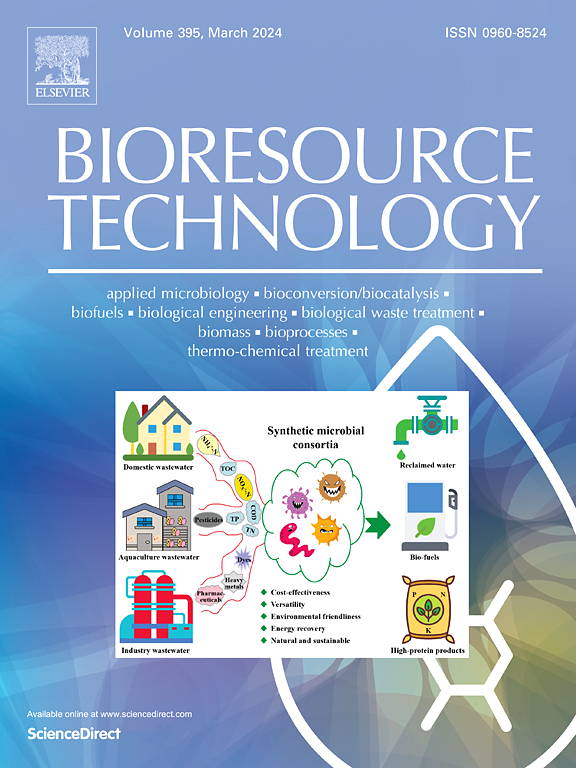
Bioresource Technology publishes original articles, review articles, case studies, and short communications covering the fundamentals, applications, and management of bioresource technology. The journal seeks to advance and disseminate knowledge across various areas related to biomass, biological waste treatment, bioenergy, biotransformations, bioresource systems analysis, and associated conversion or production technologies.
Topics include:
• Biofuels: liquid and gaseous biofuels production, modeling and economics
• Bioprocesses and bioproducts: biocatalysis and fermentations
• Biomass and feedstocks utilization: bioconversion of agro-industrial residues
• Environmental protection: biological waste treatment
• Thermochemical conversion of biomass: combustion, pyrolysis, gasification, catalysis.

 求助内容:
 应助结果提醒方式:


 京公网安备 11010802042870号


