
Drone carrier: An integrated unmanned surface vehicle for autonomous inspection and intervention in GNSS-denied maritime environment
IF 5.8
1区 工程技术
Q1 ENGINEERING, MARINE
Journal of Ocean Engineering and Science
Pub Date : 2026-08-01
Epub Date: 2026-02-10
DOI:10.1016/j.joes.2026.02.002
引用次数: 0
Abstract
GNSS denial and interference increasingly challenge maritime robotics. While heterogeneous Unmanned Aerial Vehicles (UAVs) and Unmanned Surface Vehicles (USVs) teams are promising for inspection and intervention, open-sea non-cooperative docking and reliable deck landing on a moving platform remain difficult. This work addresses that gap with a fully electric, modular USV-based drone carrier that autonomously approaches, docks to, and services target vessels without Global Navigation Satellite System (GNSS). The system integrates on-shore camera handover, onboard gimbaled vision and Light Detection and Ranging (LiDAR), Ultra-Wide Band (UWB)+Extended Kalman Filter (EKF) localization, Quick Response (QR)-based terminal landing, and a thrust-vectoring docking controller within a unified Robot Operating System (ROS) architecture. In sea-state-3 trials, the carrier achieved offshore handover at 200 m (3 km standoff), onboard vision lock to 500 m, LiDAR modeling within 200 m, non-cooperative docking with 1 m error, and QR-assisted deck landings with 20 cm accuracy. These results demonstrate robust closed-loop operation under GNSS denial and delineate the present envelope (rigid deck edge; sea state 3), informing deployment for port security and offshore rescue and guiding future extensions to higher sea states and broader target geometries.
无人机载体:在gnss缺失的海洋环境中,用于自主巡检和干预的一体化无人水面车辆
GNSS拒止和干扰对海事机器人的挑战日益严峻。虽然异构无人机(uav)和无人水面车辆(usv)团队有望进行检查和干预,但公海非合作对接和在移动平台上可靠的甲板着陆仍然很困难。这项工作通过全电动、模块化的usv无人机载体解决了这一差距,该载体可以在没有全球导航卫星系统(GNSS)的情况下自主接近、停靠和服务目标船只。该系统集成了岸上摄像机切换、机载平衡视觉和光探测和测距(LiDAR)、超宽带(UWB)+扩展卡尔曼滤波(EKF)定位、基于快速响应(QR)的终端着陆,以及统一机器人操作系统(ROS)架构中的推力矢量对接控制器。在海况-3试验中,该航母实现了约200米(3公里距离)的海上交接,约500米的舰载视觉锁定,200米内的激光雷达建模,误差≤1米的非合作对接,以及精度约20厘米的qr辅助甲板着陆。这些结果展示了在GNSS拒绝下强大的闭环操作,并描绘了当前的包线(刚性甲板边缘;海况≤3),为港口安全和海上救援部署提供了信息,并指导未来扩展到更高的海况和更广泛的目标几何形状。
本文章由计算机程序翻译,如有差异,请以英文原文为准。
求助全文
约1分钟内获得全文
求助全文
来源期刊
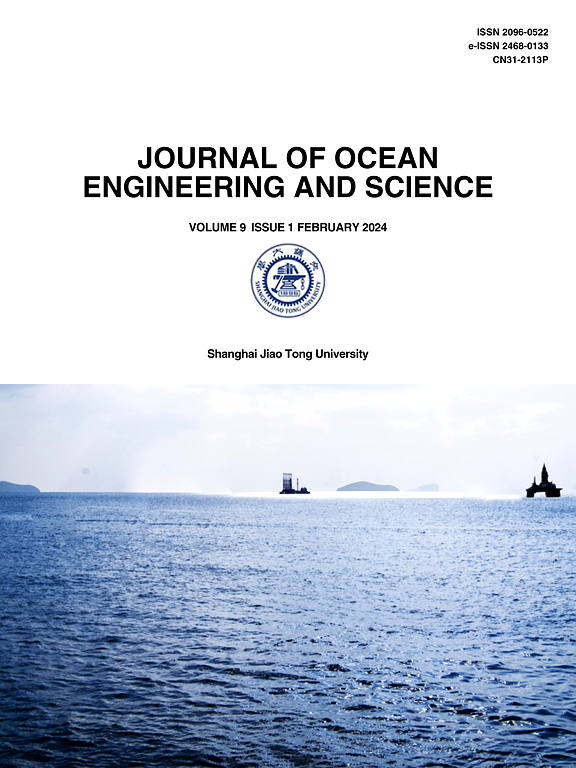
Journal of Ocean Engineering and Science
Multiple-
CiteScore
11.50
自引率
19.70%
发文量
224
审稿时长
29 days
期刊介绍:
The Journal of Ocean Engineering and Science (JOES) serves as a platform for disseminating original research and advancements in the realm of ocean engineering and science.
JOES encourages the submission of papers covering various aspects of ocean engineering and science.
 求助内容:
 应助结果提醒方式:


 京公网安备 11010802042870号


