L Zhang, Y Shen, X D Hu, J Li, W Duan, Y Y Wang, J X Ma, J J Zhang, D T Zhang, C N Ma
{"title":"[Attribution analysis of common respiratory pathogens in influenza-like illness, 2024-2025 surveillance years in Beijing].","authors":"L Zhang, Y Shen, X D Hu, J Li, W Duan, Y Y Wang, J X Ma, J J Zhang, D T Zhang, C N Ma","doi":"10.3760/cma.j.cn112338-20260211-00118","DOIUrl":null,"url":null,"abstract":"<p><p><b>Objective:</b> Analyze the contribution of common respiratory pathogens to influenza-like illness (ILI) in Beijing during the 2024-2025 surveillance years, and identify the dominant local pathogens and their differences across age groups. <b>Methods:</b> Collect ILI consultation data from secondary-level and above medical institutions in Beijing during the 2024-2025 surveillance year, as well as the positive rates for 22 respiratory pathogens from 19 sentinel hospitals. We used the elastic network model to screen for pathogens, and construct generalized additive models (GAM) for the entire population and each age group separately. Based on the correction of confounding factors such as time and holidays, calculate the attributable contribution of each pathogen to the ILI through the attributable fraction (AF). <b>Results:</b> A total of 1 389 954 cases of ILI were monitored, averaging 26 730 cases per week. A total of 14 pathogens had a positive rate of ≥1.00% among the 22 pathogens. The top 5 pathogens with the highest positive rates were haemophilus influenzae (10.78%,2 188/20 296), streptococcus pneumoniae (10.62%,2 155/20 296), and 2019-nCoV (9.96%,2 021/20 296), influenza virus (9.34%, 1 895/20 296) and rhinovirus (5.79%, 1 175/20 296). In the pathogen attribution analysis, the elastic network model screened out a total of 9 pathogens, with a combined AF of 52.88%, and the number of attributed ILI was 735 008 cases. The top three pathogens by AF (and number of attributed cases) were influenza virus at 20.46% (284 385 cases), rhinovirus at 10.47% (145 528 cases), and human metapneumovirus at 8.09% (112 447 cases). Among the age groups of 0-4 years, 15-59 years and over 60 years, AF of influenza virus was the highest, being 11.71% (95%<i>CI</i>: 0.00%-17.77%), 26.38% (95%<i>CI</i>: 13.60%- 36.94%), and 29.89% (95%<i>CI</i>: 3.30%-37.66%) respectively; among the 5-14 years age group, AF of rhinovirus was the highest, being 9.82% (95%<i>CI</i>: 0.00%-18.37%). <b>Conclusions:</b> During the 2024-2025 surveillance years, the number of patients visiting the outpatient and emergency departments with ILI was caused by multiple pathogens. Influenza virus, rhinovirus, and human metapneumovirus were the main causative pathogens, and their contributions varied across age groups. GAM can effectively measure the disease burden of different pathogens and provide reliable data support for the precise monitoring and stratified prevention and control of respiratory infectious diseases.</p>","PeriodicalId":23968,"journal":{"name":"中华流行病学杂志","volume":"47 8","pages":"1451-1456"},"PeriodicalIF":0.0000,"publicationDate":"2026-08-10","publicationTypes":"Journal Article","fieldsOfStudy":null,"isOpenAccess":false,"openAccessPdf":"","citationCount":"0","resultStr":null,"platform":"Semanticscholar","paperid":null,"PeriodicalName":"中华流行病学杂志","FirstCategoryId":"3","ListUrlMain":"https://doi.org/10.3760/cma.j.cn112338-20260211-00118","RegionNum":0,"RegionCategory":null,"ArticlePicture":[],"TitleCN":null,"AbstractTextCN":null,"PMCID":null,"EPubDate":"","PubModel":"","JCR":"Q1","JCRName":"Medicine","Score":null,"Total":0}
引用次数: 0
Abstract
Objective: Analyze the contribution of common respiratory pathogens to influenza-like illness (ILI) in Beijing during the 2024-2025 surveillance years, and identify the dominant local pathogens and their differences across age groups. Methods: Collect ILI consultation data from secondary-level and above medical institutions in Beijing during the 2024-2025 surveillance year, as well as the positive rates for 22 respiratory pathogens from 19 sentinel hospitals. We used the elastic network model to screen for pathogens, and construct generalized additive models (GAM) for the entire population and each age group separately. Based on the correction of confounding factors such as time and holidays, calculate the attributable contribution of each pathogen to the ILI through the attributable fraction (AF). Results: A total of 1 389 954 cases of ILI were monitored, averaging 26 730 cases per week. A total of 14 pathogens had a positive rate of ≥1.00% among the 22 pathogens. The top 5 pathogens with the highest positive rates were haemophilus influenzae (10.78%,2 188/20 296), streptococcus pneumoniae (10.62%,2 155/20 296), and 2019-nCoV (9.96%,2 021/20 296), influenza virus (9.34%, 1 895/20 296) and rhinovirus (5.79%, 1 175/20 296). In the pathogen attribution analysis, the elastic network model screened out a total of 9 pathogens, with a combined AF of 52.88%, and the number of attributed ILI was 735 008 cases. The top three pathogens by AF (and number of attributed cases) were influenza virus at 20.46% (284 385 cases), rhinovirus at 10.47% (145 528 cases), and human metapneumovirus at 8.09% (112 447 cases). Among the age groups of 0-4 years, 15-59 years and over 60 years, AF of influenza virus was the highest, being 11.71% (95%CI: 0.00%-17.77%), 26.38% (95%CI: 13.60%- 36.94%), and 29.89% (95%CI: 3.30%-37.66%) respectively; among the 5-14 years age group, AF of rhinovirus was the highest, being 9.82% (95%CI: 0.00%-18.37%). Conclusions: During the 2024-2025 surveillance years, the number of patients visiting the outpatient and emergency departments with ILI was caused by multiple pathogens. Influenza virus, rhinovirus, and human metapneumovirus were the main causative pathogens, and their contributions varied across age groups. GAM can effectively measure the disease burden of different pathogens and provide reliable data support for the precise monitoring and stratified prevention and control of respiratory infectious diseases.
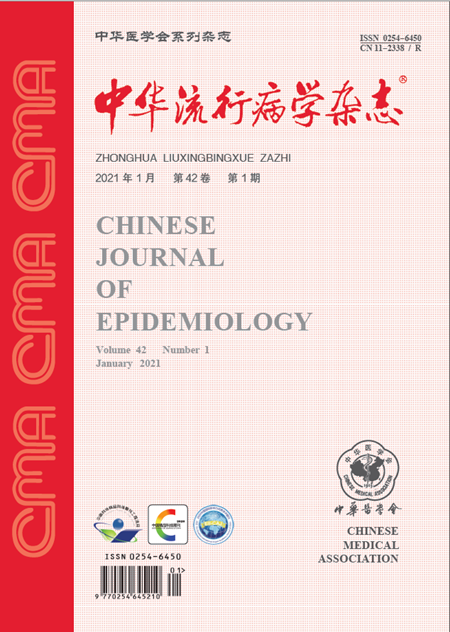
期刊介绍:
Chinese Journal of Epidemiology, established in 1981, is an advanced academic periodical in epidemiology and related disciplines in China, which, according to the principle of integrating theory with practice, mainly reports the major progress in epidemiological research. The columns of the journal include commentary, expert forum, original article, field investigation, disease surveillance, laboratory research, clinical epidemiology, basic theory or method and review, etc.
The journal is included by more than ten major biomedical databases and index systems worldwide, such as been indexed in Scopus, PubMed/MEDLINE, PubMed Central (PMC), Europe PubMed Central, Embase, Chemical Abstract, Chinese Science and Technology Paper and Citation Database (CSTPCD), Chinese core journal essentials overview, Chinese Science Citation Database (CSCD) core database, Chinese Biological Medical Disc (CBMdisc), and Chinese Medical Citation Index (CMCI), etc. It is one of the core academic journals and carefully selected core journals in preventive and basic medicine in China.

 求助内容:
 应助结果提醒方式:


 京公网安备 11010802042870号


