{"title":"Regulating the Dynamic Properties of Knoevenagel Condensation Cross-Linked Hydrogels via Thia-Michael Addition Reaction.","authors":"Yu Yan, Ruizhu Yang, Mingming Zhao, Yuqian Ji, Zhiqiang Sun, Xiaonong Zhang, Chunsheng Xiao","doi":"10.1002/marc.70416","DOIUrl":null,"url":null,"abstract":"<p><p>The strategies for regulating dynamic mechanical properties of dynamic hydrogels have attracted significant attention. Herein, we developed a new strategy to regulate the dynamic properties of Knoevenagel condensation (KC) reaction cross-linked hydrogels through reversible thia-Michael addition reaction. In this system, the dynamic C═C bonds formed by the reversible KC reaction could react with thiols via the reversible Michael addition reaction, leading to the structural changes from C═C to C─C bonds and thereby enabling effective modulation of the hydrogel's viscoelastic behaviors. Furthermore, decreasing the pH reduced the reverse reaction rates of both the KC reaction and the thia-Michael addition reaction, reinforcing the stability of the C═C bonds and thia-Michael adducts. To implement this dual regulation, N-acetylcysteine, a small molecule containing both thiol and carboxyl groups, was introduced, which allowed synergistic modulation through thiol-C═C reversible addition and pH responsiveness. This cooperative regulation enables fine-tuned control of hydrogel dynamics, extending stress relaxation time from 20 to 1900 s, enhancing the storage modulus from 2205 to 4705 Pa, and improving the structural stability. Overall, this reversible thia-Michael addition-mediated mechanism paves a new way for regulating the dynamic properties of the KC reaction cross-linked hydrogels.</p>","PeriodicalId":205,"journal":{"name":"Macromolecular Rapid Communications","volume":" ","pages":"e70416"},"PeriodicalIF":4.1000,"publicationDate":"2026-08-20","publicationTypes":"Journal Article","fieldsOfStudy":null,"isOpenAccess":false,"openAccessPdf":"","citationCount":"0","resultStr":null,"platform":"Semanticscholar","paperid":null,"PeriodicalName":"Macromolecular Rapid Communications","FirstCategoryId":"92","ListUrlMain":"https://doi.org/10.1002/marc.70416","RegionNum":3,"RegionCategory":"化学","ArticlePicture":[],"TitleCN":null,"AbstractTextCN":null,"PMCID":null,"EPubDate":"","PubModel":"","JCR":"Q2","JCRName":"POLYMER SCIENCE","Score":null,"Total":0}
引用次数: 0
Abstract
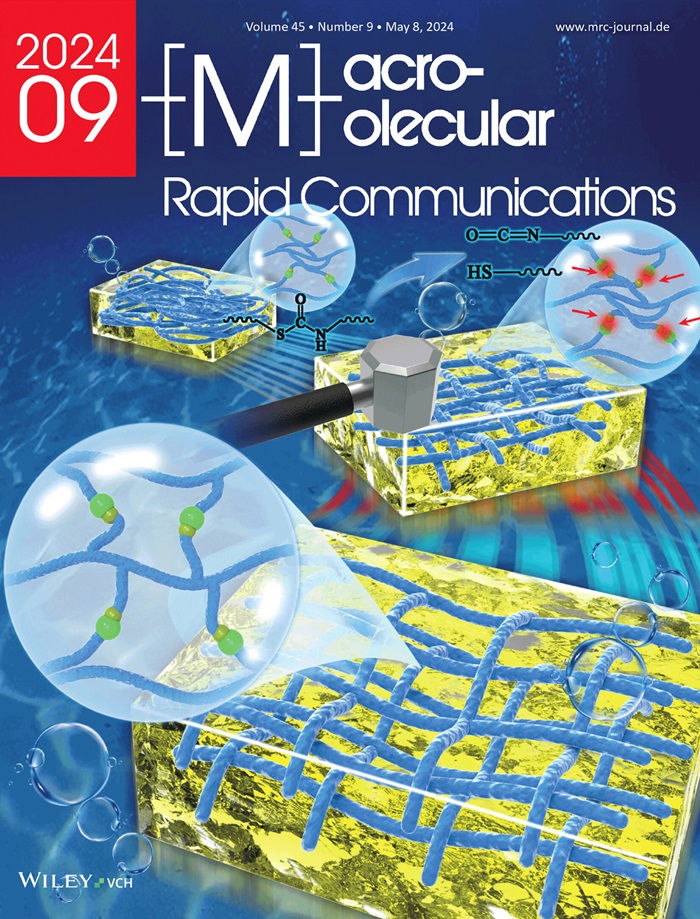
The strategies for regulating dynamic mechanical properties of dynamic hydrogels have attracted significant attention. Herein, we developed a new strategy to regulate the dynamic properties of Knoevenagel condensation (KC) reaction cross-linked hydrogels through reversible thia-Michael addition reaction. In this system, the dynamic C═C bonds formed by the reversible KC reaction could react with thiols via the reversible Michael addition reaction, leading to the structural changes from C═C to C─C bonds and thereby enabling effective modulation of the hydrogel's viscoelastic behaviors. Furthermore, decreasing the pH reduced the reverse reaction rates of both the KC reaction and the thia-Michael addition reaction, reinforcing the stability of the C═C bonds and thia-Michael adducts. To implement this dual regulation, N-acetylcysteine, a small molecule containing both thiol and carboxyl groups, was introduced, which allowed synergistic modulation through thiol-C═C reversible addition and pH responsiveness. This cooperative regulation enables fine-tuned control of hydrogel dynamics, extending stress relaxation time from 20 to 1900 s, enhancing the storage modulus from 2205 to 4705 Pa, and improving the structural stability. Overall, this reversible thia-Michael addition-mediated mechanism paves a new way for regulating the dynamic properties of the KC reaction cross-linked hydrogels.
期刊介绍:
Macromolecular Rapid Communications publishes original research in polymer science, ranging from chemistry and physics of polymers to polymers in materials science and life sciences.

 求助内容:
 应助结果提醒方式:


 京公网安备 11010802042870号


