Tomas Rimkus, Hannes Geisler, Taha B. El-Jourani, Aurélien F. A. Moumbock, Matthias Schiedel, Stephan Reichl
{"title":"Benzophenone Derivatives as a New Class of Anti-Infectives Against Acanthamoeba spp","authors":"Tomas Rimkus, Hannes Geisler, Taha B. El-Jourani, Aurélien F. A. Moumbock, Matthias Schiedel, Stephan Reichl","doi":"10.1002/ardp.70321","DOIUrl":null,"url":null,"abstract":"<p>The rare but sight-threatening ocular disease <i>Acanthamoeba</i> keratitis represents a therapeutic challenge due to its causative agents, <i>Acanthamoeba spp</i>., being able to penetrate the corneal epithelium and persist in the corneal stroma as dormant and highly resistant cysts. To combat the scarcity and limitations of current treatment options, we developed a new class of anti-infective agents against <i>Acanthamoeba spp</i>. based on Ro 48-8071 (<b>3</b>), a known inhibitor of the human oxidosqualene cyclase (hOSC). The compound design was guided by docking studies using a homology model of the cycloartenol synthase (CAS), which is the homolog of hOSC found in <i>Acanthamoeba spp</i>. and essential for the parasite's steroid biosynthesis. Among the synthesized Ro 48-8071 analogues, MSHG19 (<b>4f</b>) evoked the most potent activity against <i>Acanthamoeba hatchetti</i> leading to total eradication of trophozoites and cysts at single-digit micromolar concentrations, whereas having no effects within this concentration range on the viability of human corneal epithelial cells. With our initial set of synthesized compounds, we established a first structure–activity relationship model, which nicely aligns with the predicted binding mode of <b>4f</b> to CAS. Overall, the presented findings highlight the potential of benzophenones as a new class of anti-infectives for the treatment of <i>Acanthamoeba</i> keratitis.</p>","PeriodicalId":128,"journal":{"name":"Archiv der Pharmazie","volume":"359 8","pages":""},"PeriodicalIF":3.5000,"publicationDate":"2026-08-20","publicationTypes":"Journal Article","fieldsOfStudy":null,"isOpenAccess":false,"openAccessPdf":"https://onlinelibrary.wiley.com/doi/epdf/10.1002/ardp.70321","citationCount":"0","resultStr":null,"platform":"Semanticscholar","paperid":null,"PeriodicalName":"Archiv der Pharmazie","FirstCategoryId":"3","ListUrlMain":"https://onlinelibrary.wiley.com/doi/10.1002/ardp.70321","RegionNum":3,"RegionCategory":"医学","ArticlePicture":[],"TitleCN":null,"AbstractTextCN":null,"PMCID":null,"EPubDate":"","PubModel":"","JCR":"Q2","JCRName":"CHEMISTRY, MEDICINAL","Score":null,"Total":0}
引用次数: 0
Abstract
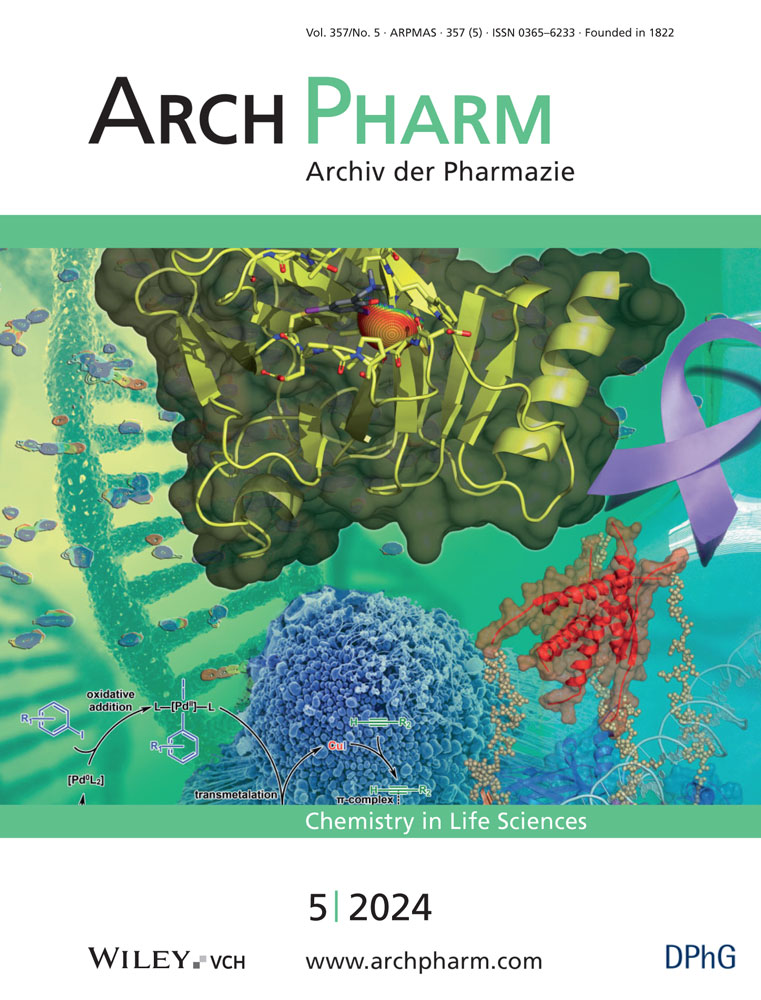
The rare but sight-threatening ocular disease Acanthamoeba keratitis represents a therapeutic challenge due to its causative agents, Acanthamoeba spp., being able to penetrate the corneal epithelium and persist in the corneal stroma as dormant and highly resistant cysts. To combat the scarcity and limitations of current treatment options, we developed a new class of anti-infective agents against Acanthamoeba spp. based on Ro 48-8071 (3), a known inhibitor of the human oxidosqualene cyclase (hOSC). The compound design was guided by docking studies using a homology model of the cycloartenol synthase (CAS), which is the homolog of hOSC found in Acanthamoeba spp. and essential for the parasite's steroid biosynthesis. Among the synthesized Ro 48-8071 analogues, MSHG19 (4f) evoked the most potent activity against Acanthamoeba hatchetti leading to total eradication of trophozoites and cysts at single-digit micromolar concentrations, whereas having no effects within this concentration range on the viability of human corneal epithelial cells. With our initial set of synthesized compounds, we established a first structure–activity relationship model, which nicely aligns with the predicted binding mode of 4f to CAS. Overall, the presented findings highlight the potential of benzophenones as a new class of anti-infectives for the treatment of Acanthamoeba keratitis.
期刊介绍:
Archiv der Pharmazie - Chemistry in Life Sciences is an international journal devoted to research and development in all fields of pharmaceutical and medicinal chemistry. Emphasis is put on papers combining synthetic organic chemistry, structural biology, molecular modelling, bioorganic chemistry, natural products chemistry, biochemistry or analytical methods with pharmaceutical or medicinal aspects such as biological activity. The focus of this journal is put on original research papers, but other scientifically valuable contributions (e.g. reviews, minireviews, highlights, symposia contributions, discussions, and essays) are also welcome.

 求助内容:
 应助结果提醒方式:


 京公网安备 11010802042870号


