Tian-Qi Du, Yuhong Ou, Rui-Ji Liu, Yi Feng, Yaxun Li, Gang Chen, Xingyu Wu
{"title":"Unveiling the New Trick for Epigenetic Drug: Radiation Enhancement of Prostate Cancer by the EZH2 Inhibitor Tazemetostat","authors":"Tian-Qi Du, Yuhong Ou, Rui-Ji Liu, Yi Feng, Yaxun Li, Gang Chen, Xingyu Wu","doi":"10.1111/jcmm.71330","DOIUrl":null,"url":null,"abstract":"<p>The enhancer of zeste homologue 2 inhibitor (EZH2i) Tazemetostat (EPZ-6438) has demonstrated antitumour efficacy in various malignancies. This study aims to evaluate its radiosensitising potential and underlying mechanisms in prostate cancer (PCa). In vitro functional assays, including wound healing, Transwell invasion, EdU proliferation, flow cytometry, and Western blotting, were employed to assess invasion, migration, proliferation, and apoptosis. DNA damage was evaluated via comet assay, immunofluorescence staining of γH2AX/53BP1 foci, and Western blot. In vivo effects on tumour progression and survival were examined in mouse models using immunohistochemistry and TUNEL apoptosis assays. Safety was also systematically evaluated. The combination of Tazemetostat and irradiation significantly suppressed PCa cell invasion, migration, and proliferation, and promoted apoptosis compared to radiation alone. In vivo, the combination group showed inhibited tumour growth, reduced invasion, induced apoptosis, and extended survival. Mechanistically, EZH2 inhibition enhanced radiation-induced DNA damage, increased double-strand breaks (DSBs), and impaired DSB repair capacity. The combination therapy exhibited a favourable safety profile without observable systemic toxicity. Tazemetostat effectively enhances radiosensitivity in PCa models by augmenting DNA damage and compromising repair mechanisms. These results support the clinical translation of EZH2 inhibition as a novel radiosensitising strategy for PCa patients.</p>","PeriodicalId":101321,"journal":{"name":"JOURNAL OF CELLULAR AND MOLECULAR MEDICINE","volume":"30 16","pages":""},"PeriodicalIF":4.7000,"publicationDate":"2026-08-19","publicationTypes":"Journal Article","fieldsOfStudy":null,"isOpenAccess":false,"openAccessPdf":"https://onlinelibrary.wiley.com/doi/epdf/10.1111/jcmm.71330","citationCount":"0","resultStr":null,"platform":"Semanticscholar","paperid":null,"PeriodicalName":"JOURNAL OF CELLULAR AND MOLECULAR MEDICINE","FirstCategoryId":"1085","ListUrlMain":"https://onlinelibrary.wiley.com/doi/10.1111/jcmm.71330","RegionNum":0,"RegionCategory":null,"ArticlePicture":[],"TitleCN":null,"AbstractTextCN":null,"PMCID":null,"EPubDate":"","PubModel":"","JCR":"","JCRName":"","Score":null,"Total":0}
引用次数: 0
Abstract
The enhancer of zeste homologue 2 inhibitor (EZH2i) Tazemetostat (EPZ-6438) has demonstrated antitumour efficacy in various malignancies. This study aims to evaluate its radiosensitising potential and underlying mechanisms in prostate cancer (PCa). In vitro functional assays, including wound healing, Transwell invasion, EdU proliferation, flow cytometry, and Western blotting, were employed to assess invasion, migration, proliferation, and apoptosis. DNA damage was evaluated via comet assay, immunofluorescence staining of γH2AX/53BP1 foci, and Western blot. In vivo effects on tumour progression and survival were examined in mouse models using immunohistochemistry and TUNEL apoptosis assays. Safety was also systematically evaluated. The combination of Tazemetostat and irradiation significantly suppressed PCa cell invasion, migration, and proliferation, and promoted apoptosis compared to radiation alone. In vivo, the combination group showed inhibited tumour growth, reduced invasion, induced apoptosis, and extended survival. Mechanistically, EZH2 inhibition enhanced radiation-induced DNA damage, increased double-strand breaks (DSBs), and impaired DSB repair capacity. The combination therapy exhibited a favourable safety profile without observable systemic toxicity. Tazemetostat effectively enhances radiosensitivity in PCa models by augmenting DNA damage and compromising repair mechanisms. These results support the clinical translation of EZH2 inhibition as a novel radiosensitising strategy for PCa patients.
期刊介绍:
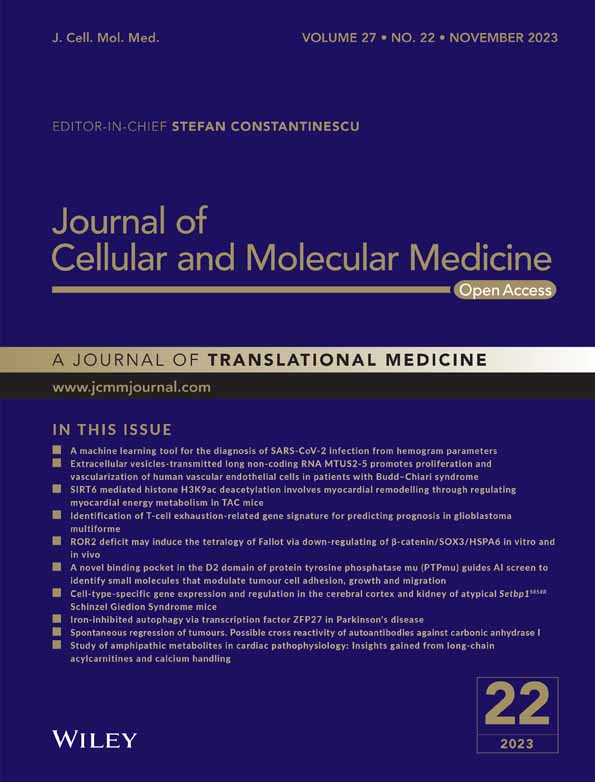
The Journal of Cellular and Molecular Medicine serves as a bridge between physiology and cellular medicine, as well as molecular biology and molecular therapeutics. With a 20-year history, the journal adopts an interdisciplinary approach to showcase innovative discoveries.
It publishes research aimed at advancing the collective understanding of the cellular and molecular mechanisms underlying diseases. The journal emphasizes translational studies that translate this knowledge into therapeutic strategies. Being fully open access, the journal is accessible to all readers.

 求助内容:
 应助结果提醒方式:


 京公网安备 11010802042870号


