A. Parveen, N. Surumbarkuzhali, D. Anitha Kumari, R. Kanimozhi, Arumugam Krishnan Arulmozhi
{"title":"Dual-functional Bi₂(Se₀0.8 S₀.₂)₃@C composite for high-performance supercapacitors and visible-light photocatalytic MB degradation","authors":"A. Parveen, N. Surumbarkuzhali, D. Anitha Kumari, R. Kanimozhi, Arumugam Krishnan Arulmozhi","doi":"10.1007/s10934-026-01933-y","DOIUrl":null,"url":null,"abstract":"<div><p>The development of stable, high-density electrode materials for use in advanced electrochemical energy storage systems is of utmost importance. This study presents a simple one-step chemical precipitation approach for the fabrication of Bi₂(Se₀.<sub>8</sub>S₀.₂)₃@C, a sulfur-modified bismuth selenide solid solution coupled with amorphous carbon. The presence of crystalline bismuth selenosulfide was verified through structural investigation. Morphological analysis revealed a network of nanosheets embedded within a carbon matrix, facilitating enhanced charge transfer and providing abundant electroactive sites. Electrochemical testing in a 3 M KOH electrolyte showed that the Bi₂(Se₀.₈S₀.₂)₃@C electrode achieved a specific capacitance of 950 F g⁻¹ at 1 A g⁻¹ and exhibited excellent cycling stability, retaining 98% of its capacitance after 5000 cycles with nearly 100% efficiency. An asymmetric supercapacitor device, using activated carbon as the negative electrode and Bi₂(Se₀.<sub>8</sub>S₀.₂)₃@C as the positive electrode, delivered a maximum energy density of 65 Wh kg⁻¹ at 877 W kg⁻¹ and 35 Wh kg⁻¹ at 3117 W kg⁻¹. Furthermore, after just 20 s of charging, two ASC coin cells connected in series were able to power multiple LEDs for approximately 10 min, demonstrating excellent power delivery and rapid energy storage capability. These results indicate that asymmetric supercapacitors based on sulfur-modified bismuth selenide–carbon composite electrodes can be highly effective. In addition, Bi₂(Se₀0.8 S₀.₂)₃@C shows enhanced photocatalytic performance with ~ 92% MB degradation, higher rate constant (0.0761 min⁻¹), and excellent stability over five cycles due to improved charge separation.</p></div>","PeriodicalId":660,"journal":{"name":"Journal of Porous Materials","volume":"33 4","pages":"1185 - 1199"},"PeriodicalIF":3.0000,"publicationDate":"2026-06-15","publicationTypes":"Journal Article","fieldsOfStudy":null,"isOpenAccess":false,"openAccessPdf":"","citationCount":"0","resultStr":null,"platform":"Semanticscholar","paperid":null,"PeriodicalName":"Journal of Porous Materials","FirstCategoryId":"88","ListUrlMain":"https://link.springer.com/article/10.1007/s10934-026-01933-y","RegionNum":4,"RegionCategory":"材料科学","ArticlePicture":[],"TitleCN":null,"AbstractTextCN":null,"PMCID":null,"EPubDate":"","PubModel":"","JCR":"Q2","JCRName":"CHEMISTRY, APPLIED","Score":null,"Total":0}
引用次数: 0
Abstract
The development of stable, high-density electrode materials for use in advanced electrochemical energy storage systems is of utmost importance. This study presents a simple one-step chemical precipitation approach for the fabrication of Bi₂(Se₀.8S₀.₂)₃@C, a sulfur-modified bismuth selenide solid solution coupled with amorphous carbon. The presence of crystalline bismuth selenosulfide was verified through structural investigation. Morphological analysis revealed a network of nanosheets embedded within a carbon matrix, facilitating enhanced charge transfer and providing abundant electroactive sites. Electrochemical testing in a 3 M KOH electrolyte showed that the Bi₂(Se₀.₈S₀.₂)₃@C electrode achieved a specific capacitance of 950 F g⁻¹ at 1 A g⁻¹ and exhibited excellent cycling stability, retaining 98% of its capacitance after 5000 cycles with nearly 100% efficiency. An asymmetric supercapacitor device, using activated carbon as the negative electrode and Bi₂(Se₀.8S₀.₂)₃@C as the positive electrode, delivered a maximum energy density of 65 Wh kg⁻¹ at 877 W kg⁻¹ and 35 Wh kg⁻¹ at 3117 W kg⁻¹. Furthermore, after just 20 s of charging, two ASC coin cells connected in series were able to power multiple LEDs for approximately 10 min, demonstrating excellent power delivery and rapid energy storage capability. These results indicate that asymmetric supercapacitors based on sulfur-modified bismuth selenide–carbon composite electrodes can be highly effective. In addition, Bi₂(Se₀0.8 S₀.₂)₃@C shows enhanced photocatalytic performance with ~ 92% MB degradation, higher rate constant (0.0761 min⁻¹), and excellent stability over five cycles due to improved charge separation.
双功能Bi₂(Se 0 0.8 S 0)。₂)₃@C复合材料用于高性能超级电容器和可见光光催化MB降解
开发稳定的高密度电极材料用于先进的电化学储能系统是至关重要的。本研究提出了一种简单的一步化学沉淀法,用于制备Bi₂(Se 0 .8 s 0)。2)₃@C,一种硫修饰的硒化铋固溶体与无定形碳结合。通过结构研究证实了硒化硫化铋结晶的存在。形态学分析显示,碳基质中嵌入了纳米片网络,促进了电荷转移并提供了丰富的电活性位点。在3m KOH电解液中进行电化学测试,结果表明:Bi₂(Se₀.₈S₀。₂)₃@C电极在1 a g⁻¹时的比电容达到950 F g⁻¹,并且表现出良好的循环稳定性,在5000次循环后保持98%的电容,效率接近100%。一种不对称超级电容器装置,使用活性炭作为负极和Bi₂(Se 0 .8 s 0)。₂)₃@C作为正极,在877 W kg⁻¹时产生的最大能量密度为65 Wh kg⁻¹,在3117 W kg⁻¹时产生的最大能量密度为35 Wh kg⁻¹。此外,在充电20秒后,串联的两个ASC硬币电池能够为多个led供电约10分钟,展示了出色的电力输送和快速储能能力。这些结果表明,基于硫修饰的硒化铋-碳复合电极的非对称超级电容器是非常有效的。另外,Bi₂(Se 0) 0.8 S 0。₂)₃@C表现出增强的光催化性能,可降解~ 92% MB,更高的速率常数(0.0761 min⁻¹),并且由于改进了电荷分离,在五个循环内具有优异的稳定性。
期刊介绍:
The Journal of Porous Materials is an interdisciplinary and international periodical devoted to all types of porous materials. Its aim is the rapid publication
of high quality, peer-reviewed papers focused on the synthesis, processing, characterization and property evaluation of all porous materials. The objective is to
establish a unique journal that will serve as a principal means of communication for the growing interdisciplinary field of porous materials.
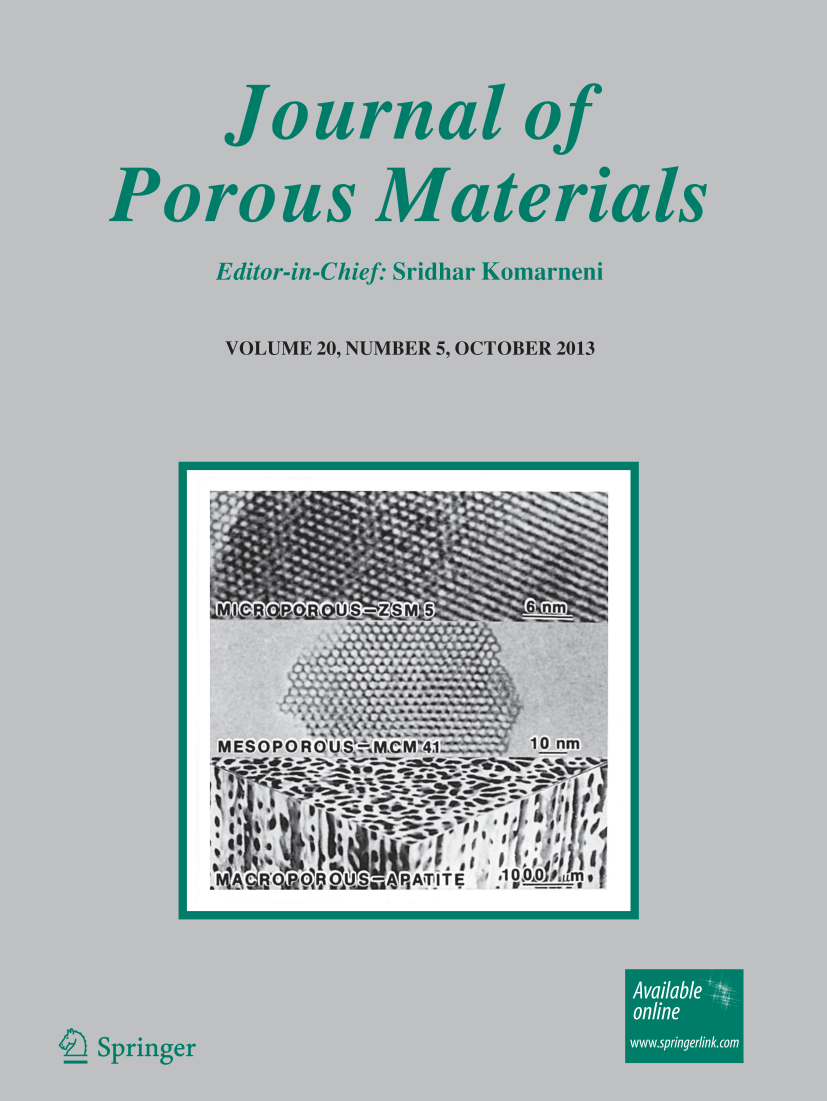
Porous materials include microporous materials with 50 nm pores.
Examples of microporous materials are natural and synthetic molecular sieves, cationic and anionic clays, pillared clays, tobermorites, pillared Zr and Ti
phosphates, spherosilicates, carbons, porous polymers, xerogels, etc. Mesoporous materials include synthetic molecular sieves, xerogels, aerogels, glasses, glass
ceramics, porous polymers, etc.; while macroporous materials include ceramics, glass ceramics, porous polymers, aerogels, cement, etc. The porous materials
can be crystalline, semicrystalline or noncrystalline, or combinations thereof. They can also be either organic, inorganic, or their composites. The overall
objective of the journal is the establishment of one main forum covering the basic and applied aspects of all porous materials.

 求助内容:
求助内容: 应助结果提醒方式:

 京公网安备 11010802042870号


