
On-chip broadband magnonic frequency combs based on multi-tone excitation
IF 42.3
1区 工程技术
Q1 ENGINEERING, ELECTRICAL & ELECTRONIC
引用次数: 0
Abstract
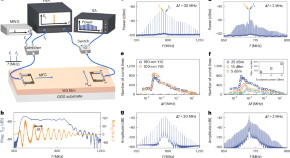
Magnonic frequency combs—the magnetic analogue of optical frequency combs—consist of evenly spaced spin-wave spectral lines and are of potential use in applications such as metrology, spectroscopy and information processing. However, their narrow bandwidths and small number of comb lines limit practical implementation. Here we report an on-chip broadband magnonic frequency comb based on multi-tone excitation. The octave-spanning magnonic frequency comb is generated at low power thresholds in a continuous yttrium iron garnet thin film. It is driven by spin-wave modulation instability stemming from four-magnon scattering, a nonlinear process validated by micromagnetic simulations. Our magnonic frequency combs exhibit long decay lengths, reaching up to hundreds of micrometres, and offer broad tunability in both the number of comb lines and their frequency spacing. We demonstrate, in particular, a comb with over 2,100 comb lines and densities of up to 200 lines per kilohertz. We also create a magnonic ruler that uses this finely structured spectra to detect microwave frequencies with high precision.
基于多音激励的片上宽带磁振频率梳
磁振频率梳——光学频率梳的磁性类似物——由均匀间隔的自旋波谱线组成,在计量学、光谱学和信息处理等应用中具有潜在的用途。然而,它们的窄带宽和较少的梳线限制了实际实现。本文报道了一种基于多音激励的片上宽带磁振频率梳。在低功率阈值下,在连续钇铁石榴石薄膜中产生了跨八度的磁频率梳。它是由四磁子散射引起的自旋波调制不稳定性驱动的,这是一个由微磁模拟验证的非线性过程。我们的磁振频率梳具有很长的衰减长度,可达数百微米,并且在梳线数量和频率间隔方面都具有广泛的可调性。我们特别展示了一个梳子,它有超过2100个梳线,密度高达每千赫兹200个梳线。我们还创建了一个磁尺子,使用这种结构精细的光谱来高精度地检测微波频率。
本文章由计算机程序翻译,如有差异,请以英文原文为准。
求助全文
约1分钟内获得全文
求助全文
来源期刊
Nature Electronics
Engineering-Electrical and Electronic Engineering
CiteScore
47.50
自引率
2.30%
发文量
159
期刊介绍:
Nature Electronics is a comprehensive journal that publishes both fundamental and applied research in the field of electronics. It encompasses a wide range of topics, including the study of new phenomena and devices, the design and construction of electronic circuits, and the practical applications of electronics. In addition, the journal explores the commercial and industrial aspects of electronics research.
The primary focus of Nature Electronics is on the development of technology and its potential impact on society. The journal incorporates the contributions of scientists, engineers, and industry professionals, offering a platform for their research findings. Moreover, Nature Electronics provides insightful commentary, thorough reviews, and analysis of the key issues that shape the field, as well as the technologies that are reshaping society.
Like all journals within the prestigious Nature brand, Nature Electronics upholds the highest standards of quality. It maintains a dedicated team of professional editors and follows a fair and rigorous peer-review process. The journal also ensures impeccable copy-editing and production, enabling swift publication. Additionally, Nature Electronics prides itself on its editorial independence, ensuring unbiased and impartial reporting.
In summary, Nature Electronics is a leading journal that publishes cutting-edge research in electronics. With its multidisciplinary approach and commitment to excellence, the journal serves as a valuable resource for scientists, engineers, and industry professionals seeking to stay at the forefront of advancements in the field.
 求助内容:
求助内容: 应助结果提醒方式:

 京公网安备 11010802042870号


