Hybrid electrolyte of ionic liquid and functionalized nanofiller for energy storage: dynamic and thermodynamic properties under extreme temperature and pressure conditions.
Soorya Koymeth, Marian Paluch, Riccardo Casalini, Aleksandra Nyga, Mateusz Dulski, Josh J Bailey, Pranav Sharda, Joanna Klimontko, Maciej Zubko, Zaneta Wojnarowska
{"title":"Hybrid electrolyte of ionic liquid and functionalized nanofiller for energy storage: dynamic and thermodynamic properties under extreme temperature and pressure conditions.","authors":"Soorya Koymeth, Marian Paluch, Riccardo Casalini, Aleksandra Nyga, Mateusz Dulski, Josh J Bailey, Pranav Sharda, Joanna Klimontko, Maciej Zubko, Zaneta Wojnarowska","doi":"10.1039/d6nh00170j","DOIUrl":null,"url":null,"abstract":"<p><p>Hybrid electrolytes combining ionic liquids with nanoscale fillers offer a transformative route toward safe, high-performance energy storage; however, the lack of understanding of their charge transport over a broad range of temperature and pressure conditions limits their application. Herein, we address this issue by examining the structural, conducting, viscoelastic and thermodynamic properties of a model quasi-solid electrolyte composed of an ammonium ionic liquid and charged polyhedral oligomeric silsesquioxane (POSS) nanoparticles over an extended temperature (173-393 K) and pressure (0.1-600 MPa) range. We demonstrate that the rigid POSS scaffold creates excess free volume, reduces compressibility and thermal expansion, and introduces reversible shear-thinning viscoelasticity while maintaining efficient ion conduction. Furthermore, our high-pressure experiments reveal that ion dynamics is mostly thermally activated in this nano-hybrid electrolyte and satisfies the density-scaling concept, enabling accurate prediction of ionic conductivity over 12 decades across a wide <i>T</i>-<i>P</i> landscape. This work establishes a fundamental and predictive framework for designing next-generation nano-hybrid electrolytes for operation in extreme environments.</p>","PeriodicalId":93,"journal":{"name":"Nanoscale Horizons","volume":" ","pages":"2602-2613"},"PeriodicalIF":6.4000,"publicationDate":"2026-10-12","publicationTypes":"Journal Article","fieldsOfStudy":null,"isOpenAccess":false,"openAccessPdf":"","citationCount":"0","resultStr":null,"platform":"Semanticscholar","paperid":null,"PeriodicalName":"Nanoscale Horizons","FirstCategoryId":"88","ListUrlMain":"https://doi.org/10.1039/d6nh00170j","RegionNum":2,"RegionCategory":"材料科学","ArticlePicture":[],"TitleCN":null,"AbstractTextCN":null,"PMCID":null,"EPubDate":"","PubModel":"","JCR":"Q1","JCRName":"CHEMISTRY, PHYSICAL","Score":null,"Total":0}
引用次数: 0
Abstract
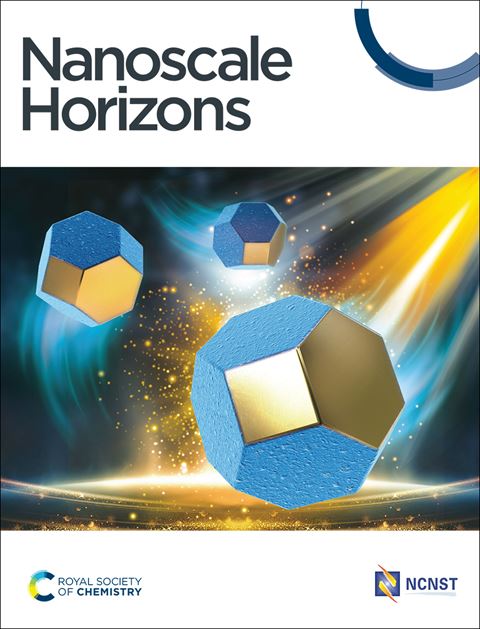
Hybrid electrolytes combining ionic liquids with nanoscale fillers offer a transformative route toward safe, high-performance energy storage; however, the lack of understanding of their charge transport over a broad range of temperature and pressure conditions limits their application. Herein, we address this issue by examining the structural, conducting, viscoelastic and thermodynamic properties of a model quasi-solid electrolyte composed of an ammonium ionic liquid and charged polyhedral oligomeric silsesquioxane (POSS) nanoparticles over an extended temperature (173-393 K) and pressure (0.1-600 MPa) range. We demonstrate that the rigid POSS scaffold creates excess free volume, reduces compressibility and thermal expansion, and introduces reversible shear-thinning viscoelasticity while maintaining efficient ion conduction. Furthermore, our high-pressure experiments reveal that ion dynamics is mostly thermally activated in this nano-hybrid electrolyte and satisfies the density-scaling concept, enabling accurate prediction of ionic conductivity over 12 decades across a wide T-P landscape. This work establishes a fundamental and predictive framework for designing next-generation nano-hybrid electrolytes for operation in extreme environments.
期刊介绍:
Nanoscale Horizons stands out as a premier journal for publishing exceptionally high-quality and innovative nanoscience and nanotechnology. The emphasis lies on original research that introduces a new concept or a novel perspective (a conceptual advance), prioritizing this over reporting technological improvements. Nevertheless, outstanding articles showcasing truly groundbreaking developments, including record-breaking performance, may also find a place in the journal. Published work must be of substantial general interest to our broad and diverse readership across the nanoscience and nanotechnology community.

 求助内容:
 应助结果提醒方式:


 京公网安备 11010802042870号


