{"title":"Synthesis and Electrocatalytic Mechanism of SrO/Monolayer C3N4 Composite for Vanillin Detection","authors":"Haibo Pan, Yongbo Qi, Fengzhen Xu, Yuanjie Xu","doi":"10.1002/elan.70198","DOIUrl":null,"url":null,"abstract":"<p>Synthesis at low temperature and interface characteristics in electrocatalysis for nanocomposites are alternative challenge up to date. A SrO nanoparticles (NPs)/g-C<sub>3</sub>N<sub>4</sub> nanosheets (SrO/ng-C<sub>3</sub>N<sub>4</sub>) composite was prepared by a feasible one-pot synthesis at 80 °C without post-sintering, where SrO NPs (with diameters of 20 ∼ 50 nm) were loaded onto ng-C<sub>3</sub>N<sub>4</sub> nanosheets to form an efficient electrocatalyst. By the aid of XPS and FT-IR analysis, it confirms that SrO NPs were anchored in proximity to the s-triazine units of ng-C<sub>3</sub>N<sub>4</sub> via Sr<span></span>N bonds. Based on the surface charge characteristics, the electrostatic adsorption between SrO/ng-C<sub>3</sub>N<sub>4</sub> and vanillin as a catalysant was verified. C<sub>7</sub>H<sub>5</sub>O<sub>2</sub><sup>−</sup> anions after the hydrolyzation and ionization of vanillin in PBS solution were adsorbed on the surface of positively charged SrO/ng-C<sub>3</sub>N<sub>4</sub> before electro-oxidation. The electrocatalytically active centers, i.e., oxygen vacancies on the surface of SrO NPs, facilitate in the oxidation of vanillin, and further the overpotential of the electrocatalyst by SrO/ng-C<sub>3</sub>N<sub>4</sub> toward vanillin is reduced. A detail eletro-oxidation process of vanillin was identified by UV–vis spectra and differential pulse voltammetry analysis. Based on the Laviron equation, two electrons transfer from vanillin during the oxidation reaction, and speculates the reaction mechanism. Under optimal conditions, vanillin oxidation current is linear to its concentration in the range of 2.0 × 10<sup>−8</sup> to 1.4 × 10<sup>−5 </sup>M, with a detection limit of 6.7 nM (S/N = 3). The limit value complies with the requirements of the World Health Organization and the Chinese Health Standard. As-prepared sensor applied for the quantification of vanillin in milk samples is long-term stable, selective, and feasible.</p>","PeriodicalId":162,"journal":{"name":"Electroanalysis","volume":"38 8","pages":""},"PeriodicalIF":2.6000,"publicationDate":"2026-08-13","publicationTypes":"Journal Article","fieldsOfStudy":null,"isOpenAccess":false,"openAccessPdf":"","citationCount":"0","resultStr":null,"platform":"Semanticscholar","paperid":null,"PeriodicalName":"Electroanalysis","FirstCategoryId":"92","ListUrlMain":"https://onlinelibrary.wiley.com/doi/10.1002/elan.70198","RegionNum":3,"RegionCategory":"化学","ArticlePicture":[],"TitleCN":null,"AbstractTextCN":null,"PMCID":null,"EPubDate":"","PubModel":"","JCR":"Q2","JCRName":"CHEMISTRY, ANALYTICAL","Score":null,"Total":0}
引用次数: 0
Abstract
Synthesis at low temperature and interface characteristics in electrocatalysis for nanocomposites are alternative challenge up to date. A SrO nanoparticles (NPs)/g-C3N4 nanosheets (SrO/ng-C3N4) composite was prepared by a feasible one-pot synthesis at 80 °C without post-sintering, where SrO NPs (with diameters of 20 ∼ 50 nm) were loaded onto ng-C3N4 nanosheets to form an efficient electrocatalyst. By the aid of XPS and FT-IR analysis, it confirms that SrO NPs were anchored in proximity to the s-triazine units of ng-C3N4 via SrN bonds. Based on the surface charge characteristics, the electrostatic adsorption between SrO/ng-C3N4 and vanillin as a catalysant was verified. C7H5O2− anions after the hydrolyzation and ionization of vanillin in PBS solution were adsorbed on the surface of positively charged SrO/ng-C3N4 before electro-oxidation. The electrocatalytically active centers, i.e., oxygen vacancies on the surface of SrO NPs, facilitate in the oxidation of vanillin, and further the overpotential of the electrocatalyst by SrO/ng-C3N4 toward vanillin is reduced. A detail eletro-oxidation process of vanillin was identified by UV–vis spectra and differential pulse voltammetry analysis. Based on the Laviron equation, two electrons transfer from vanillin during the oxidation reaction, and speculates the reaction mechanism. Under optimal conditions, vanillin oxidation current is linear to its concentration in the range of 2.0 × 10⁻⁸ to 1.4 × 10⁻⁵ M, with a detection limit of 6.7 nM (S/N = 3). The limit value complies with the requirements of the World Health Organization and the Chinese Health Standard. As-prepared sensor applied for the quantification of vanillin in milk samples is long-term stable, selective, and feasible.
期刊介绍:
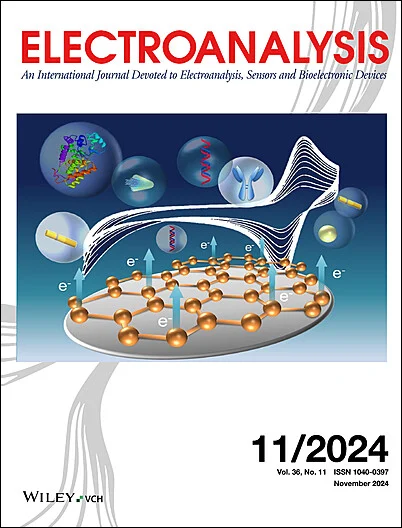
Electroanalysis is an international, peer-reviewed journal covering all branches of electroanalytical chemistry, including both fundamental and application papers as well as reviews dealing with new electrochemical sensors and biosensors, nanobioelectronics devices, analytical voltammetry, potentiometry, new electrochemical detection schemes based on novel nanomaterials, fuel cells and biofuel cells, and important practical applications.
Serving as a vital communication link between the research labs and the field, Electroanalysis helps you to quickly adapt the latest innovations into practical clinical, environmental, food analysis, industrial and energy-related applications. Electroanalysis provides the most comprehensive coverage of the field and is the number one source for information on electroanalytical chemistry, electrochemical sensors and biosensors and fuel/biofuel cells.

 求助内容:
 应助结果提醒方式:


 京公网安备 11010802042870号


