Shuai He, Man Zhao, Ze Wang, Shili Fang, Yuhong Chang, Junming Zhang, Li Zhang, Haishun Wu, He Xiao, JianFeng Jia
{"title":"Built-in Electric Field Enables Relay Catalysis in Ni4Mo/MoO2 Mott-Schottky Heterojunction for Selective Methanol-to-Formate Electrooxidation","authors":"Shuai He, Man Zhao, Ze Wang, Shili Fang, Yuhong Chang, Junming Zhang, Li Zhang, Haishun Wu, He Xiao, JianFeng Jia","doi":"10.1002/cjoc.70693","DOIUrl":null,"url":null,"abstract":"<div>\n \n <p>The selective electrooxidation of methanol to formate is a kinetically complex process involving multiple intermediates (<i>e.g</i>., *CH<sub>3</sub>O, *CHO, *OH), whose adsorption energies are difficult to regulate simultaneously. Here, we report a conceptually new electric-field-directed relay catalysis strategy based on a Ni<sub>4</sub>Mo/MoO<sub>2</sub> Mott-Schottky heterojunction. Using a combination of UPS, XPS, and XAFS, we demonstrate that the built-in electric field (BIEF) drives directional electron transfer from metallic Ni<sub>4</sub>Mo to semiconducting MoO<sub>2</sub>, creating spatially separated electron-deficient Ni sites and electron-rich MoO<sub>2</sub> interfaces. Operando FTIR and Raman spectroscopy directly visualize the dynamic evolution of intermediates, revealing a relay mechanism: Ni sites promote *CH<sub>3</sub>O adsorption and C–H/O–H bond cleavage, while MoO<sub>2</sub> enhances *OH supply to accelerate *CHO oxidation. DFT calculations confirm that this BIEF-mediated spatial decoupling lowers the energy barrier of the potential-determining step (*CHO → *HCOOH) from 1.96 eV (Ni<sub>4</sub>Mo) to only 0.76 eV. Consequently, the obtained catalyst achieves a peak current density of 345.2 mA·cm<sup>–2</sup> with >97% Faradaic efficiency for formate. This work establishes a new paradigm for designing heterojunction electrocatalysts that leverage interfacial electric fields to orchestrate multi-step reaction pathways with high selectivity.</p>\n <p></p>\n </div>","PeriodicalId":151,"journal":{"name":"Chinese Journal of Chemistry","volume":"44 18","pages":"3043-3054"},"PeriodicalIF":5.7000,"publicationDate":"2026-08-17","publicationTypes":"Journal Article","fieldsOfStudy":null,"isOpenAccess":false,"openAccessPdf":"","citationCount":"0","resultStr":null,"platform":"Semanticscholar","paperid":null,"PeriodicalName":"Chinese Journal of Chemistry","FirstCategoryId":"92","ListUrlMain":"https://onlinelibrary.wiley.com/doi/10.1002/cjoc.70693","RegionNum":1,"RegionCategory":"化学","ArticlePicture":[],"TitleCN":null,"AbstractTextCN":null,"PMCID":null,"EPubDate":"2026/7/15 0:00:00","PubModel":"Epub","JCR":"Q2","JCRName":"CHEMISTRY, MULTIDISCIPLINARY","Score":null,"Total":0}
引用次数: 0
Abstract
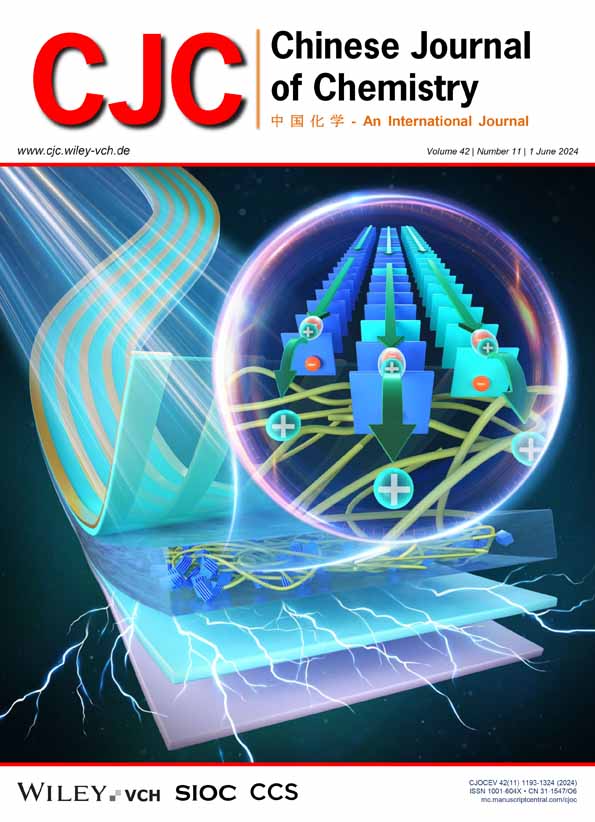
The selective electrooxidation of methanol to formate is a kinetically complex process involving multiple intermediates (e.g., *CH3O, *CHO, *OH), whose adsorption energies are difficult to regulate simultaneously. Here, we report a conceptually new electric-field-directed relay catalysis strategy based on a Ni4Mo/MoO2 Mott-Schottky heterojunction. Using a combination of UPS, XPS, and XAFS, we demonstrate that the built-in electric field (BIEF) drives directional electron transfer from metallic Ni4Mo to semiconducting MoO2, creating spatially separated electron-deficient Ni sites and electron-rich MoO2 interfaces. Operando FTIR and Raman spectroscopy directly visualize the dynamic evolution of intermediates, revealing a relay mechanism: Ni sites promote *CH3O adsorption and C–H/O–H bond cleavage, while MoO2 enhances *OH supply to accelerate *CHO oxidation. DFT calculations confirm that this BIEF-mediated spatial decoupling lowers the energy barrier of the potential-determining step (*CHO → *HCOOH) from 1.96 eV (Ni4Mo) to only 0.76 eV. Consequently, the obtained catalyst achieves a peak current density of 345.2 mA·cm–2 with >97% Faradaic efficiency for formate. This work establishes a new paradigm for designing heterojunction electrocatalysts that leverage interfacial electric fields to orchestrate multi-step reaction pathways with high selectivity.
期刊介绍:
The Chinese Journal of Chemistry is an international forum for peer-reviewed original research results in all fields of chemistry. Founded in 1983 under the name Acta Chimica Sinica English Edition and renamed in 1990 as Chinese Journal of Chemistry, the journal publishes a stimulating mixture of Accounts, Full Papers, Notes and Communications in English.

 求助内容:
 应助结果提醒方式:


 京公网安备 11010802042870号


