{"title":"Binding Properties and Sensitivity of the Electrochemical Aptasensor for Aflatoxin M1 Detection in Milk","authors":"Lenka Bábelová, Cyril Slabý, Tibor Hianik","doi":"10.1002/elan.70200","DOIUrl":null,"url":null,"abstract":"<p>We report a sensitive aptamer-based biosensor for electrochemical detection of aflatoxin M1 (AFM1). The DNA aptamers specific to AFM1 in a molecular beacon configuration were modified at 3′-terminal by redox probe methylene blue (MB) and by thiol group at 5′ terminal. The aptamers immobilized at the gold surface changed the conformation in the presence of AFM1, which resulted in a decrease in the current amplitude due to increased distance between MB and the sensing surface. The limit of detection (LOD) of the aptasensor in buffer and in 10× diluted milk sample has been determined as 2.92 and 8.63 ng/L, respectively, which is below the maximum permissible limit (MPL) for AFM1 in milk established by EU (50 ng/L). The analysis of the binding of AFM1 to the aptamers by adsorption isotherms showed that, in the case of buffer, the Langmuir model described this binding well. However, in milk, the satisfactory results were obtained only using the Freundlich adsorption model. This is evidence that in addition to the specific adsorption of the AFM1 to the aptamer binding sites, certain physical adsorption of milk components such as caseins took place.</p>","PeriodicalId":162,"journal":{"name":"Electroanalysis","volume":"38 8","pages":""},"PeriodicalIF":2.6000,"publicationDate":"2026-08-11","publicationTypes":"Journal Article","fieldsOfStudy":null,"isOpenAccess":false,"openAccessPdf":"","citationCount":"0","resultStr":null,"platform":"Semanticscholar","paperid":null,"PeriodicalName":"Electroanalysis","FirstCategoryId":"92","ListUrlMain":"https://onlinelibrary.wiley.com/doi/10.1002/elan.70200","RegionNum":3,"RegionCategory":"化学","ArticlePicture":[],"TitleCN":null,"AbstractTextCN":null,"PMCID":null,"EPubDate":"","PubModel":"","JCR":"Q2","JCRName":"CHEMISTRY, ANALYTICAL","Score":null,"Total":0}
引用次数: 0
Abstract
We report a sensitive aptamer-based biosensor for electrochemical detection of aflatoxin M1 (AFM1). The DNA aptamers specific to AFM1 in a molecular beacon configuration were modified at 3′-terminal by redox probe methylene blue (MB) and by thiol group at 5′ terminal. The aptamers immobilized at the gold surface changed the conformation in the presence of AFM1, which resulted in a decrease in the current amplitude due to increased distance between MB and the sensing surface. The limit of detection (LOD) of the aptasensor in buffer and in 10× diluted milk sample has been determined as 2.92 and 8.63 ng/L, respectively, which is below the maximum permissible limit (MPL) for AFM1 in milk established by EU (50 ng/L). The analysis of the binding of AFM1 to the aptamers by adsorption isotherms showed that, in the case of buffer, the Langmuir model described this binding well. However, in milk, the satisfactory results were obtained only using the Freundlich adsorption model. This is evidence that in addition to the specific adsorption of the AFM1 to the aptamer binding sites, certain physical adsorption of milk components such as caseins took place.
期刊介绍:
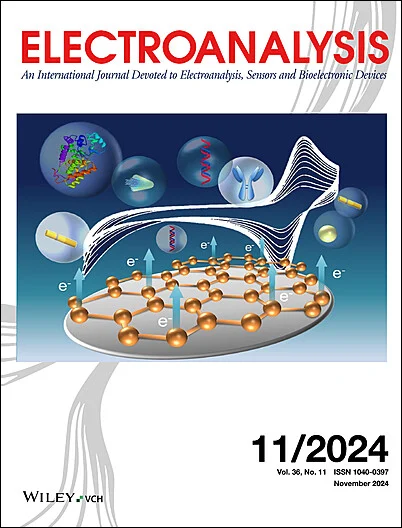
Electroanalysis is an international, peer-reviewed journal covering all branches of electroanalytical chemistry, including both fundamental and application papers as well as reviews dealing with new electrochemical sensors and biosensors, nanobioelectronics devices, analytical voltammetry, potentiometry, new electrochemical detection schemes based on novel nanomaterials, fuel cells and biofuel cells, and important practical applications.
Serving as a vital communication link between the research labs and the field, Electroanalysis helps you to quickly adapt the latest innovations into practical clinical, environmental, food analysis, industrial and energy-related applications. Electroanalysis provides the most comprehensive coverage of the field and is the number one source for information on electroanalytical chemistry, electrochemical sensors and biosensors and fuel/biofuel cells.

 求助内容:
 应助结果提醒方式:


 京公网安备 11010802042870号


