{"title":"Atmospheric deposition of microparticles on the seasonally-touristed island of Nantucket, Massachusetts, US","authors":"Nicholas Warner, Juanita Urban-Rich","doi":"10.1007/s11869-026-02064-8","DOIUrl":null,"url":null,"abstract":"<div><p>Major sources of atmospheric microplastic originate from human activities (e.g. construction, driving, laundry, and agriculture dust), along with sea-spray. Due to their small size (< 5 mm), they are easily transported long distances, being found in both urban and remote environments. This research examines the atmospheric deposition of microparticles on a seasonally-touristed island. Nantucket Island, USA, is a unique study site due to its proximity to ocean-atmospheric exchanges and its high influx of seasonal visitors. Atmospheric microparticles were collected at two contrasting sites and analyzed for amount and type from October 2021 to September 2022. Samples were collected each month and processed, counted, and measured. Microparticle flux ranged from 4.6 to 62.2 mp/m<sup>2</sup>/d and were composed mostly of fibers, > 75 μm. The Hatchery site had an average and s.d. of 28.2 ± 13.3 mp/m<sup>2</sup>/d and the Station site had an average and s.d. of 15.7 ± 8.2 mp/m<sup>2</sup>/d. Concentrations during the tourist months were 1.5 times greater than the non-tourist months.</p></div>","PeriodicalId":49109,"journal":{"name":"Air Quality Atmosphere and Health","volume":"19 8","pages":""},"PeriodicalIF":3.1000,"publicationDate":"2026-08-11","publicationTypes":"Journal Article","fieldsOfStudy":null,"isOpenAccess":false,"openAccessPdf":"","citationCount":"0","resultStr":null,"platform":"Semanticscholar","paperid":null,"PeriodicalName":"Air Quality Atmosphere and Health","FirstCategoryId":"93","ListUrlMain":"https://link.springer.com/article/10.1007/s11869-026-02064-8","RegionNum":4,"RegionCategory":"环境科学与生态学","ArticlePicture":[],"TitleCN":null,"AbstractTextCN":null,"PMCID":null,"EPubDate":"","PubModel":"","JCR":"Q3","JCRName":"ENVIRONMENTAL SCIENCES","Score":null,"Total":0}
引用次数: 0
Abstract
Major sources of atmospheric microplastic originate from human activities (e.g. construction, driving, laundry, and agriculture dust), along with sea-spray. Due to their small size (< 5 mm), they are easily transported long distances, being found in both urban and remote environments. This research examines the atmospheric deposition of microparticles on a seasonally-touristed island. Nantucket Island, USA, is a unique study site due to its proximity to ocean-atmospheric exchanges and its high influx of seasonal visitors. Atmospheric microparticles were collected at two contrasting sites and analyzed for amount and type from October 2021 to September 2022. Samples were collected each month and processed, counted, and measured. Microparticle flux ranged from 4.6 to 62.2 mp/m2/d and were composed mostly of fibers, > 75 μm. The Hatchery site had an average and s.d. of 28.2 ± 13.3 mp/m2/d and the Station site had an average and s.d. of 15.7 ± 8.2 mp/m2/d. Concentrations during the tourist months were 1.5 times greater than the non-tourist months.
期刊介绍:
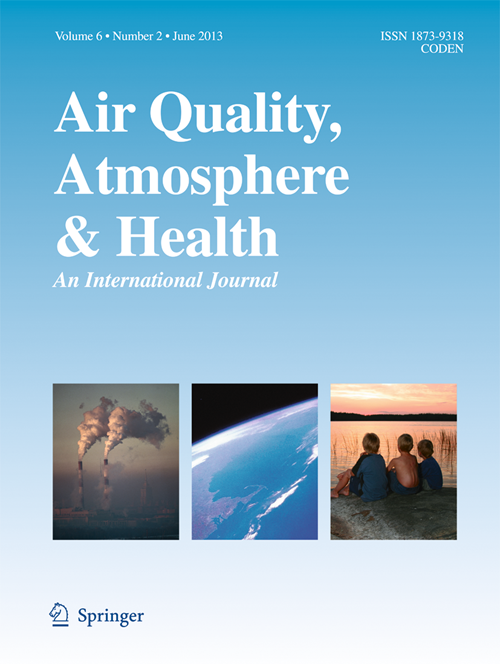
Air Quality, Atmosphere, and Health is a multidisciplinary journal which, by its very name, illustrates the broad range of work it publishes and which focuses on atmospheric consequences of human activities and their implications for human and ecological health.
It offers research papers, critical literature reviews and commentaries, as well as special issues devoted to topical subjects or themes.
International in scope, the journal presents papers that inform and stimulate a global readership, as the topic addressed are global in their import. Consequently, we do not encourage submission of papers involving local data that relate to local problems. Unless they demonstrate wide applicability, these are better submitted to national or regional journals.
Air Quality, Atmosphere & Health addresses such topics as acid precipitation; airborne particulate matter; air quality monitoring and management; exposure assessment; risk assessment; indoor air quality; atmospheric chemistry; atmospheric modeling and prediction; air pollution climatology; climate change and air quality; air pollution measurement; atmospheric impact assessment; forest-fire emissions; atmospheric science; greenhouse gases; health and ecological effects; clean air technology; regional and global change and satellite measurements.
This journal benefits a diverse audience of researchers, public health officials and policy makers addressing problems that call for solutions based in evidence from atmospheric and exposure assessment scientists, epidemiologists, and risk assessors. Publication in the journal affords the opportunity to reach beyond defined disciplinary niches to this broader readership.

 求助内容:
 应助结果提醒方式:


 京公网安备 11010802042870号


