
{"title":"GreenAirOps: production-ready MLOps for real-time air quality index prediction","authors":"Sahil Goyal, Vaibhav Sharma, Vivek Hotchandani, Girish Mahale, Mayur Gaikwad, Aniket K. Shahade","doi":"10.1007/s11869-026-02068-4","DOIUrl":null,"url":null,"abstract":"<div><p>Pollution is a growing problem with dire effects on public health; therefore, accurate prediction of Air Quality Index (AQI) is paramount for both urban development and public health strategy. Here, we present GreenAirOps, a production-ready MLOps system that ingests multithsource environmental data, automatizes preprocessing and feature extraction, and combines Random For- est and XGBoost with ensemble learning for prediction of low-latency, near real-time AQI. This production pipeline has full MLOps pipeline capabilities: Data versioning with DVC; experiment tracking and model registration with MLflow; automated retraining and deployment using GitHub Actions. The deployment infrastructure utilizes Docker containers run on an AWS environ- ment and is designed for production grade. The specific contributions of this work are: an optimized ensemble learning system for low-latency AQI prediction; an end-to-end MLOps system which guarantee reproducibility and operational capability; and a set of production grade functions for auto-retraining, model health monitoring and auto-rollback.</p></div>","PeriodicalId":49109,"journal":{"name":"Air Quality Atmosphere and Health","volume":"19 8","pages":""},"PeriodicalIF":3.1000,"publicationDate":"2026-08-04","publicationTypes":"Journal Article","fieldsOfStudy":null,"isOpenAccess":false,"openAccessPdf":"https://link.springer.com/content/pdf/10.1007/s11869-026-02068-4.pdf","citationCount":"0","resultStr":null,"platform":"Semanticscholar","paperid":null,"PeriodicalName":"Air Quality Atmosphere and Health","FirstCategoryId":"93","ListUrlMain":"https://link.springer.com/article/10.1007/s11869-026-02068-4","RegionNum":4,"RegionCategory":"环境科学与生态学","ArticlePicture":[],"TitleCN":null,"AbstractTextCN":null,"PMCID":null,"EPubDate":"","PubModel":"","JCR":"Q3","JCRName":"ENVIRONMENTAL SCIENCES","Score":null,"Total":0}
引用次数: 0
Abstract
Pollution is a growing problem with dire effects on public health; therefore, accurate prediction of Air Quality Index (AQI) is paramount for both urban development and public health strategy. Here, we present GreenAirOps, a production-ready MLOps system that ingests multithsource environmental data, automatizes preprocessing and feature extraction, and combines Random For- est and XGBoost with ensemble learning for prediction of low-latency, near real-time AQI. This production pipeline has full MLOps pipeline capabilities: Data versioning with DVC; experiment tracking and model registration with MLflow; automated retraining and deployment using GitHub Actions. The deployment infrastructure utilizes Docker containers run on an AWS environ- ment and is designed for production grade. The specific contributions of this work are: an optimized ensemble learning system for low-latency AQI prediction; an end-to-end MLOps system which guarantee reproducibility and operational capability; and a set of production grade functions for auto-retraining, model health monitoring and auto-rollback.
期刊介绍:
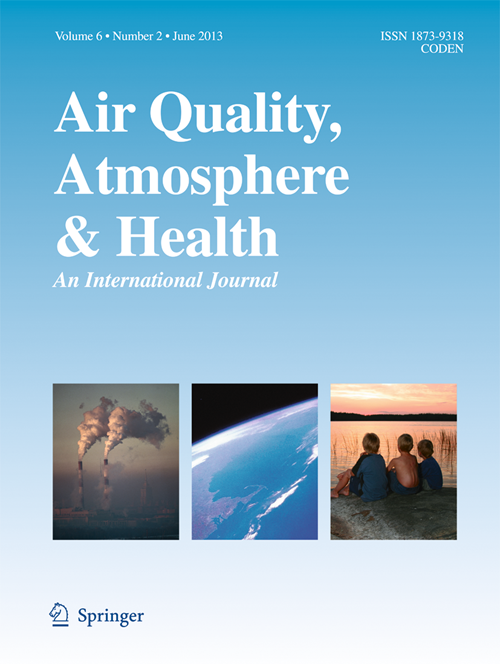
Air Quality, Atmosphere, and Health is a multidisciplinary journal which, by its very name, illustrates the broad range of work it publishes and which focuses on atmospheric consequences of human activities and their implications for human and ecological health.
It offers research papers, critical literature reviews and commentaries, as well as special issues devoted to topical subjects or themes.
International in scope, the journal presents papers that inform and stimulate a global readership, as the topic addressed are global in their import. Consequently, we do not encourage submission of papers involving local data that relate to local problems. Unless they demonstrate wide applicability, these are better submitted to national or regional journals.
Air Quality, Atmosphere & Health addresses such topics as acid precipitation; airborne particulate matter; air quality monitoring and management; exposure assessment; risk assessment; indoor air quality; atmospheric chemistry; atmospheric modeling and prediction; air pollution climatology; climate change and air quality; air pollution measurement; atmospheric impact assessment; forest-fire emissions; atmospheric science; greenhouse gases; health and ecological effects; clean air technology; regional and global change and satellite measurements.
This journal benefits a diverse audience of researchers, public health officials and policy makers addressing problems that call for solutions based in evidence from atmospheric and exposure assessment scientists, epidemiologists, and risk assessors. Publication in the journal affords the opportunity to reach beyond defined disciplinary niches to this broader readership.



