
Hydrodynamics rather than water temperature shapes the macroinvertebrate communities in alpine rivers on the Qinghai–Xizang Plateau
IF 14.3
1区 环境科学与生态学
Q1 ENVIRONMENTAL SCIENCES
Environmental Science and Ecotechnology
Pub Date : 2026-09-01
Epub Date: 2026-08-10
DOI:10.1016/j.ese.2026.100752
引用次数: 0
Abstract
Climate change is rapidly altering global glacier-fed rivers, with prevailing models assuming that water temperature increases dictate aquatic community succession. However, this thermal-centric paradigm struggles to explain biodiversity patterns within the extreme topographic and hydrologic gradients of the Third Pole. By analyzing macroinvertebrate assemblages across the Yarlung Tsangpo Basin, we show that hydrodynamic condition, rather than water temperature, primarily influences biodiversity and community assembly in these high-altitude alpine rivers. With hydrodynamic intensity indicated by specific stream power, taxa richness exhibits a universal unimodal response, consistently peaking under moderate hydrodynamic intensity (1 to 10 W m−2). Extreme stream power acts as a severe physical filter, driving a stark taxonomic shift from filamentous-gilled species in moderate flows to robust, flat-bodied specialists capable of resisting ultra-high-power environments. These findings demonstrate that localized hydrodynamic modulation—rather than unattainable temperature control—provides a highly viable, climate-resilient strategy to safeguard biodiversity in the Third Pole and analogous alpine river networks worldwide.
青藏高原高寒河流中大型无脊椎动物群落由水动力而非水温决定
本文章由计算机程序翻译,如有差异,请以英文原文为准。
求助全文
约1分钟内获得全文
求助全文
来源期刊
Environmental Science and Ecotechnology
Multiple-
CiteScore
20.40
自引率
6.30%
发文量
11
审稿时长
18 days
期刊介绍:
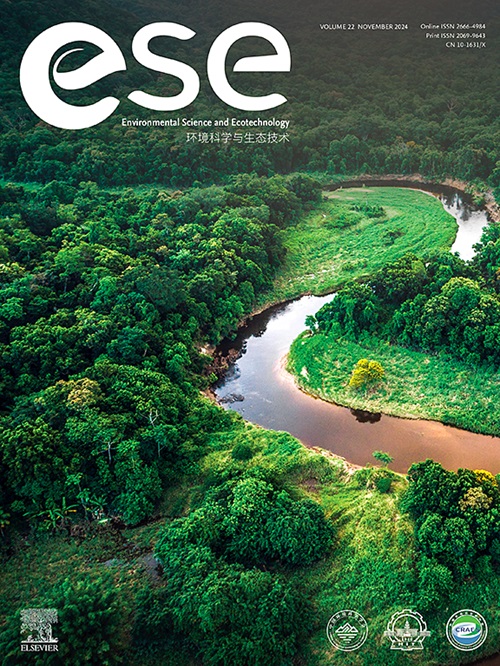
Environmental Science & Ecotechnology (ESE) is an international, open-access journal publishing original research in environmental science, engineering, ecotechnology, and related fields. Authors publishing in ESE can immediately, permanently, and freely share their work. They have license options and retain copyright. Published by Elsevier, ESE is co-organized by the Chinese Society for Environmental Sciences, Harbin Institute of Technology, and the Chinese Research Academy of Environmental Sciences, under the supervision of the China Association for Science and Technology.
 求助内容:
求助内容: 应助结果提醒方式:

 京公网安备 11010802042870号


