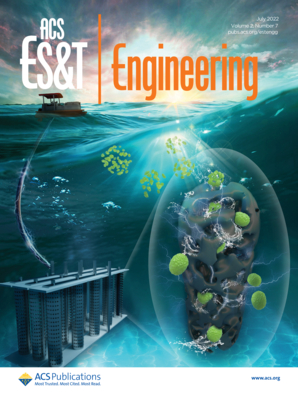
{"title":"Hydrodynamic Regulation of Anodic Biocake in AnEMBRs: from Community Assembly and Spatial Structure to “Cell Filter” Engineering","authors":"Peijin Cheng, Lin Zhang, Xuejie Zhao, Chen Wang, Guozhong Shi, Zhuodong Yu, Haoran Xu, Xiangyang Xu, Liang Zhu","doi":"10.1021/acsestengg.6c00269","DOIUrl":null,"url":null,"abstract":"<p>Transitioning the biocake of anaerobic electrochemical\r\nmembrane\r\nbioreactors (AnEMBRs) into a functional “cell filter”\r\npresents an ideal paradigm for simultaneous fouling mitigation and\r\ndeep effluent purification. However, the strategic orchestration for\r\nthe precision regulation of the biointerface remains unresolved. This\r\nstudy investigated the effect of hydrodynamics on the community assembly,\r\nspatial structure, and metabolic activity of anodic biocakes. AnEMBRs\r\nwere operated under gradient flux (8.5–34 LMH) and shear (0.13–2.12\r\nPa) regimes. Ecological analysis revealed that under the interplay\r\nof deterministic anodic selection and stochastic hydrodynamic deposition,\r\nlow-flux operation (8.5 LMH) amplified the homogeneous selection of\r\nthe anodic potential, maximizing the enrichment of core electroactive\r\ngenera (e.g., <em>Geobacter</em>, <em>Desulfovibrio</em>) to 24.7%, forwarding an enhanced synergetic metabolism of “acetogenesis-anode\r\nrespiration.” Meanwhile, unconstrained thickening of biocakes\r\ntriggered an “active-outer/decayed-inner” stratification,\r\nwhere <em>Methanosaeta</em>-mediated occlusion starved the\r\ninner exoelectrogens due to limited substrate diffusion. Crucially,\r\nthe application of moderate shear (0.87 Pa) effectively constrained\r\nthickness of biocake (<50 μm) to suppress methanogens colonization.\r\nThe formed “cell filter” exhibited superior permeability\r\nwith improved porosity and reduced resistance, while maintaining robust\r\nmetabolic activity for the discharged DOM. This research provided\r\na strategic framework for the directional assembly of “cell\r\nfilter,” advancing the precision engineering of biointerfaces\r\nfor sustainable wastewater treatment.</p>","PeriodicalId":7008,"journal":{"name":"ACS ES&T engineering","volume":"6 8","pages":"2195–2207"},"PeriodicalIF":6.3000,"publicationDate":"2026-08-14","publicationTypes":"Journal Article","fieldsOfStudy":null,"isOpenAccess":false,"openAccessPdf":"","citationCount":"0","resultStr":null,"platform":"Semanticscholar","paperid":null,"PeriodicalName":"ACS ES&T engineering","FirstCategoryId":"1085","ListUrlMain":"https://pubs.acs.org/doi/10.1021/acsestengg.6c00269","RegionNum":0,"RegionCategory":null,"ArticlePicture":[],"TitleCN":null,"AbstractTextCN":null,"PMCID":null,"EPubDate":"2026/7/7 0:00:00","PubModel":"Epub","JCR":"Q1","JCRName":"ENGINEERING, ENVIRONMENTAL","Score":null,"Total":0}
引用次数: 0
Abstract
Transitioning the biocake of anaerobic electrochemical
membrane
bioreactors (AnEMBRs) into a functional “cell filter”
presents an ideal paradigm for simultaneous fouling mitigation and
deep effluent purification. However, the strategic orchestration for
the precision regulation of the biointerface remains unresolved. This
study investigated the effect of hydrodynamics on the community assembly,
spatial structure, and metabolic activity of anodic biocakes. AnEMBRs
were operated under gradient flux (8.5–34 LMH) and shear (0.13–2.12
Pa) regimes. Ecological analysis revealed that under the interplay
of deterministic anodic selection and stochastic hydrodynamic deposition,
low-flux operation (8.5 LMH) amplified the homogeneous selection of
the anodic potential, maximizing the enrichment of core electroactive
genera (e.g., Geobacter, Desulfovibrio) to 24.7%, forwarding an enhanced synergetic metabolism of “acetogenesis-anode
respiration.” Meanwhile, unconstrained thickening of biocakes
triggered an “active-outer/decayed-inner” stratification,
where Methanosaeta-mediated occlusion starved the
inner exoelectrogens due to limited substrate diffusion. Crucially,
the application of moderate shear (0.87 Pa) effectively constrained
thickness of biocake (<50 μm) to suppress methanogens colonization.
The formed “cell filter” exhibited superior permeability
with improved porosity and reduced resistance, while maintaining robust
metabolic activity for the discharged DOM. This research provided
a strategic framework for the directional assembly of “cell
filter,” advancing the precision engineering of biointerfaces
for sustainable wastewater treatment.
期刊介绍:
ACS ES&T Engineering publishes impactful research and review articles across all realms of environmental technology and engineering, employing a rigorous peer-review process. As a specialized journal, it aims to provide an international platform for research and innovation, inviting contributions on materials technologies, processes, data analytics, and engineering systems that can effectively manage, protect, and remediate air, water, and soil quality, as well as treat wastes and recover resources.
The journal encourages research that supports informed decision-making within complex engineered systems and is grounded in mechanistic science and analytics, describing intricate environmental engineering systems. It considers papers presenting novel advancements, spanning from laboratory discovery to field-based application. However, case or demonstration studies lacking significant scientific advancements and technological innovations are not within its scope.
Contributions containing experimental and/or theoretical methods, rooted in engineering principles and integrated with knowledge from other disciplines, are welcomed.

 求助内容:
求助内容: 应助结果提醒方式:

 京公网安备 11010802042870号


