Nicolas D Moya, Bowen Wang, Robyn E Tanny, Michael E G Sauria, Lance M O'Connor, Ayeh Khorshidian, Ryan McKeown, Charlie Gosse, Clayton M Dilks, Timothy A Crombie, Gaotian Zhang, Emha Rais, Lise Frézal, Viet Dai Dang, Elkana Haryoso, Mia P Devi, Clotilde Gimond, Daniel E Cook, Jung-Chen Hsu, Amanda O Shaver, Stefan Zdraljevic, Aurélien Richaud, Tongshu Wen, Aatira Mehraj, Sharanya H, Karthick Raja Arulprakasam, Emily J Koury, Nicole M Roberto, Etta S Schaye, Varsha Singh, Hagus Tarno, Michael Ailion, Annalise B Paaby, Zhongying Zhao, Asher D Cutter, John Wang, Matthew V Rockman, Marie-Anne Félix, Christian Braendle, Erik C Andersen
{"title":"Population structure and punctuated genomic hyper-diversity in Caenorhabditis briggsae.","authors":"Nicolas D Moya, Bowen Wang, Robyn E Tanny, Michael E G Sauria, Lance M O'Connor, Ayeh Khorshidian, Ryan McKeown, Charlie Gosse, Clayton M Dilks, Timothy A Crombie, Gaotian Zhang, Emha Rais, Lise Frézal, Viet Dai Dang, Elkana Haryoso, Mia P Devi, Clotilde Gimond, Daniel E Cook, Jung-Chen Hsu, Amanda O Shaver, Stefan Zdraljevic, Aurélien Richaud, Tongshu Wen, Aatira Mehraj, Sharanya H, Karthick Raja Arulprakasam, Emily J Koury, Nicole M Roberto, Etta S Schaye, Varsha Singh, Hagus Tarno, Michael Ailion, Annalise B Paaby, Zhongying Zhao, Asher D Cutter, John Wang, Matthew V Rockman, Marie-Anne Félix, Christian Braendle, Erik C Andersen","doi":"10.1093/molbev/msag202","DOIUrl":null,"url":null,"abstract":"<p><p>Comparative genomics provides a powerful framework to uncover the molecular and evolutionary mechanisms that shape genetic diversity, revealing how shared or lineage-specific processes influence their evolutionary trajectories. The nematode Caenorhabditis briggsae is distributed world-wide and is a comparative model to Caenorhabditis elegans in the biology of development, cellular mechanisms, neurobiology, complex trait mappings, and evolution. Following massive collection efforts by the nematode research community, we present the isolation of over 1,900 wild strains and analyses of genome sequences that catalog over six million single-nucleotide and insertion-deletion variants. These resources provide a powerful means to interrogate the causal genetic bases of phenotypic variation. Additionally, we describe C. briggsae population structure and discover new, genetically distinct groups within this primarily self-fertilizing species, including groups of highly related strains sampled across entire continents. We leveraged expansive genetic variation to decipher the effects of linkage and selection on the distribution of genetic diversity across the genome and across geographic regions. Within the species, we find genomic regions with extremely high levels of genetic variation similar to hyper-divergent regions found in C. elegans and other species. These regions harbor new genes and variation enriched for environmental sensing and pathogen responses. Based on comparisons to the outbreeding sister species Caenorhabditis nigoni, we conclude that long-term balancing selection has maintained substantial functional variation, likely associated with ecological variation, within C. briggsae since its divergence from an outbreeding ancestor. Overall, this massive strain resource enables future comparative genetics studies, including genome-wide association study contrasts between Caenorhabditis species.</p>","PeriodicalId":18730,"journal":{"name":"Molecular biology and evolution","volume":" ","pages":""},"PeriodicalIF":6.4000,"publicationDate":"2026-08-01","publicationTypes":"Journal Article","fieldsOfStudy":null,"isOpenAccess":false,"openAccessPdf":"https://www.ncbi.nlm.nih.gov/pmc/articles/PMC13524100/pdf/","citationCount":"0","resultStr":null,"platform":"Semanticscholar","paperid":null,"PeriodicalName":"Molecular biology and evolution","FirstCategoryId":"99","ListUrlMain":"https://doi.org/10.1093/molbev/msag202","RegionNum":1,"RegionCategory":"生物学","ArticlePicture":[],"TitleCN":null,"AbstractTextCN":null,"PMCID":null,"EPubDate":"","PubModel":"","JCR":"Q1","JCRName":"BIOCHEMISTRY & MOLECULAR BIOLOGY","Score":null,"Total":0}
引用次数: 0
Abstract
Comparative genomics provides a powerful framework to uncover the molecular and evolutionary mechanisms that shape genetic diversity, revealing how shared or lineage-specific processes influence their evolutionary trajectories. The nematode Caenorhabditis briggsae is distributed world-wide and is a comparative model to Caenorhabditis elegans in the biology of development, cellular mechanisms, neurobiology, complex trait mappings, and evolution. Following massive collection efforts by the nematode research community, we present the isolation of over 1,900 wild strains and analyses of genome sequences that catalog over six million single-nucleotide and insertion-deletion variants. These resources provide a powerful means to interrogate the causal genetic bases of phenotypic variation. Additionally, we describe C. briggsae population structure and discover new, genetically distinct groups within this primarily self-fertilizing species, including groups of highly related strains sampled across entire continents. We leveraged expansive genetic variation to decipher the effects of linkage and selection on the distribution of genetic diversity across the genome and across geographic regions. Within the species, we find genomic regions with extremely high levels of genetic variation similar to hyper-divergent regions found in C. elegans and other species. These regions harbor new genes and variation enriched for environmental sensing and pathogen responses. Based on comparisons to the outbreeding sister species Caenorhabditis nigoni, we conclude that long-term balancing selection has maintained substantial functional variation, likely associated with ecological variation, within C. briggsae since its divergence from an outbreeding ancestor. Overall, this massive strain resource enables future comparative genetics studies, including genome-wide association study contrasts between Caenorhabditis species.
期刊介绍:
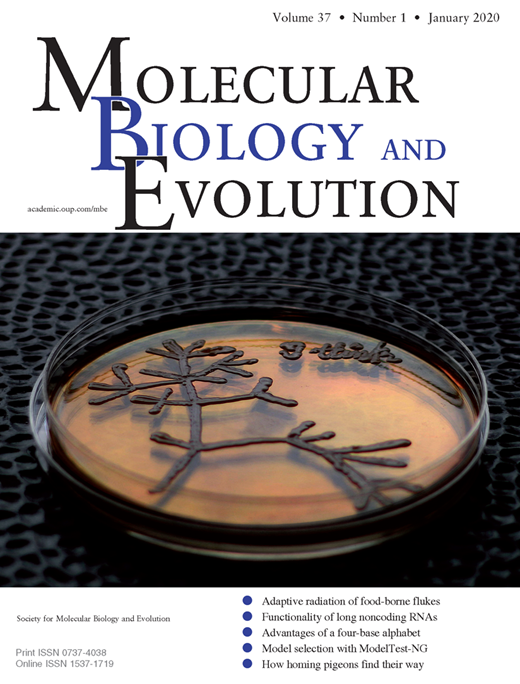
Molecular Biology and Evolution
Journal Overview:
Publishes research at the interface of molecular (including genomics) and evolutionary biology
Considers manuscripts containing patterns, processes, and predictions at all levels of organization: population, taxonomic, functional, and phenotypic
Interested in fundamental discoveries, new and improved methods, resources, technologies, and theories advancing evolutionary research
Publishes balanced reviews of recent developments in genome evolution and forward-looking perspectives suggesting future directions in molecular evolution applications.

 求助内容:
 应助结果提醒方式:


 京公网安备 11010802042870号


